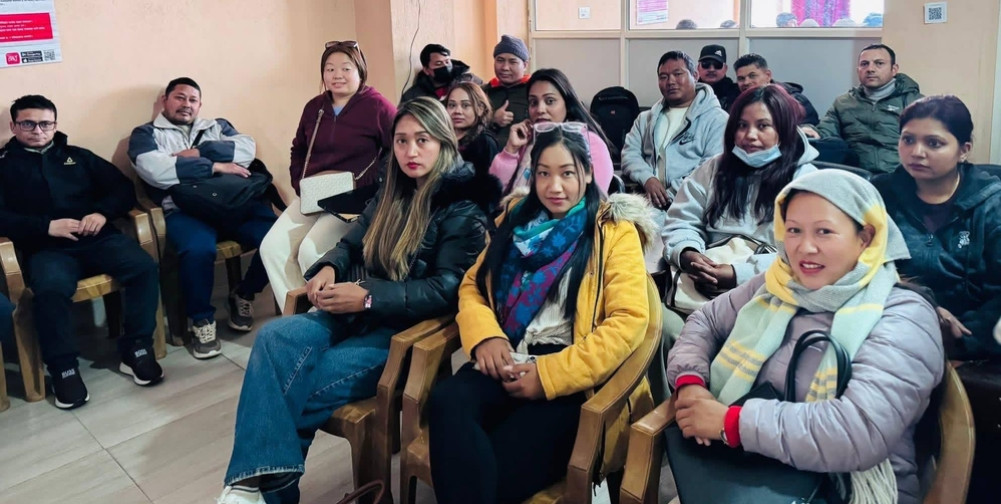
According to the Non-Resident Nepali Association, Iraq, approximately 30,000 Nepali workers are working in Iraq, most of whom are female workers.
We use Google Cloud Translation Services. Google requires we provide the following disclaimer relating to use of this service:
This service may contain translations powered by Google. Google disclaims all warranties related to the translations, expressed or implied, including any warranties of accuracy, reliability, and any implied warranties of merchantability, fitness for a particular purpose, and noninfringement.
Even after a month since the government decided to issue work permits to Nepalis working in Iraq for foreign employment, the workers have not received their work permits.
Nepali workers who came from Iraq on vacation have been forced to stay in Kathmandu due to not receiving work permits.
The workers have not received work permits as the Department of Foreign Employment has not been able to take a clear decision on the issue of visas and residency cards for Nepalis working in Iraq and the autonomous state of Kurdistan in Iraq. The Cabinet meeting on December 29 had decided to issue work permits to citizens who have received official visas if they submit an application along with the original and photocopy of the residency card when they come to Nepal.
Based on this decision, the department had requested Nepalis who have received official visas to apply through the Foreign Employment Management System (FEMIS). According to which, the department had asked for a passport with a validity of at least three months, official visa, temporary life insurance, proof of deposit in the social security fund and welfare fund, a contract agreement with the employer, an arrival and departure stamp on the passport by the Iraqi immigration, orientation training and medical examination. The person seeking the work permit was called to the department for identification along with his original passport, visa and contract agreement.
‘We had brought all the documents requested by the department. We have a residency card. But the residency card was not recognized,’ said Binod Shrestha, president of the Non-Resident Nepali Association, Iraq. ‘We are getting frustrated every time we go to the department and the ministry.’
Shrestha had urged Minister of Labor, Employment and Social Security Rajendra Singh Bhandari on Thursday to implement the decision regarding Iraq. ‘We were happy to be able to work in Iraq legally. Now we are very disappointed every time we go to the ministry,’ he said.
Mira Acharya, Director General of the Department of Foreign Employment, said that coordination is being done with the ministry to clarify the problem regarding visas. ‘If it had been clearly stated as an official visa or residency card, there would have been no problem with the work permit. It was difficult for us to identify that the residency card is the official visa. We have asked the ministry to reach a conclusion on this,' she said.
NRN President Shrestha said that those working in the Iraqi capital and surrounding areas will have visas and those working in Kurdistan will have residency cards. Nepalis who have reached the Gulf countries for foreign employment also have residency cards. Recently, those countries have stopped affixing visas to their passports and have only provided residency cards.
According to the Non-Resident Nepali Association, Iraq, about 30,000 Nepali workers are working in Iraq. Most of them are female workers.
After the murder of 12 Nepalis on Bhadra 15, 2061, the government banned them from going to Iraq citing security reasons. Since then, Nepalis have been working in Iraq's US base camp, embassies of various countries, petroleum projects, and as domestic workers.
Godavari Tamang, who has been working in Iraq for 13 years, said that she has faced a lot of hassle in obtaining work permits. "I have been working in a casino for 13 years. The company has provided all the facilities. We have not been able to travel to and from Nepal due to not getting a work permit. They give us two months of leave a year. But even though I wanted to come to Nepal, I was not able to travel there. The last time I came to Nepal was after 6 years," she told Kantipur. "We were happy that the work permit was given. It would have been easy to come and go. But it is becoming difficult for us to get a work permit."