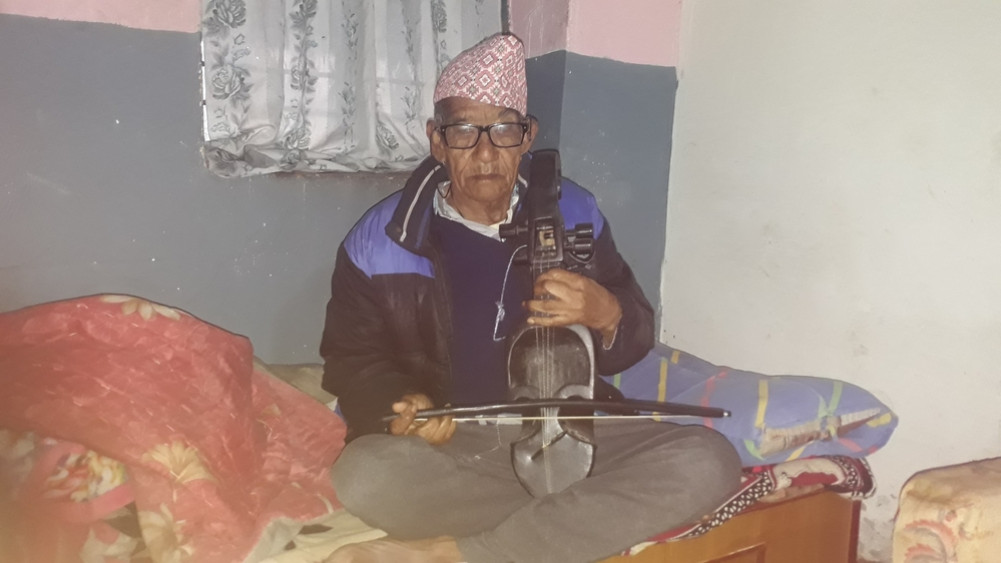
Khim Bahadur, who played the sarangi for Mahendra's coronation, Mao in Beijing, and Indira Gandhi in Delhi, used to compose his own melodies from the strings of the sarangi. He would mix his own words into those melodies. He resonated with his own words, voice, and melody.
We use Google Cloud Translation Services. Google requires we provide the following disclaimer relating to use of this service:
This service may contain translations powered by Google. Google disclaims all warranties related to the translations, expressed or implied, including any warranties of accuracy, reliability, and any implied warranties of merchantability, fitness for a particular purpose, and noninfringement.
Khim Bahadur Gandharva, who sang songs to Mao Zedong and Indira Gandhi on his sarangi, breathed his last on Wednesday at Batulechaur in Pokhara. Sarangi player and Karkha singer Gandharva passed away at the age of 91 at his home.
From the coronation of King Mahendra to the then Chairman of the Communist Party of China Mao Zedong and the Prime Minister of India Indira Gandhi, the life of Khim Bahadur Gandharva, who had the privilege of singing songs to the tune of his sarangi, was a living history of Nepali folk art. But his immense talent and historical contribution passed away in the darkness of oblivion.
In 2013, he was invited to play the sarangi at the palace on the occasion of King Mahendra's coronation. After returning to Pokhara after receiving honors and some money from the king, he received a letter asking him to come to Kathmandu immediately. But he had no money. He bought a plane ticket with sixty rupees, which his mother had given him, and reached Kathmandu.
At the request of King Mahendra, the Chinese government had invited a Nepali cultural team. Khim Bahadur was also among the five-member team selected under the leadership of Janakavi Keshari Dharmaraj Thapa. In 2013, he visited China and had a rare opportunity to sing a song in front of Mao Zedong to the tune of the sarangi he had sung to Mahendra.
Then, when he reached Delhi with the Danfe Kala Mandir team, he played the sarangi and sang a song to the then Indian Prime Minister Indira Gandhi. Khim Bahadur, who was even invited to Indira Gandhi's residence, hung a group photo taken with her on the wall of his house.

There is a dense settlement of Gandharvas in Pokhara-16 Batulechaur. Dharmaraj Thapa and Jhalakman Gandharvas are from Batulechaur. According to scholar Sunil Ulak, in history, after the King of Kaski built a winter palace in Batulechaur, he brought Gandharvas from Tanahun for entertainment. But Khim Bahadur's ancestors had come down to Batulechaur from Hemja.
Near his house, which was located on the upper bank of the Kalikhola River, was the home of Jhalakman Gandharva, a well-known figure in Nepali folk music. Khim Bahadur and Jhalakman were brother-in-law. Although they had the same talent and reached the villages at the same time, they did not find the same place in the music world. Jhalakman got a job on the radio and sang songs and became famous. But Khim Bahadur could not get the song recorded.
Khim Bahadur used to make his own melodies from the strings of the sarangi. He would mix his own words in those melodies. He was beginning to resonate with his own words, voice and melodies. He became close to the poet Dharmaraj Thapa, and it was Thapa who gave him the opportunity to go to Kathmandu for the coronation of King Mahendra.
But Khim Bahadur, who spent decades in art, spent his life in obscurity. ‘Jhalkaman recorded the song, I didn’t, I couldn’t get it done . He sang it and left it, I don’t know where it went . If only he had recorded it, it would have been there,’ he had expressed regret to Kantipur three years ago . A few years ago, Japan’s Minpaku Museum made a documentary on Gandharvas, which also includes the story of Khim Bahadur . He also worked as a sarangi instructor at the Vindhyavasini Music Training Center under Pokhara Metropolitan City for almost a decade .
His left hand had stopped moving for a decade due to high blood pressure . Along with his hand, his art, meditation, consciousness, and talent had also faded . It was almost a decade since he had not played the sarangi . The frames of certificates he had received at various times used to hang on the walls of his house without lead . He was haunted by one fear – that songs like Mangal and Karkha would disappear with him . A history of the Gandharva caste will be erased.
‘Those songs are gone,’ he used to joke, ‘I am the only one who survived, I don’t know when my day will come.’ The song, which he wrote but did not record, reflected his pain – ‘Gandharva Dai, burdened with sorrow, life passed in the same way....’
He was survived by his wife, two sons and three daughters, said Dilip Gaik, chairman of Jhalakman Sangeet Pathshala, who was laid to rest in Pokhara on Thursday.
Related News