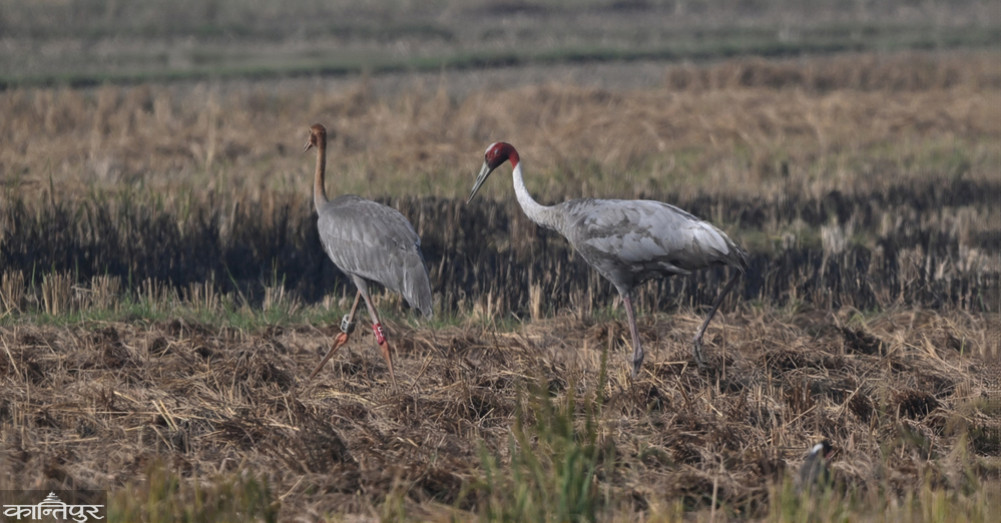
A month and a half ago, GPS was fitted to six semi-adult storks, each about 100 days old, to study their behavior, migration routes, migration, and reproduction.
We use Google Cloud Translation Services. Google requires we provide the following disclaimer relating to use of this service:
This service may contain translations powered by Google. Google disclaims all warranties related to the translations, expressed or implied, including any warranties of accuracy, reliability, and any implied warranties of merchantability, fitness for a particular purpose, and noninfringement.
The baby stork, one of the world's rarest birds, that was fitted with GPS has been found to be healthy and strong.
A month and a half ago, six half-adult storks, aged about 100 days, were fitted with GPS. Colorful numbering rings were also placed on the storks' legs to facilitate identification. All the stork pairs fitted with GPS were found to be living together with their mothers. This is the first time that a stork has been fitted with GPS in Nepal. The storks live in the vicinity of the GPS-fitted area. They have been seen to move 2 to 2.5 kilometers daily. According to Dikpal Krishna Karmacharya, a zoologist at Bhaktapur Multiple Campus, the storks go to other places for food in the morning and return to their original place in the evening. 'They fly away when they see danger while walking in some places. Now they are able to fly with pleasure. Once they are capable of breeding, they start living separately from their mothers in one and a half to two years,' he said.
With the technical assistance of Beijing Forest University, China, Karmacharya, a zoologist at Bhaktapur Multiple Campus, and Arjun Kurmi, president of Green Youth Lumbini and stork conservationist, fitted GPS to the storks. Three of the fledglings of one pair of storks and three of the fledglings of the other pair have been fitted with GPS. Three storks each from Rupandehi and Kapilvastu were fitted with tags in the third week of last Kartik.
Arjun Kurmi said that GPS was used to study the behavior, migration routes, migration and reproduction of storks. “We know about the flight routes, resting places, what time and which area they use and new information about seasonal migration from this. This information does not come out through other means,” he said.
Technicians are monitoring the storks fitted with GPS from time to time on the ground. Zoologist Karmacharya said that computer software is regularly collecting data through GPS connection and providing updated details. This study will be monitored for the next 3 to 5 years.
Zoologist Karmacharya said that Nepal is the fourth country to install GPS on storks. According to a study in 2080, the number of storks in Nepal is about 690. Of these, 80 percent are in Rupandehi, Kapilvastu and West Nawalparasi.
Out of the 15 species found in the world, four species of storks are found in Nepal. The storks, Karyangkurung, Laxman and Kalikantha storks are found here. The Karyangkurung, Laxman and Kalikantha storks are winter visitors. They migrate from the North Pole to the southern region in winter, while some storks live here permanently.
Since the stork is a rare bird, it is one of the 9 protected bird species according to the Wildlife Conservation Act 029. It was listed as a rare bird in the world in 2000 after it became less visible.