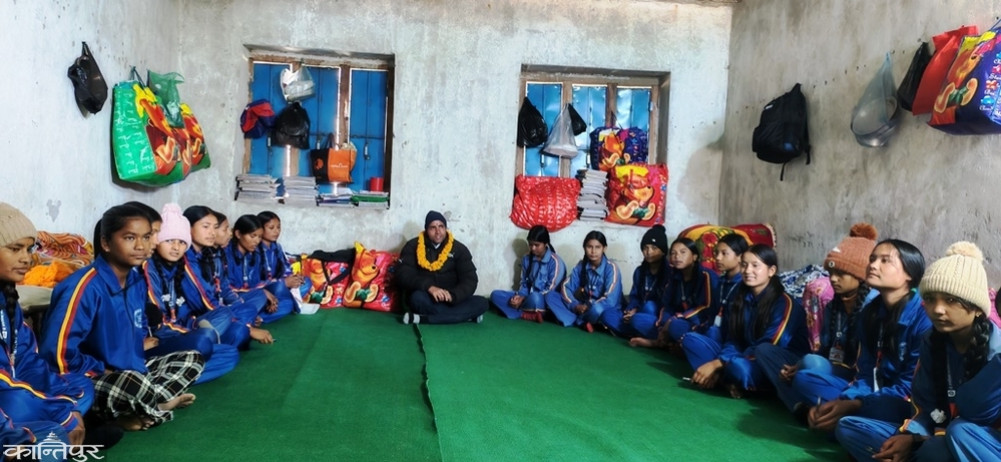
To improve the continuously declining SEE results and eliminate the need to travel far for tuition, some community schools in Karnali are conducting extra classes with accommodation at the school, charging fees from students.
We use Google Cloud Translation Services. Google requires we provide the following disclaimer relating to use of this service:
This service may contain translations powered by Google. Google disclaims all warranties related to the translations, expressed or implied, including any warranties of accuracy, reliability, and any implied warranties of merchantability, fitness for a particular purpose, and noninfringement.
Prakash Secondary School, located in Lum, Chhayanathrara Municipality-13, Mugu, has arranged additional classes with residential facilities for Grade 10 students.
To improve SEE results and educational quality, additional classes have been arranged from 6 am to 9 am and from 4 pm to 6 pm. Two halls of the school have been used for student accommodation. ‘Students sometimes eat with close relatives and sometimes run their own mess,’ said school principal Man Bahadur Khadka. ‘After this arrangement was made in the school, students are no longer forced to pay expensive tuition fees and go to the district headquarters Gamgadhi.’ Earlier, students were forced to go to Gamgadhi and rent a room to study.
According to the school, 52 students are studying in class 10. Last year, 9 out of 10 students who participated in SEE passed, while one participated in the grade enhancement exam. Students from Tharp, Rugha, and Bam of Ward No. 14, along with Lum, come to study at the school. Since students have to walk for an hour and a half to reach school, their studies are affected, so arrangements have been made for boys to stay in one of the two halls of the school and girls in the other. 'It would have been easier if the school had its own dormitory, but since there was no other option, we have made the hall a dormitory,' said Principal Khadka. 'The municipality did not cooperate, now we are running additional classes with dormitory on our own initiative.'
The school has 5 temporary teachers in the lower secondary and primary schools. But since there are no permanent teachers at the secondary level, two have been hired from private sources. Two teachers are working on federal grants and two on contract service. School teacher Vikram Khadka informed that he is teaching additional classes in English, mathematics and science.
According to him, a fee of 2,500 per student is being charged for the additional remuneration of the teacher. Local parent Chhatra Bahadur Khadka said that after this arrangement was made in the school, the obligation to send children to Gamgadhi and Surkhet for tuition has been removed. ‘In Gamgadhi, the tuition fee is 1,000 rupees for a single subject, and the student used to spend at least 7-8 thousand rupees per month on room and board,’ he said. ‘After the school started offering classes at a low fee, the obligation to take loans to pay for tuition has been removed.’ His youngest son Kushal is studying in class 10.’
Hima Rural Municipality of Jumla has decided to provide free coaching through a meeting of the principals of all schools on Mangsir 15. Acting Chief Administrative Officer Bam Bahadur Shah said that nearly 900 students from 6 secondary schools within the municipality are going to appear for SEE this year. ‘Coaching classes are currently being conducted by making good use of the winter vacation,’ he said. ‘This arrangement is expected to increase the passing rate and learning level of students.’ According to him, the municipality has given winter vacation from Mangsir 15 to Poush 15.’
Rural Municipality Chairman Laxman Bahadur Shahi said that the municipality has arranged remuneration for teachers teaching extra classes and educational materials for students. According to him, extra classes have been arranged for 3 schools in Mastamadu Secondary School and 3 schools in Kalika Secondary School, Badki. ‘Sending extra classes in all schools has reduced the number of students and made it difficult to manage teachers,’ he said. ‘With the municipality’s facilitation, the obligation to go to Surkhet and the district headquarters for tuition has been removed, at least 10,000 rupees per month has been saved per student.’
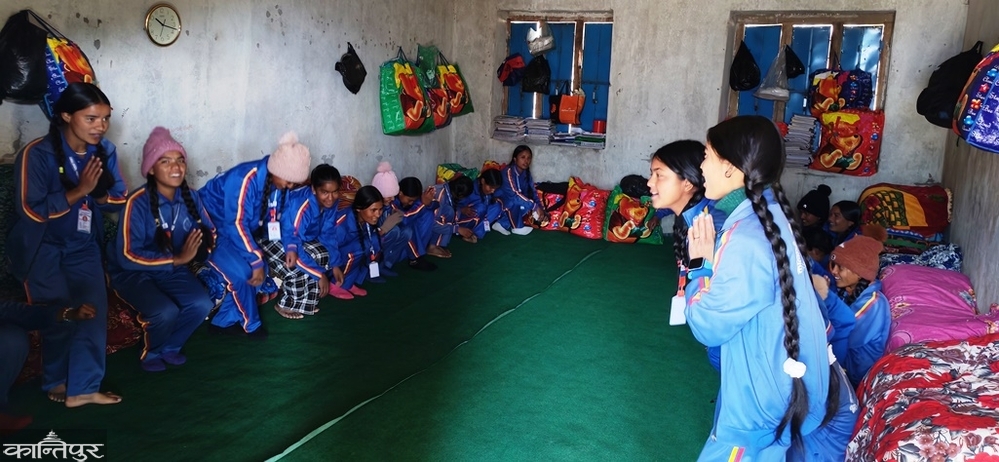
Sushma Tiruwa of Raskot-5 Bimal Tole in Kalikot has started studying in a residential class at Kalashilla Secondary School in Gorkhali Village, Ward 6, since last month. Even though it takes 20 minutes to reach school from home, she stays in the residential facility to prepare for SEE. She has a family of 5 including her parents and siblings. Her father Jay Tiruwa went to India on November 20 in search of work. ‘I don’t study at home, so I stay in school,’ said Sushma. ‘I study English, mathematics and science with my friends and teachers in the morning and evening.’ She said that she has to pay a monthly fee of Rs 4,950 for living in the residential class.
Krishna Sahakari, a physically disabled student of class 10 who is studying at Kalashilla Secondary School, has been looking for a place near the school due to the lack of residential facilities. Her father is also in India for wages. ‘It was difficult for me to reach school. Earlier, I used to live in a dormitory, but since November I have been living in a residential facility,’ he said. He said that when we live in a group at school, we can discuss and learn and the stay is also fun.
Shanti Sarki of Raskot-3, who studies at Badimalika Secondary School, lives 1 hour away from the school. Although it is far from the school, she used to come and go from home, but after Dashain, the school has arranged for her to stay in the school.
Subash Sanjyal of Tolibhid, Pachaljharna-6, Kalikot is also studying SEE preparatory class in a residential school in Raskot. ‘Although there is a secondary school near the village, I live in Raskot, which is 4 hours away, because the studies are not good,’ he said.
It is not just Sushma, Krishna, Shanti and Subash who are preparing for SEE, all 4 secondary schools in Raskot Municipality have been providing residential accommodation to 309 students for SEE preparation this year and are conducting additional preparatory classes in the morning and evening in addition to regular classes in the afternoon. Khemraj Shahi, Head of the Education, Youth and Sports Branch of Raskot Municipality, said that all four secondary schools have been asked to run residential classes with the aim of improving SEE results.
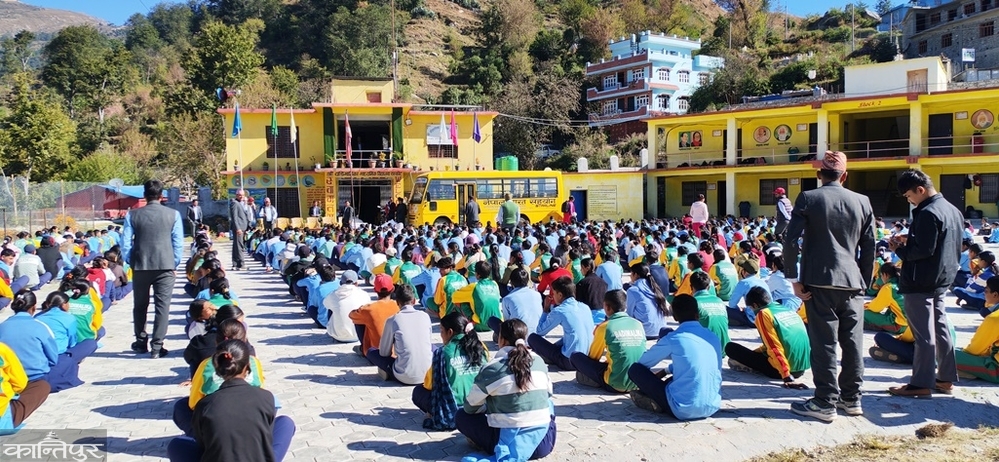
The school has also waived fees for some economically disadvantaged students. According to him, Badimalika Secondary School, Raskot, has set a monthly fee of 4,000 for 104 students, including 56 male students and 48 female students, Kalashilla Secondary School, has set a monthly fee of 4,950 per student, and Janajagruti Secondary School, Phukot, has set a monthly fee of 4,000 for 81 students, including 37 male students and 44 female students.
Students who cannot pay in cash can also provide rice, pulses, vegetables, and firewood of the same value. Motiram Secondary School is collecting cash of Rs 3,000 and 15 kg of rice and 2 kg of pulses from 43 people, including 20 girls and 23 boys.
The municipality will provide Rs 200,000 per school for residential schools, and the Empowered Girls Project, run in collaboration with Plan International and Hurendek under Accelerated Learning, will provide Rs 50,000 for teachers' salaries and tests, while the students will cover their own food and other expenses.
The fee collected from students will be used to prepare a menu that includes breakfast, lunch, dinner, and dinner, along with a meat-based meal every Saturday, said Devraj Chaulagain, principal of Kalashilla Secondary School. ‘The fee is free for 11 children from poor families who cannot pay,’ he said, ‘We have asked those who can afford it to pay only for food at home.’
He said that since his school’s SEE results were weak last year, it has started providing education with residential facilities this year. The school has made arrangements for female teacher Bipana Rokaya to stay with the students at night for the safety of the students.
Badimalika Mavi, which used to have less than 50 percent of students pass till 2078, has been gradually improving its SEE results since 2079, said Principal Pushparaj Baral. According to him, after placing teachers and students in residential facilities, 43 out of 63 passed in 2079, 39 out of 40 in 2080, and 48 out of 59 in 2081. He informed that the school aims to increase the proficiency rate from 30 percent to 50 percent this year.
Although students from other local levels of the district are forced to wander to places such as the district headquarters Manma and Surkhet in search of tuition, Raskot Municipality has arranged for all students to be placed in schools with residential facilities from November 1, said Mayor Dharmaraj Shahi. Only Badimalika Secondary School in the city had previously held additional classes with students on a residential basis, which has improved the results, said Deputy Mayor Maniraj Baral.
Chief District Officer Gokarna Raj Suyal said that residential schools, science laboratories, green schools, model classrooms, menstrual hygiene rooms, and gender-friendly toilets in Raskot Municipality are very effective. He said that there is cooperation between people's representatives, teachers, and representative organizations for educational reform in this municipality. Pradya Suyal, who visited Raskot for monitoring last week, said that parents should also be interested in improving education along with school education.
To eliminate the compulsion to leave the village for SEE preparation, all schools in Kalikot should provide residential education, said Harsha Prasad Chaulagain, head of the Education Development and Coordination Unit. He said that most of the students in Tilagufa here have to pay at least 50 thousand rupees per person to study tuition, and the government should also provide special grants to remote schools to keep them in the village. According to him, more than 4 thousand students are participating in SEE this year in Kalikot.
Due to the lack of subject-specific teachers and the lack of timely completion of the 'course' in the Himalayan districts of Karnali, students are forced to take SEE based on tuition. Due to which the results have been weak every year. Last year, out of 35 thousand 61 candidates from Karnali participated in SEE, 20 thousand 384 failed. According to the Education Development Directorate, not a single student from 46 schools has passed out of 730 community and private schools across the province.
There are 4,993 vacancies for teachers from grades 1 to 10 in Karnali Province. Of these, 1,749 vacancies have not been filled at the secondary level, according to the Education Division of the Ministry of Social Development. ‘There is an acute shortage of English, mathematics and science teachers,’ said Balbir Sunar, Senior Education Officer of the Division. ‘Due to the shortage of teachers, some or the other course is incomplete in almost all schools, which directly affects the poor SEE results every year.’
Currently, nearly three dozen tuition centers in the provincial capital, Birendranagar, are full due to students coming from the Himalayan districts to study tuition. The tuition centers are charging Rs. 3,500 per subject per student.
According to a study conducted by the Directorate of Education Development in 110 schools last year, it was concluded that barely 60 percent of the courses were completed by the end of the academic session. Devkala Acharya, principal of Nigasaini Secondary School Dashala in Kalikot, said that it is difficult to complete the courses due to winter and summer holidays, Dashain-Tihar, farming season, and students going to pick herbs with their parents in the Himalayan districts.