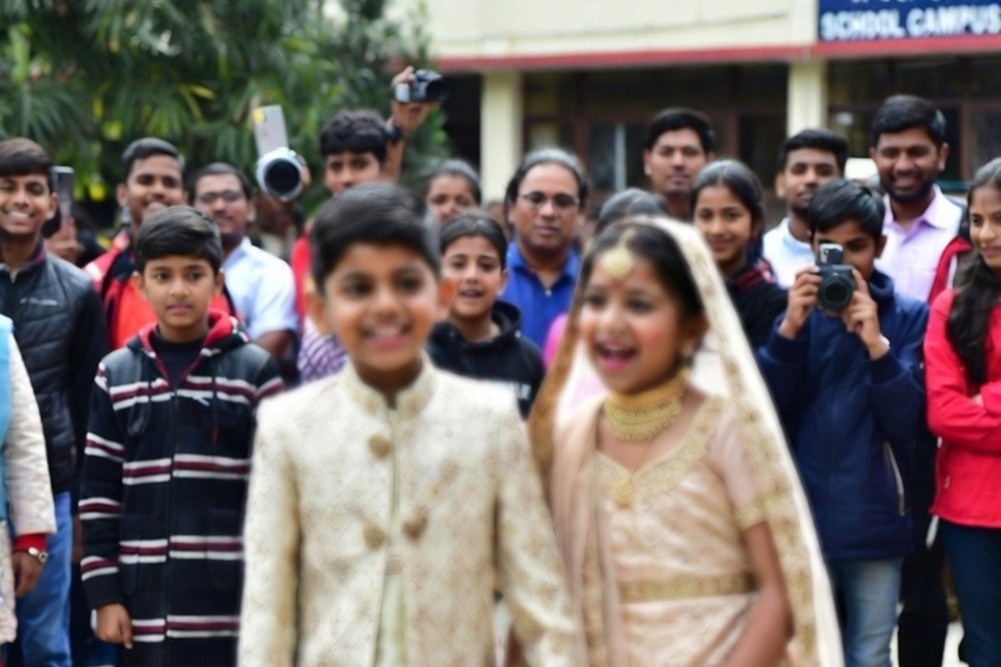
Debate has heated up over the violation of child rights and psychological effects after children were made to act out a wedding in a cultural program at a school.
We use Google Cloud Translation Services. Google requires we provide the following disclaimer relating to use of this service:
This service may contain translations powered by Google. Google disclaims all warranties related to the translations, expressed or implied, including any warranties of accuracy, reliability, and any implied warranties of merchantability, fitness for a particular purpose, and noninfringement.
A crowd of students and parents surrounds them. Students watching from the balcony and windows of the school building. A scene of a ritualistic 'marriage' taking place in the mandap amidst the crowd.
The priest is reciting mantras from the microphone. In the mandap, the 'groom-bride' are performing the rituals according to Hindu tradition. The folk are seen helping. The tradition of washing the feet is completed by sitting on the sofa. The tradition of applying the Samdhi-Samdhini is also completed. Then the bride is bid farewell. The daughter and mother-father are seen crying at the farewell. All the work is done as instructed by the priest from the microphone.
Although this scene looks like a marriage ceremony, it is a dramatic performance within the school.
This is a scene from a play presented at a cultural program organized at the Everest English Boarding School in Butwal on November 25. This scene has recently been the subject of debate on social media.
According to the school, 24 performances related to different cultures were presented that day. Among them, a video of a traditional marriage between two children went viral on Tuesday. The video mentions 'boarding started marriage'. Two weeks after the program was organized, inquiries about the video began. After criticism began to be received about this presentation, various reactions have started to be made public on social media.
Yubaraj Kandel, a teacher at Kalika Mavi in Butwal, has posted a long response on social media. 'A school in Butwal got children married, it was seen that people were crying on Facebook saying that this was wrong,' Kandel wrote, 'Marriage is an important culture and an integral part of Nepali society.' It is the duty of the family and the school to provide real information about it.'
Even if it is for the sake of the play, presenting children in adult roles before they have reached the age of maturity hinders their natural development - Anil Raghuvanshi, President, Child Safe Net He said that the program, which was conducted with the aim of raising public awareness, was being wrongly publicized. He said that it should not be considered negative because the school was trying to show the social side. 'Now, street plays can no longer be shown,' he said, 'the section on sex education should also be removed from the textbooks.'
Similarly, social media user 'Kandel Ayusha' wrote, 'This is a very wrong practice.' The school's action of making children undergo the entire marriage ceremony in the name of teaching tradition is objectionable. This is against child rights. How aware is the school administration about the impact of bullying that will be done to those two children in the school from tomorrow, calling them the bride and groom of so-and-so?'
Similarly, mentioning the Nepal Police, journalist Savita Acharya wrote on Facebook, 'This school should be taken action. There are many ways to teach marriage rituals.' There is no need to teach such young children about their customs by getting them married (why not in a dramatic style?).'
Children may be affected mentally.
The video that has become popular has also been criticized. 'The intentions may be good, but it has gone a bit too far,' one user commented, 'We can't do this much in the name of awareness. It seems necessary to inform them about the Children's Act.'
After the video went viral, concerned organizations have stated that it is against the rights of children. Tillottam Poudel, president of the 'Children's Peace Area National Campaign' (CJOP), said that this video is against the rights of children. 'According to the Children's Act 2075, this is a serious violation of children's rights,' Poudel said, 'It is one thing to do ordinary plays for awareness, but this is more like a wedding by a wealthy family than a play, which is wrong from a legal and child rights perspective.'
According to Poudel, due to this small mistake of the school, the children will have to face mental problems in the future. 'No curriculum says to do this in the name of preserving heritage and culture, marriage below the age of 20 is a crime socially and legally and it is not forgivable,' he said, 'Such scenes increase the possibility of mental health problems, depression and bullying in children tomorrow; who will take responsibility for this?'
After widespread criticism, the school's principal Krishna Neupane said that he has been organizing a cultural program every year. He said that students from grades 4 to 12 participate in the program at different levels. 'All classes present acts according to their own traditions,' he said, '24 acts were also presented on Mangsir 25.' He said that he did not get to see the act on 'marriage tradition' as he left after the inaugural session of the program.
'The act of marriage took place with the consent of the parents,' he claimed, 'till the time of watching the program, everyone had praised it . Now it has been made viral .' He said that the students participating in the performance were of class 6/7 .
Anil Raghuvanshi, president of Child Safe Net, also said that such activities can affect the mental health of children . 'Even if it is for the sake of drama, presenting children in adult roles before they have reached their age hinders their natural development and can leave an imprint of wrong values on their minds,' he said .
We did not expect such a discriminatory message to be sent, we will delete that video now - Ajay Shah , School principal According to child psychiatrist Ganga Pathak, the school abused the children . 'This can be called child abuse . Such incidents cause mental trauma to children, which can last for their entire lives,' Pathak said .
But this incident in a school in Butwal is not the first . Various schools have been using children's photos and videos . One such example is that of the Rising Nepal Academy School in Chandrapur-6, Jhanjantol, Rautahat .
A video was posted on the school's TikTok account on June 19, in which some girl students are shown washing clothes . In the 34-second video, the girl students are washing clothes . The students are watching . Child psychiatrists say that this could send the message to those children that the girl students do the washing work . 'The school has crossed its limits while conducting the demo,' said child psychiatrist Pathak, 'The teachers do not take child rights and child psychology into account at all .'
Video that promotes discrimination
Child Safe Net President Anil Raghuvanshi said that children may later be bullied due to the video. He said, 'Due to the behavior shown in the video, children may later become victims of 'bullying' or bad behavior from other people, which will deeply hurt their self-confidence.'
After such a discriminatory video was posted using children, we contacted the principal of the same school Uday Singh. But he said that he did not have a TikTok account. When we sent him the video and asked him, he did not pick up the phone.
Then we contacted the school's director Ajay Shah. He also said that he did not know anything about it and asked to contact the school's staff Naveen Shah. We also contacted him. He said that he had posted the video. 'The students were also working on the other side, we did not post that video. But we did not expect such a discriminatory message to be sent,' he said, 'We will delete that video now.'
Various schools have been posting similar discriminatory photos and videos. Child psychiatrist Harsana Shrestha says that making students act as 'pilots' and students as 'airhostesses', students as 'doctors' and students as 'nurses' can lead to a misconception about gender and cultural roles in children. 'Doing such activities before they reach puberty can lead to a misconception or misconception about gender and cultural roles in them,' she says.
Recently, many schools (especially Montessori) have posted photos and videos of young children on social media in the name of updating activities. Not only schools, but teachers also post photos and videos of children from their own personal accounts.
Especially during festivals, schools make it mandatory for children to dress up and post photos on social media. For example, on the day of Krishna Janmashtami, photos and videos are posted by making Krishna.
Making children dance to songs according to the current 'trend' has become normal for schools. Along with schools, teachers also post photos and videos of children from their personal accounts.
Schools and parents are equally responsible
Parents are equally responsible for posting photos and videos of children along with schools. In this way, parents post photos and videos of their children on social media.
Child psychiatrists say that uploading children's photos and videos on social media is a violation of child rights. According to child psychiatrist Dr. Sushil Kandel, this tradition has become a wrong comment in our society. 'If a school has to do any glamorous work or act, the girl is put forward,' he said, 'This has become a kind of unanswered taboo in our society, in which we are all involved in some way or the other.'
If schools and parents start encouraging such activities, the wrong message may be sent to society that children are used only for commercial or entertainment purposes, said Raghuvanshi, president of Child SafeNet.
'Schools using children for promotion on Montessori or TikTok and not letting them sing inappropriate songs raises questions about the level of awareness and education of the school in the society,' he said, 'Putting children in item songs or acts that reflect violent tendencies is against the community guidelines of digital platforms and the principles of child protection.'
Child psychiatrists say that uploading children's photos and videos on social media in this way is a violation of children's rights.
'Since children are not old enough to give consent, making their photos or videos public is a violation of their rights,' said child psychiatrist Harsana Shrestha. 'Since such information or data will remain on the internet forever, there is a risk of its misuse and abuse or other bad incidents in the future.'
She says that such school activities expose children's privacy. 'What will they think when they grow up? When children reach the age of 15-16 and see their childhood videos spread all over the world, they may feel uncomfortable,' she said. 'People's old comments can have a negative impact on their self-image or the way they think about themselves. They may feel used.'
Similarly, child psychiatrist Ganga also said that such school activities will seriously affect children's privacy and future. 'Due to such videos, the child may go into anxiety and depression because his friends will tease him at school tomorrow,' Ganga said, 'If the child is of a sensitive nature, his personality may be ruined. In the name of experimental learning, a wrong and deep impression has been made in the mind.'
Tillottam, president of the Children's Peace Zone National Campaign (CJOP), said that even if permission is obtained from the child, it is not considered legal. 'Even if the child gives consent for fun, it is not considered legal approval,' he said, 'Publicizing photos and videos of children on social media is wrong from a cyber and technological perspective.'