President's preparation to stop it, saying it is against the constitution
We use Google Cloud Translation Services. Google requires we provide the following disclaimer relating to use of this service:
This service may contain translations powered by Google. Google disclaims all warranties related to the translations, expressed or implied, including any warranties of accuracy, reliability, and any implied warranties of merchantability, fitness for a particular purpose, and noninfringement.
President Ram Chandra Poudel has been in favor of not issuing an ordinance to amend the Constitutional Council Act after the Sushila Karki-led government recommended unconstitutional provisions for the appointment of constitutional body officials and ambassadors. The Council of Ministers meeting on November 2 passed the Constitutional Council Act Ordinance on the proposal of the Prime Minister's Office and the Ministry of Home Affairs and sent it to the President.
Although the President issued an ordinance amending the Special Services Act on November 5, he has stopped the ordinance amending the Constitutional Council Act. The ordinance on the Constitutional Council seeks a way to make constitutional appointments even when the council members are in a minority. Earlier, when the parliament passed the bill with this provision, the president returned it without certifying it. Now, a provision has been added that the officials appointed under the ordinance will assume office and work, but the parliamentary hearing will be held in the next parliament.
The ordinance has been recommended by adding Section 7 (a) after Section 7 of the original act. ‘Section 7 (a) shall not prevent appointment before parliamentary hearing, (1) Notwithstanding anything contained in Section 7, if the Council recommends an office bearer for appointment in the event of dissolution of the House of Representatives, there shall be no obstacle to appointing such office bearer before parliamentary hearing,’ the ordinance states, ‘(2) For the purposes of Sub-section (1), the Secretary shall send a letter to the President’s Office to submit the person recommended by the Council to the President for appointment.’
The ordinance further states, ‘The Secretary shall send a letter to the Federal Parliament Secretariat for parliamentary hearing of the appointed office bearer and if the Parliamentary Hearing Committee decides not to approve the name of such office bearer within 45 days of the formation of the House of Representatives, he shall automatically be relieved of his post.’
 However, President Poudel has stopped the ordinance, saying that the Constitution itself has made parliamentary hearing mandatory before appointment to constitutional posts. Article 292 of the Constitution contains a provision regarding parliamentary hearing. The article states that ‘A parliamentary hearing shall be held in accordance with federal law before the appointment of the Chief Justice, Supreme Court judges, members of the Judicial Council, heads or officials of constitutional bodies, heads or officials of constitutional bodies and ambassadors to the posts of ambassadors, who are appointed on the recommendation of the Constitutional Council.
The bill had a provision that decisions could be made only with the participation of the chairperson and the remaining members when at least 50 percent of the current members are present. The President had also raised questions about this provision. The bill had a provision that a quorum would be considered reached if four members were present in a meeting of the six-member Constitutional Council. Accordingly, if there were five members including the chairperson in the council, four would be considered a quorum, three would be considered a quorum when there were four members including the chairperson, and two would be considered a quorum when there were three members including the chairperson.
The bill stated, ‘In the case of a chairperson and 5 members, the council shall be decided by the votes of the chairperson and at least 4 members, in the case of a chairperson and 4 members, the chairperson and at least 3 members, in the case of a chairperson and 4 members, the chairperson and at least 3 members, in the case of a chairperson and 3 members, the chairperson and at least 3 members, and in the case of a chairperson and 2 members, the chairperson and at least 1 member, in the case of a chairperson and 2 members, the chairperson and at least 2 members.’
At that time, the President also reminded the spirit of the Constitution that recommendations and decisions should be made by consensus of the total number in the Constitutional Council. There is a constitutional provision that the Chief Justice, Speaker, National Assembly Speaker, leader of the main opposition party and deputy speaker are members of the Constitutional Council, which is chaired by the Prime Minister.
Although the Constitutional Council Bill was passed by Parliament on 25 Ashad 2082 and sent for verification, the President sent it back. The bill provided that the House of Representatives and the National Assembly could not hold a meeting without the presence of the chairperson (Prime Minister) of the Council. If no agreement is reached in the first meeting of the Constitutional Council, the Chairperson may convene a second meeting within 48 hours and the agenda and information of such a meeting shall not be mandatory for the members.
 The President had sent the bill back saying that the ‘provisions and spirit of the Constitution have been trampled on in places’. The President had expressed concern, saying that making a law targeting the unimaginable situation that the Chairperson and other members of the Constitutional Council may not remain in office or may be absent would create a serious and complex situation.
Senior Advocate Baburam Kunwar, the President’s Legal Advisor, said that a study is being done on what to do since the ordinance has come with the same provisions with which the bill was sent back to the Parliament earlier. ‘The President should not adopt double standards while issuing or stopping bills and ordinances,’ Kunwar said. ‘The ordinance related to the Constitutional Council is currently being studied, and no decision has been made.’
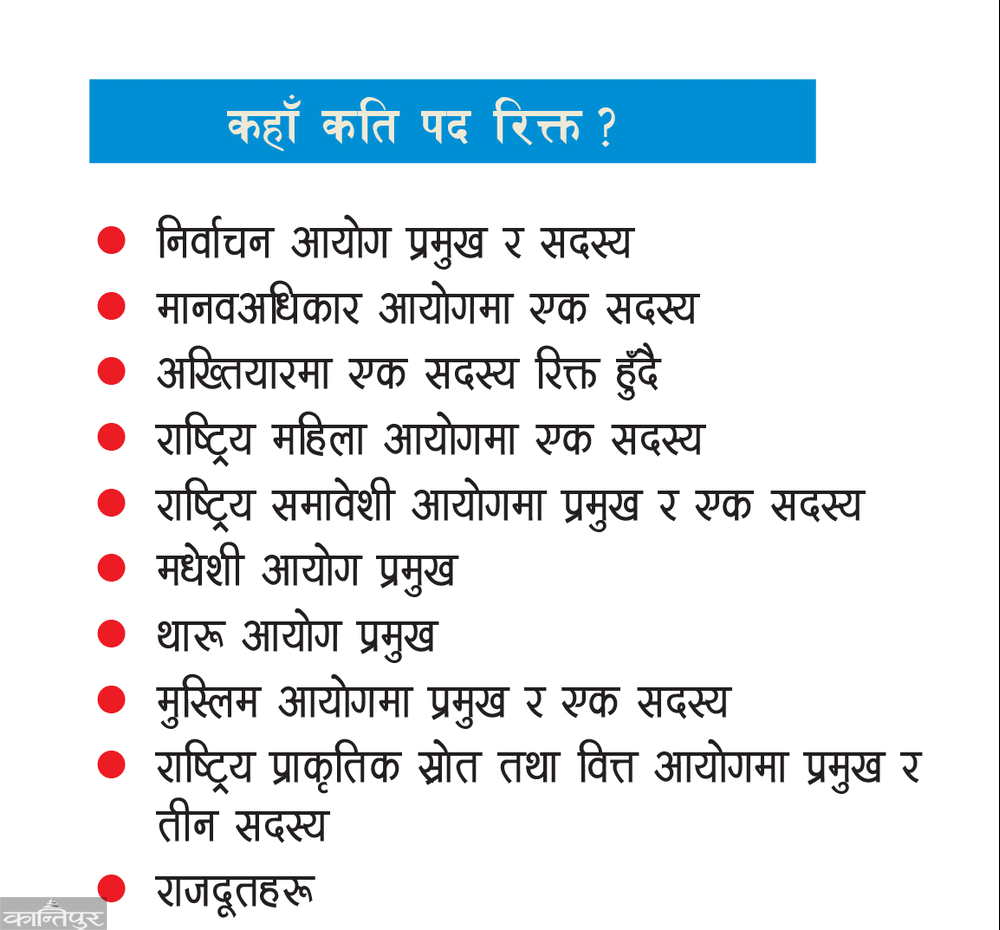
However, the President’s Office has informally conveyed to the government ministers that the ordinance will not be issued. "It seems certain that the President's Office will inform about the reasons why it cannot issue the ordinance after completing the legal process," said an official from the Prime Minister's Office. "The President's Office says that it cannot issue the ordinance because it contains content that conflicts with the constitution." The government is trying to amend the Constitutional Council Bill, saying that the posts of Chief Commissioner and one commissioner are vacant in the Election Commission, and filling them is necessary to hold elections. However, if the ordinance is issued, the government will be able to appoint 14 constitutional posts from the Election Commission to the Finance Commission and ambassadors. Office bearers can be appointed to the Election Commission, National Human Rights Commission, Commission for the Investigation of Abuse of Authority, National Women's Commission, Madhesh, Muslim, Tharu Commission and National Natural Resources and Finance Commission.
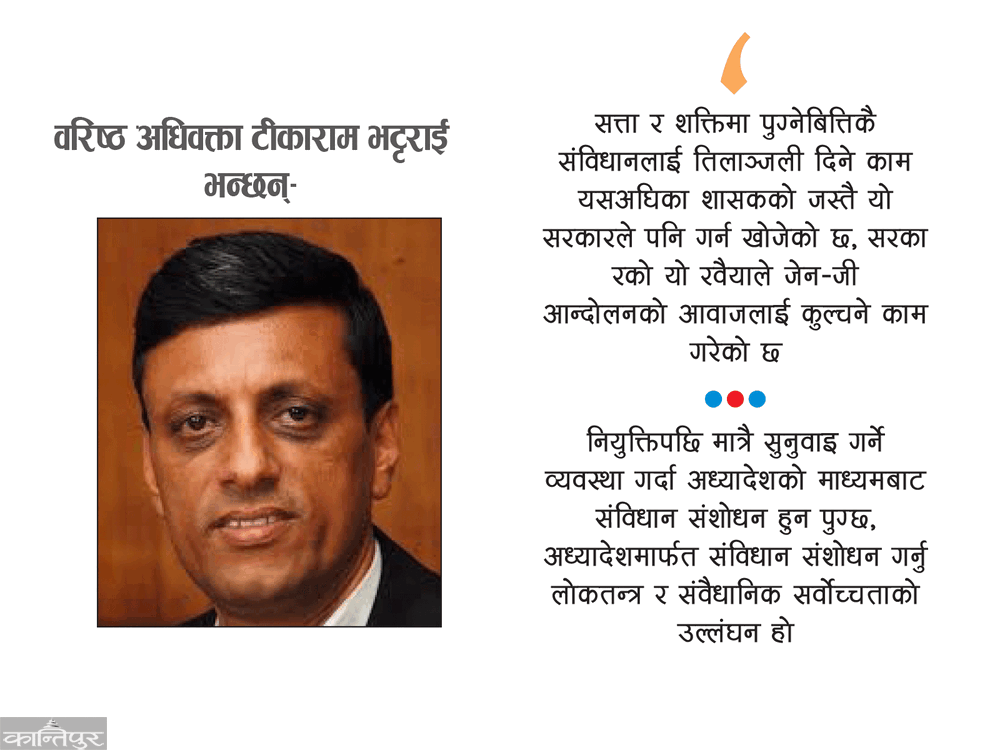
Six commissions, including Finance, are currently without a chairperson and seven member posts are vacant. One commissioner post is falling vacant in the Authority soon. There are also ambassadors on the government's list of appointments. If the ordinance is issued, the government will be able to appoint ambassadors to 11 countries that recently recalled their ambassadors. Despite the Supreme Court's order to allow the recalled ambassadors to work, the government has forced them to appear at the Ministry of Foreign Affairs. The government has also tried to open the way for the appointment of ambassadors by bringing an ordinance. Constitutional scholars are of the opinion that the government's actions have violated the constitution. Senior advocate Tikaram Bhattarai claimed that the government is trying to amend the constitution itself through the Constitutional Council Act Amendment Ordinance. 'No one is eligible for appointment to the Constitutional Commission without a parliamentary hearing. They can only work after being eligible for appointment and taking an oath,' he said. 'By arranging for a hearing only after appointment, the constitution will be amended through an ordinance. Amending the constitution through an ordinance is a violation of democracy and constitutional supremacy.'
Bhattarai also said that it is objectionable that a government dominated by the Chief Justice, judges and legal practitioners is trying to amend the constitution through an ordinance. 'The Prime Minister, Law Minister and Home Minister in the current cabinet are people knowledgeable in the field of law. "They were experts in constitutional supremacy and the rule of law before they reached the government," he said. "They are trying to do the same thing as the previous rulers who abandoned the constitution as soon as they came to power. This attitude of the government has also trampled on the voice of the Gen-G movement."
The Prime Minister's Chief Advisor Ajaybhadra Khanal said that he did not know much about the ordinance. However, he said that he expected a positive response from the President's Office regarding the ordinance.
The previous government had also tried to amend the Constitutional Council (Work, Duties, Powers and Term of Office) Act, 2066. After hanging it in the parliamentary committee for almost 2 years, the ruling leaders had put provisions in the National Assembly as they wanted. In which there was a provision for constitutional appointments even by the minority. However, the President himself had returned it saying that it was against the constitution. The President was under pressure at that time saying that a bill with provisions that were against the constitution should not be verified publicly.
The then Prime Minister Pushpa Kamal Dahal registered this bill in the House of Representatives on 14 Falgun 2079. On 15 Baisakh 2080, the bill was submitted to the State Affairs and Good Governance Committee of the House of Representatives for clause-wise discussion. A year later, the bill was passed by the committee and submitted to the House of Representatives. Although the report was submitted to the House on 17 Jestha 2081, it was not presented for decision in the House, saying that the provisions were against the government's wishes.
Speaker Devraj Ghimire did not move the bill forward as the government wanted for 10 months after receiving the committee's report. The House of Representatives passed the bill only on 18 Chaitra 2081 and sent it to the National Assembly. The National Assembly passed it on 30 Jestha 2082 with provisions according to the government's wishes and sent it back to the House of Representatives.
After public concern and discussion arose that the provisions were against the constitution, the President sent the bill to the House of Representatives for reconsideration on 8 Shrawan without certifying it. The issue of the President sending the bill back did not make it to the Parliament. Speaker Ghimire did not take the process of reconsidering the bill forward in the House, and the government showed no interest either. After the President sent the bill back, a dispute arose between the then ruling coalition, the Congress and the UML. The Congress had taken the side of amending it in accordance with the President's interests, while the UML, which led the government, took the stance that the bill should be passed as is. Speaker Ghimire did not bring the bill to the agenda and discussion until the UML's stance was maintained.
In the meantime, the KP Sharma Oli government fell due to the Gen-G movement, and the House of Representatives, where the bill was located, was dissolved. The Karki-led government that was formed thereafter, sent the bill brought by Oli as is and still unconstitutional with additional provisions, to the President's Office as an ordinance.

