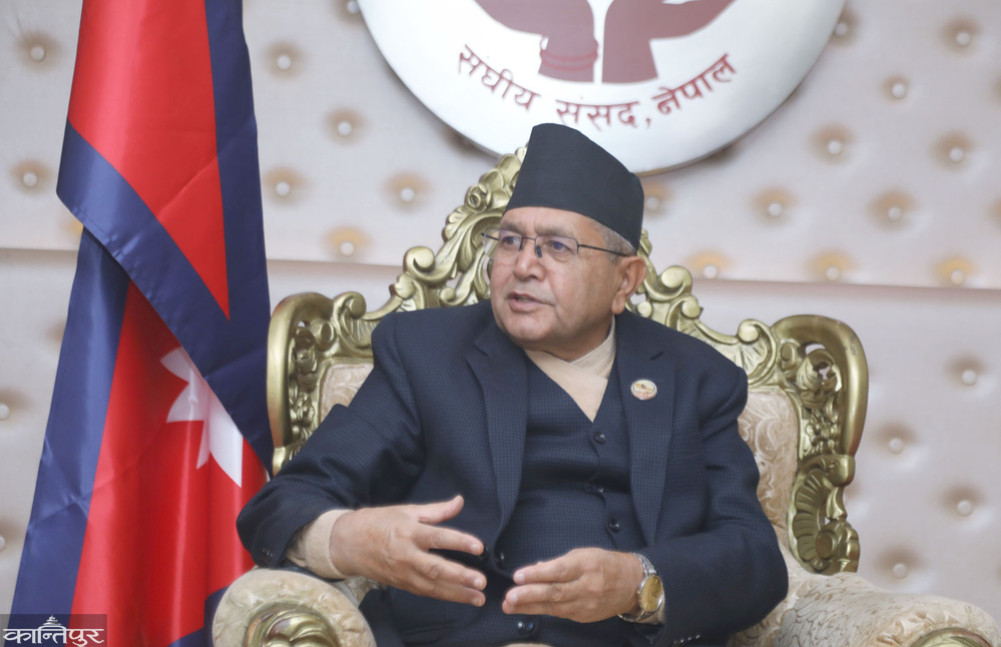
The Speaker's argument is, 'Contrary to the aforementioned clear constitutional provision, it appears that the current Prime Minister was appointed by the guardian and custodian of the Constitution, contrary to constitutionalism, the rule of law, and the prevailing system.'
We use Google Cloud Translation Services. Google requires we provide the following disclaimer relating to use of this service:
This service may contain translations powered by Google. Google disclaims all warranties related to the translations, expressed or implied, including any warranties of accuracy, reliability, and any implied warranties of merchantability, fitness for a particular purpose, and noninfringement.
Speaker Devraj Ghimire has mentioned in his written reply to the Supreme Court that President Ram Chandra Poudel, the guardian of the constitution, went against constitutionalism and appointed Sushila Karki as the Prime Minister.
A written response was sought from the Speaker, who was made the respondent in six out of 17 writ petitions filed in the Supreme Court against the dissolution of the House of Representatives and the appointment of Sushila Karki as Prime Minister. In his reply to the Supreme Court through the Attorney General, the Speaker wrote that the President had acted against constitutionalism.
The Speaker has argued that the President has also failed to implement the provisions regarding former Chief Justices and judges clearly written in the Constitution. 'Article 132 of the Constitution, under the heading that the Chief Justice and the Supreme Court Judges shall not be employed in any other work, states in Clause (1) that the Chief Justice or the Supreme Court Judge shall not be employed or assigned to any other post except as a judge, while Clause (2) states that a person who has been the Chief Justice or the Supreme Court Judge shall not be eligible for appointment to any government post except as otherwise provided in this Constitution,' the Speaker has told the President, 'Contrary to the aforementioned clear constitutional provision, it appears that the current Prime Minister has been appointed by the guardian and custodian of the Constitution, contrary to constitutionalism, the rule of law, and the prevailing system.'
Speaker Ghimire has demanded that a writ be issued by the Supreme Court as the appointment of the Prime Minister is against the Constitution and the dissolution of the Parliament. The writ petitioner has demanded that a writ be issued stating that the restoration of the House of Representatives and Karki's appointment as the Prime Minister are unconstitutional. 'As raised by the petitioner, Article 76 of the Constitution of Nepal provides for the formation of the Council of Ministers, in which a member of the House of Representatives, especially the leader of the parliamentary party with the majority, shall be appointed as the Prime Minister, and since it is against the rule of law and constitutional provisions to appoint a person who is not a member of the House of Representatives as the Prime Minister directly by the President, it seems that the writ should be issued as per the petitioner's demand,' the Speaker demanded.
Karki was appointed Prime Minister after KP Sharma Oli resigned after the Gen-G movement on Bhadra 23 and 24. Immediately after taking oath as Prime Minister on Bhadra 27, Karki's one-member Council of Ministers recommended the dissolution of the House of Representatives to the President.
On Karki's recommendation, the President dissolved the House of Representatives and announced elections for Falgun 21. With the dissolution of the House of Representatives, 17 writ petitions have been filed in the Supreme Court, calling Karki's appointment as Prime Minister unconstitutional. Among them, the Speaker was made the opponent by 6 writ petitioners.
The Constitutional Bench of the Supreme Court has sought a written response from the opponents of the writ petitions against the dissolution of Parliament. A hearing on those writ petitions has been scheduled for November 22.