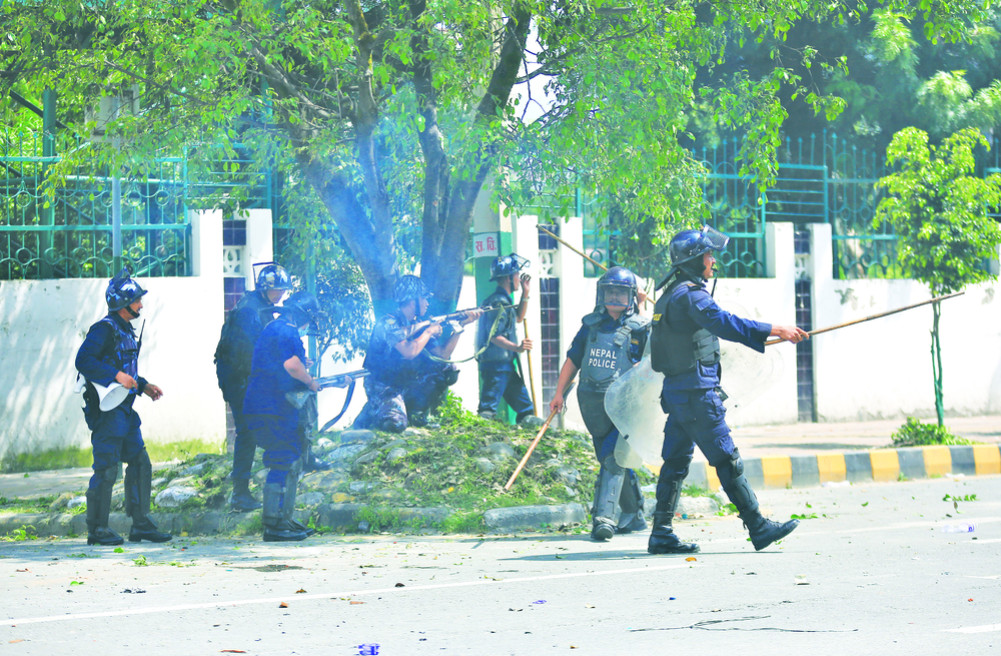
Action has been demanded against the police involved in the repression, including the then Prime Minister KP Sharma Oli, Home Minister Ramesh Lekhak, and the Home Secretary, while a complaint has also been filed on behalf of the police to immediately suspend and take action against all those involved in the crime.
We use Google Cloud Translation Services. Google requires we provide the following disclaimer relating to use of this service:
This service may contain translations powered by Google. Google disclaims all warranties related to the translations, expressed or implied, including any warranties of accuracy, reliability, and any implied warranties of merchantability, fitness for a particular purpose, and noninfringement.
A dozen complaints have been registered with the commission formed on 23 September under the leadership of former judge Gauri Bahadur Karki to investigate the incidents of 23 and 24 Bhadra. According to the commission, two private sector companies have registered complaints along with details of the damage.
The rest are individual complaints. Similarly, the commission is continuing to receive details of the damage. In the incident in which 76 people died during the Gen-G movement, most of the complaints have been filed by the victim police and the general public.
Two complaints have been filed by the families of the injured. The complaint filed by the victim family mentions that many people lost their lives due to state repression on 23 Bhadra. In it, there is a complaint about the state brutally repressing young children who protested against corruption.
‘The Gen-G movement on 23 Bhadra was purely against the government-blocked social media and the corruption prevalent in the country. We had sent our children to the streets for their future,’ the complaint says, ‘but suddenly, the ruthless government opened fire. Indiscriminate use of force was used to take lives. The complaint demands that action be taken against the police who used force in this way, those who ordered the shooting, and those in the state apparatus.'
The complaint demands that action be taken against the police who opened fire in the 'field', the police officers who ordered the shooting, the then Chief District Officer of Kathmandu Chhabilal Rijal, Inspector General of Police Chandrakuber Khapung and the security personnel involved in the incident according to their level and involvement. Similarly, the complaint demands that action be taken against the then Prime Minister KP Sharma Oli and Home Minister Ramesh Lekhak and the Home Secretary, among others.
The complaint, made on behalf of the victim, demands that an investigation be conducted as it has been made public that there was infiltration in the 23 Bhadra movement. Similarly, the complaint also states that there should be an investigation into the involvement of people outside of Gen-G in the vandalism and arson on 24 Bhadra.
'No one should be given permission to vandalize state property. Since the state has the right to take action against those who commit crimes according to the Criminal Code, it should be done accordingly,' the complaint states. 'But shooting just because they protested on the first and second days is murder. The constitution has given the right to protest in a democracy.'
Complaints have also been registered on behalf of the police deployed on duty that day. They have mentioned that they were aware of the burning of police offices and the looting of weapons. They have given detailed details of how the looting and infiltration took place, especially on 24 Bhadra. The names of the police officers who filed the complaint have been kept confidential. The five-page complaint has also demanded the identification of those who opened fire indiscriminately and immediate suspension and action against those involved in the crime.
Similarly, the complaint has demanded the recording of 'call details', claiming that there was a conversation between the acting president of the Nepali Congress (NCC) DP Aryal, Ravi Lamichhane's wife Nikita Poudel Lamichhane, the vice president of the NCC, Swarnim Wagle, the AIG of the police, Dan Bahadur Karki, the then CDO of Kathmandu, Chhabilal Rijal, the then Home Secretary Gokarnamani Duwadi and the Chief Secretary Ek Narayan Aryal.
The commission itself has also started requesting to provide details. Karki said that the commission is requesting that the details of the damage be provided as soon as possible. The commission has also started visiting the districts that suffered heavy damage during the protests. The commission has stated that since the commission has only about three months to investigate and submit the report, the visits to the places that suffered heavy damage will be conducted as a model. Commission spokesperson Vigyanraj Sharma has reached Jhapa, Morang and Sunsari for on-site observation. The commission is preparing to visit other districts as soon as he returns.
The commission has also planned to visit the Supreme Court, District Court, Attorney General's Office, Government Attorney's Offices, Parliament Building, Party Offices of Parties and public media outlets that suffered heavy damage and to monitor and assess the damage. The details requested by the commission have not been received from the Ministry of Home Affairs, while the provinces and ministries have sent only preliminary details. Some local levels have provided details of the damage. The commission has also asked the private sector to send details and has asked political parties to provide them as well.
Police communications commanders and other police personnel deployed in the police control room, which transmits orders from higher levels to lower levels in the Kathmandu Valley, have also been demanded to take statements. ‘The human losses caused by the firing on dozens by the government on 23 Bhadra,’ the complaint of the injured family states, ‘In that context, the District Police Range Kathmandu should also take action against the commanders deployed to the field from various police offices on the same day for security, DSP Sundar Tiwari, Operation Commander of the Kathmandu Range, SP Apilraj Bohara of Kilo Two Callsign, SSP Bishwa Adhikari of Kilo One Callsign, who is responsible for Kathmandu’s security, SSP Deepshamsher Jabra, who took over the responsibility of Operation Commander from the Kathmandu Valley Police Office, DIGP Om Bahadur Rana, the then acting commander commanding the Kathmandu Valley, and IGP Chandrakuber Khapung.’
‘The focus of the second day’s agitation was mainly the New Baneshwor area and the Parliament building. The army, police and armed police were deployed in most places including Baneshwor from 7 am on Bhadra 24. When the Parliament building in Baneshwor was attacked from 11 am, the security personnel assigned to security duties did not react and allowed the arson to take place,' the complaint states. 'The army's suspicious role is also seen behind the non-mobilization of the curfew order imposed since Bhadra 23. As a result, the morale of the protesters was high, and they burned various police offices, the country's main administrative building Singha Durbar, and the Supreme Court.'
The complaint claims that cadres of the Rashtriya Swayamsevak Sangh (RSS), the Maoists and the RPP were involved in such acts. Stating that the political cadres who committed the most violence and arson in the Gen-G movement were the frontline of the RSS, followed by the Maoists, the RPP and Durga Prasai, it is said, 'There were also the presence of thieves, robbers and criminals. After attacks on people and property began in some places, Congress and UML workers also participated in the counterattack.’
‘Who will take responsibility for the looting of more than 1,500 weapons and more than 90,000 rounds of ammunition, including state-of-the-art long-range weapons used by the police, including INSAS, SMG, SLR, Three-Nut Three and short-range pistols, revolvers, gas guns, and ASWAV?’, the complaint states, ‘In the backdrop of the weapons looted on 24 Bhadau, it seems that this country may face conflict. It seems that criminals can use these same weapons.’ Who and how gave the order to release detainees and hand over weapons to subordinates of the police organization operating in the ‘chain of command’? The complaint also demands an investigation into that. The complaint also states that the Supreme Court did not send police even when it requested them to do so.
Similarly, Bhatbhateni has filed a complaint claiming damage of more than 11 billion. Bhatbhateni has stated that 20 stores, including 12 that were completely destroyed, were damaged. It is claimed that more than 500 million rupees worth of goods were stolen and vandalized. ‘The protesters who entered the department store initially looted. Some of the footage of this was even recorded on the CCTV camera,’ the complaint states, ‘We were unable to keep any record after a large crowd suddenly entered the looting. We only went to save lives.’ It is also claimed that the looting was planned.
‘The burning seems to be planned. The same pattern of theft, arson and vandalism has been committed in all the stores,’ the complaint states, ‘It shows the involvement of people from different groups and experts in criminal activities rather than any one group or individual.’ The complaint states that 19 stores, including 12 that were completely destroyed in Bhatbhateni, suffered damage worth 4.4 billion 654 thousand 603 rupees and physical damage worth 6.96 billion 3 lakh rupees. The complaint also claims that more than 500 million rupees worth of goods were stolen and vandalized.
Kathmandu's Global International College has also filed a complaint with the commission. Protesters set fire to the college in Madhya Baneshwor. The complaint states that both the Science and Management buildings were burnt in the fire. The office was destroyed in the fire, while a vehicle and a motorcycle were also burnt. The complaint states that eight vehicles and four motorcycles belonging to the college and employees were burnt. The complaint states that laptops, tables and other materials inside the college were looted. The college administration has claimed that the buildings built at a cost of about Rs 700 million were burnt and destroyed.
The commission, which includes former AIG of the police, Vigyanraj Sharma and lawyer Bishweshwor Prasad Bhandari, was involved in preliminary work for 20 days after its formation. Initially, the commission office, which was located in the Meteorological Department building, has shifted to Singha Durbar after it became inconvenient there. The commission is preparing to take statements from police personnel deployed in the field from Maitighar Mandal to New Baneshwor and Tinkune on 23 Bhadau. According to spokesperson Sharma, statements will be taken from the police personnel and the higher-ups. Only after taking everyone's statements will the situation and style of the incident be known, he said. "Initially, we will call the personnel deployed in the field and the field commander for statements. Then we will call some officers who have been assigned responsibilities," Sharma said.
After security officers, the commission's agenda includes calling political figures for statements. The commission is going to take statements from the heads of all four security agencies, members of the Security Council, and even the then Home Secretary Dawadi. After the Home Secretary, the commission's agenda includes calling the then Home Minister Lekhak for statements. After that, the commission has stated that the then Prime Minister Oli will come.
The commission has also sought details from prisons across the country, including Nakkhu Prison, regarding the escape of prisoners. The commission has written a letter to Nakkhu Prison, specifying the name, to send detailed details about the release of Rashtriya Swayamsevak Sangh (RSS) President Lamichhane. How was Lamichhane released on that day? How many prisoners were released with him? The commission has asked for details. The commission had also requested the Supreme Court, party offices and individual damage details last Sunday. It has requested the Federation of Nepalese Chambers of Commerce and Industry, the Confederation of Nepalese Industries and other organizations to provide details of damage to the private sector. Chairman Karki said that the commission has started requesting all bodies including the Supreme Court since Thursday after the delay in receiving the details.
The commission has also started collecting the necessary evidence to recommend action against those who vandalized and damaged public property. For this, the commission has requested the provision of photos and videos and details recorded on CCTV cameras. Spokesperson Sharma said that such evidence can be submitted via email, WhatsApp or to the Singha Durbar office. The commission is going to study the complaints registered with the police as well as photos and videos. The commission has received many details and videos and photos of 23 and 24 Bhadra in the commission's email and Sharma's WhatsApp and the commission has stated that it will start analyzing them in a few days.
The commission had returned the complaint registered against the then Prime Minister Oli and Home Minister Lekhak to the police a few days ago, saying that the police were responsible for investigating and prosecuting regular criminal charges. Similarly, the commission has also taken notice of the complaints registered by the Youth Association and the Navy Union, said spokesperson Sharma. The commission will also study the news reported in the media as evidence, said spokesperson Sharma.
Three complaints have been received by the police. A complaint demanding the arrest of the then Prime Minister Oli and Home Minister Lekhak has been submitted by Gen-G, while the UML's Youth Association and the Nepali Congress' Navy Union have also filed complaints. The commission has taken notice of the complaints filed with the police and is preparing to obtain detailed details from the police.
The police have received more than 37,000 photos, videos and social media links during the protests and movements that took place in various places in the country, including the Kathmandu Valley, on 23 and 24 Bhadra. According to police spokesperson Deputy Inspector General (DIG) Binod Ghimire, the footage and links related to various incidents of arson, looting, vandalism of public property and creating panic among the general public have been received.
The police are preparing to conduct a detailed investigation of all these videos and photos and proceed with the investigation into criminal charges. The Lalitpur District Government Attorney's Office has filed a case against five people who looted in the name of the Gen-G movement. The District Government Attorney's Office has filed the case in the Lalitpur District Court. A criminal case has been filed against four people involved in the burning of the Harisiddhi police station and vandalizing the house of former Executive Director of Nepal Electricity Authority Hitendra Dev Shakya. They have been asked to pay compensation and at least 10 years in prison.
000
'The investigation goes from those deployed in the field to those who are responsible'
- Vigyanraj Sharma, Spokesperson, Inquiry Commission
What is the Inquiry Commission doing?
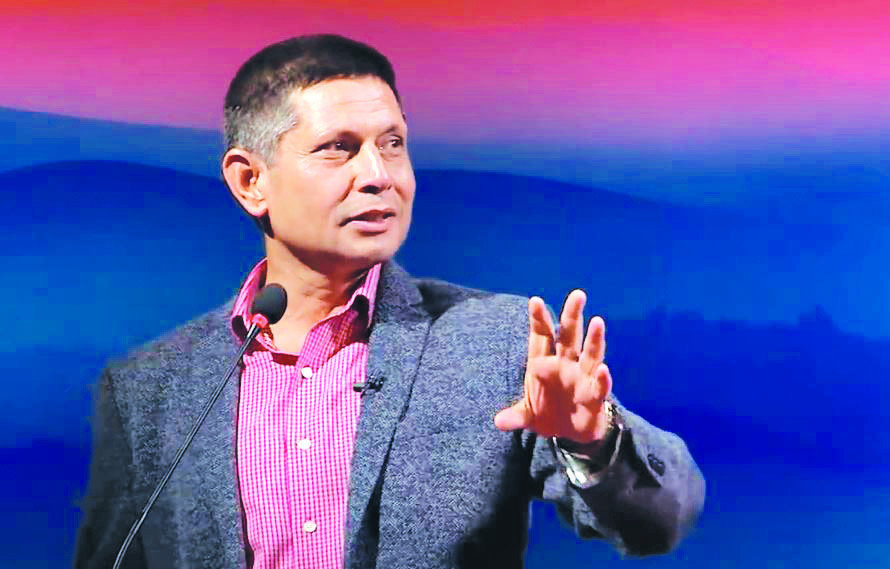
We have moved to Singha Durbar after it became difficult to work in the Meteorological Department building. Work could not be done last week due to the Dashain holiday. Before Tihar, we will move forward with the statement after completing the correspondence and other procedural work in all the bodies. The Commission has informed the government about the shortage of manpower. We are waiting for the manpower to be available soon.
How are the complaints coming to the Commission?
Some complaints are coming. We have written letters asking for some files and details. We have made a public appeal to the Ministry of Home Affairs, other ministries, the Supreme Court, the Department of Prison Management, the Federation of Nepalese Chambers of Commerce and Industry, political parties, and individual details. Details have also started to be available from some bodies.
The police had sent the complaint against the then Prime Minister and Home Minister to the Commission. Why did the Commission return it to the police?
We are not a body that investigates criminal incidents. That is why we sent the complaint back to the investigating body by putting it on a 'notice'. The body that investigates regular criminal charges is the police. We only have to submit a report. Even after our report, it is the police who will investigate. Based on that investigation, the government prosecutor's office will prosecute.
How is the commission taking complaints? How can the general public file a complaint?
Not everyone may have access to Singha Durbar. Therefore, complaints can be sent online or by post. We have also invited complaints through WhatsApp and email. You can also file a complaint in the format available on our website. If that is not possible, you can file a complaint in the name of the commission at the nearest police office.
How will you investigate incidents across the country in a short period of three months?
We have demanded more manpower from the government. We are preparing to take government employees on assignment and proceed with the investigation. We have also asked for forensic, cyber security and other experts. Since we cannot reach the country, we have requested details from various agencies. We investigate cases of prisoners escaping and prison vandalism by requesting details from various prisons.
In the case of Kathmandu, we investigate the incidents that took place from Maitighar Mandal to Tinkune on 23 and 24 Bhadau in a phased manner. The investigation goes from the people deployed in the field to the top. We do not arrest or prosecute. We call them for statements. We listen to them and make recommendations based on their statements.