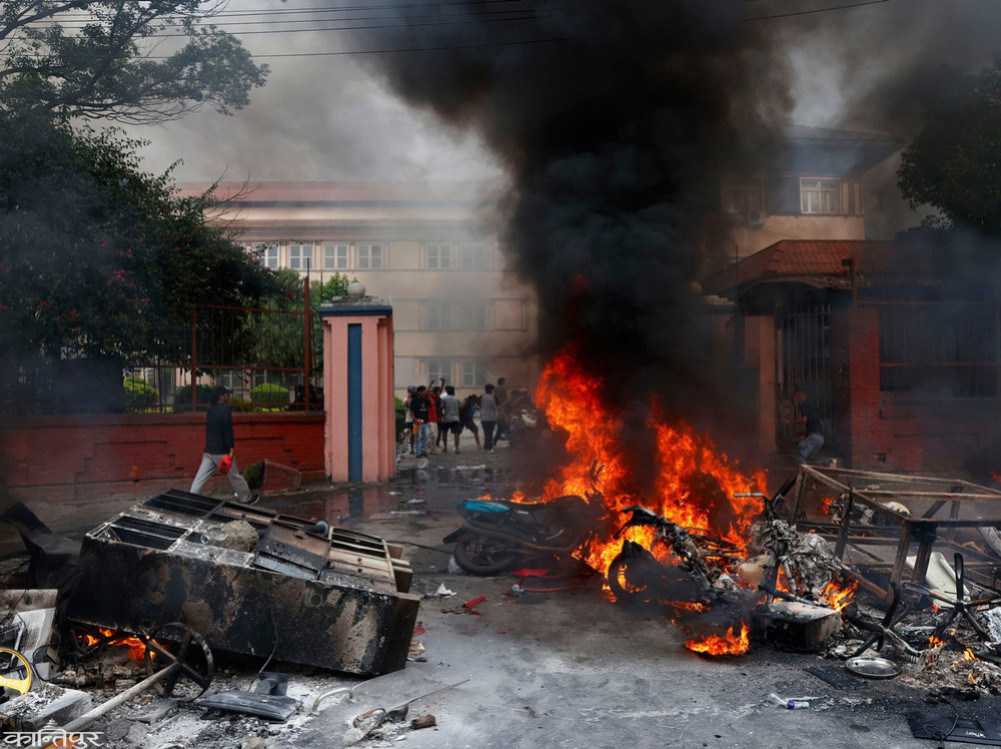
The Supreme Court has issued the ‘Directive on the Acquisition and Verification of Files and Documents Destroyed Due to Special Circumstances, 2082’. According to which, five methods/measures have been adopted to retrieve the destroyed files.
We use Google Cloud Translation Services. Google requires we provide the following disclaimer relating to use of this service:
This service may contain translations powered by Google. Google disclaims all warranties related to the translations, expressed or implied, including any warranties of accuracy, reliability, and any implied warranties of merchantability, fitness for a particular purpose, and noninfringement.
During the Genji demonstration on 24 Bhadra, 23 courts across the country were set on fire and damaged. As a result, about 933,000 cases were burned and destroyed. According to the preliminary report of the Supreme Court, 30,752 active cases and 933,071 archive cases were lost in all the courts that were set on fire and vandalized.
According to the data of 22 Bhadra, there were about 200,000 cases pending in courts across the country. Out of 24,234 cases pending in the Supreme Court, 20,034 files have been burned. How is the judicial process of those seeking justice in various courts, including the Supreme Court, progressing now?
Despite the arson and damage in the court, not all files have been burned. For example, the Supreme Court has found only 2,509 files for writs and 1,691 files for cases. 197,000 files for records have been destroyed. According to spokesperson Arjun Koirala, the ongoing cases can be returned as they are also being filed elsewhere. The Supreme Court has already started the process of creating files for ongoing cases.
The Full Court of the Supreme Court (full meeting) issued the ‘Directive on the Acquisition and Verification of Files and Documents Destroyed Due to Special Circumstances, 2082’ on 5 Asoj. According to which, five methods/measures have been adopted to recover the destroyed files.
The directive states that the documents/records related to the case before a court or agency should be collected, the decisions and documents uploaded on the websites of the Supreme Court and other government agencies should be collected, and the documents held by judges and employees in the course of the court's work should be collected. It has also been said that documents exchanged electronically between various courts, other government agencies, judges and bench officers should be collected and collected through 'appropriate means'.
The Supreme Court has also prepared a basis on how to prepare the details of the collected files and other cases. Based on the names, surnames, country of residence, contact numbers, nature of the case, case number, etc. of the parties to the case, the files will be classified as civil, criminal, writ, contempt of court, petition, report or other, based on what nature of the file and what stage they are in, such as those in the process of action, those that have been decided and the full text of the decision is yet to be prepared, or those that are in the process of implementing the decision, or those that have been completed and are in the form of records.
If it is an appellate court or body, the guidelines state that the files will be prepared based on which jurisdiction of the original jurisdiction or the appellate jurisdiction the files fall under, and in the case of the Supreme Court, on which jurisdiction the files fall, including appeals, writs, petitions, cases that have been withdrawn, repeated hearings, petition reports, reviews, or constitutional bench. The files will also be prepared based on which bench the files will be presented in, whether single, joint, full or grand full. Files can also be prepared on other bases as needed.
After the details of the destroyed files are prepared, a field-wise and summary record book will be prepared. The guidelines state that after preparing the details of the files destroyed by courts other than the Supreme Court, a copy should be sent to the Supreme Court. It has been said that the files received in this way will be uploaded on the Supreme Court website and a copy will also be provided to the Attorney General's Office, the Government Attorney's Office, the Nepal Bar Association and other bodies.