When the 30-year service period in the police comes and when it ends, it is not determined by the Police Act, but by who is close to the leaders from Girija Prasad Koirala to Pushpa Kamal Dahal, from Vamdev Gautam to Sher Bahadur Deuba.
We use Google Cloud Translation Services. Google requires we provide the following disclaimer relating to use of this service:
This service may contain translations powered by Google. Google disclaims all warranties related to the translations, expressed or implied, including any warranties of accuracy, reliability, and any implied warranties of merchantability, fitness for a particular purpose, and noninfringement.
In the first week of August, the government tried to amend the rules to extend the tenure of some senior police officers who were going to retire due to 30 years of service. But the government backed down after questions were raised saying that it would be contrary to the Supreme Court's order and the spirit of the police bill registered in the House of Representatives seven months ago. IGP Deepak Thapa retired last Wednesday after the rules were not amended. Chandrakuver Khapung has taken over the leadership of the police since Thursday.
Although the attempt to amend the rules was not successful this year, there are many instances in the past where the government changed the rules many times and put the "friendly" officers in the leadership of the police organization and extended their tenure.
The level of unnatural political interference in the change of IGP by revising the police regulations was set 33 years ago, when Girija Prasad Koirala was the Prime Minister and Sher Bahadur Deuba was the Home Minister. Motilal Bohra was brought to the leadership of the police organization after bringing the rule of 30 years service period and sending the then IGP Ratnashamsher Jabara to retirement.
The police regulations now have a provision of 58 years of age for retirement, four years of office and 30 years of service. No one has been able to lead a police organization for a full term (four years) when there is a rule of 30 years of service. 6 IGPs were in leadership for less than 1 year. They themselves did not make policies and plans and implement them. The current IGP Khapung cannot remain in leadership for two and a half months by this rule.
In the police bill that the government took to parliament last January, only the tenure and age limits for retirement have been kept. It has been proposed that the retirement age of the IGP is 60 years and the term of office is 3 years.
On 20 Chait 2070, the Supreme Court banned the Council of Ministers from revising the regulations regarding the service and conditions of the police. That is why provision has been made in the bill. But the government has not shown readiness to finalize the bill immediately.
Even though the Koirala government repealed the Police Regulations, 2033 and brought the Police Regulations, 2049 on 6 January 2049, there was a rule to retire only due to age and tenure. But soon after the regulation was amended and the rule of 30 years service period was put. On 15 February 2049, the same day as the revised regulations were published in the gazette, the government dismissed IGP Jabara with a 30-year service period rule.
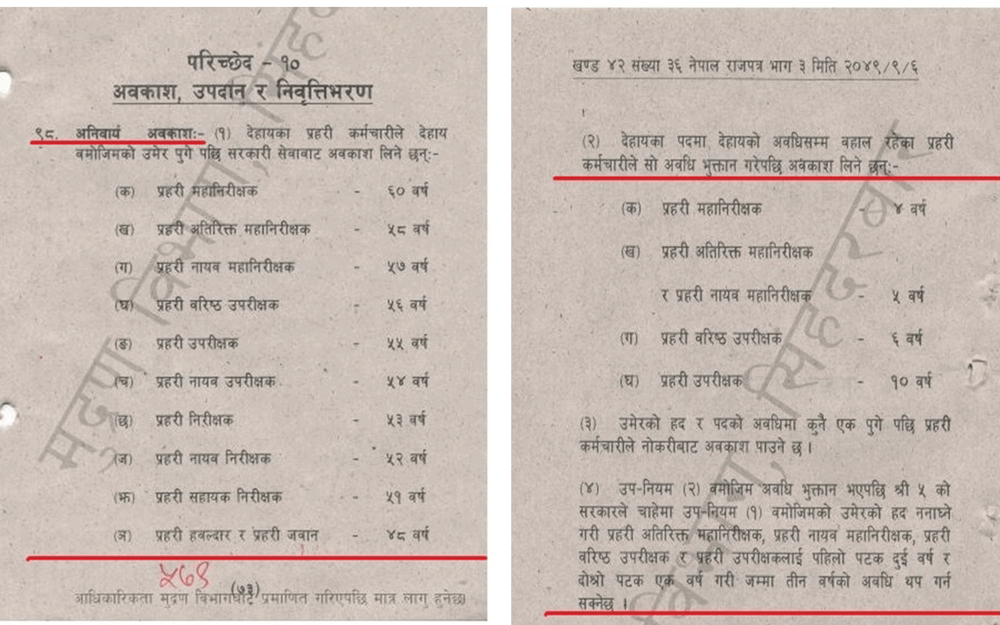 Gazette of Service and Conditions of Police Regulations issued on 6th January, 2049.
Jabara would have remained in leadership for two more years if the rule of service period had not been imposed. A former police officer said, "Partialization and exploitation in the police were institutionalized from that time." That is the basis of the distortion seen now.'
According to a former administrator, Jabra was accused of being 'loyal to the panchayat'. "He was heavily criticized because of his personal nature," says a former administrator, "when he had to be removed, he was removed with a period of service." The seeds of discord in the police were the same. After retirement, Bohra became active in Congress politics.
Bhojraj Pokharel, who was the Home Secretary when Jabara was sent on retirement and Bohra was made IGP, recalls that there were various reasons that led to that situation. One is that since it is a post-multi-party police organization, there should be a favorable attitude towards issues such as democracy, human rights and the rule of law, but the police leadership was questioned.
On the other hand, the IGP, who was loyal to the palace yesterday, was a relative of the queen, it seems that the government is not so satisfied with this,' he recalls, 'There is a briefing in the palace before the Ministry of Home Affairs about peace security and administrative corruption. There was another Far West factor. Bohra is from the Far West region of the then Home Minister Deuba. It was Deuba who took the regulation amendment proposal to the Council of Ministers.
In the regulation of 2049, the age limit of IGP was 60 years and the term of office was 4 years. From Asai to AIG, the age range was 51 to 59 years. Provision was also made that the government can extend the service period from SP to AIG by 2 years for the first time and one year for the second time so that the government does not exceed the age limit. In the amendment dated 15th February, the age of retirement was fixed from 48 to 56 years for constables to AIGs and 58 years for IGPs. It was arranged that the service period from SP to AIG can be extended by two years without exceeding the age limit.
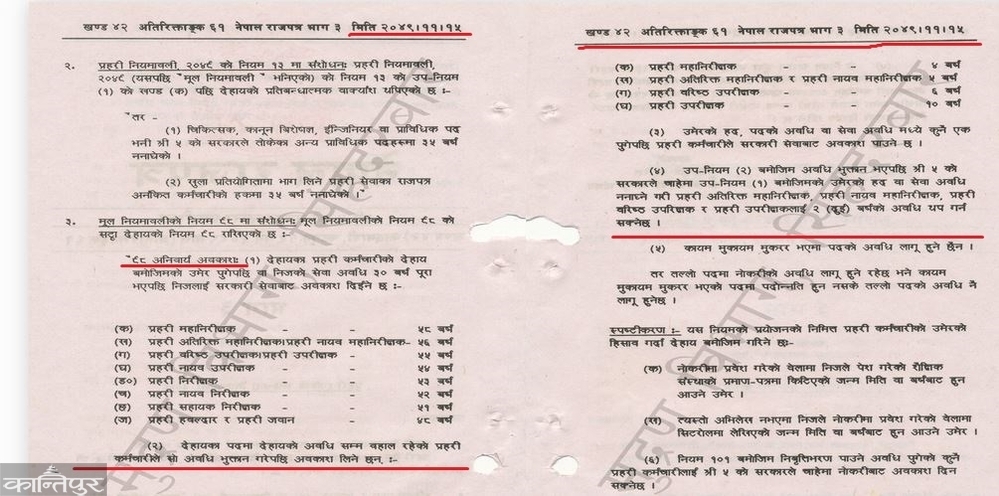 2049 Published on February 15, 2049, the gazette regarding the provisions of the amended police rules to make Motilal Bohra the IGP.
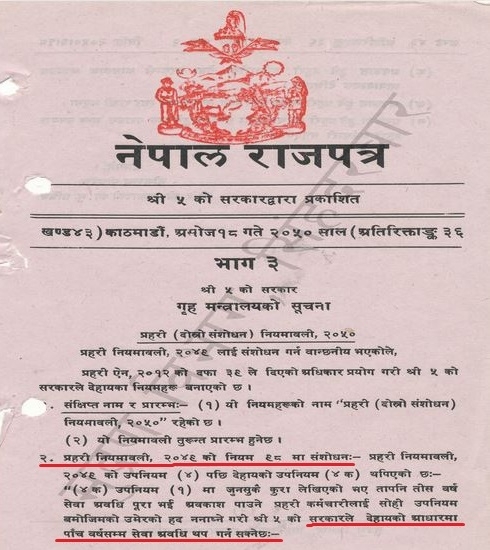
Up until Jabara's time, it was a practice for the retiring IGP to give the newly appointed IGP the darjiyan. But Bohra was given a tailor's mark by the then Home Secretary Pokharel himself. In October 2050, 7 months after Bohra became IGP, the government removed the provision of 30 years of service from the regulations. Arrangements were also made to extend the period up to 5 years so that the government does not want to increase the age limit from SP to above. The main reason for this was to continue Bohra as IGP.
 Achyutakrishna Kharel became IGP in February 2053 after Bohra. The newly appointed IGP Kharel was branded by the Bohras. Even after that, the game of taking the "friendly" officer to the police leadership in a capricious manner did not stop.
When Lokendra Bahadur Chand from RPP was Prime Minister and Vamdev Gautam from UML was Home Minister, Kharel was removed from IGP and transferred to National Investigation Department. At that time, Kharel had been IGP for only 36 days.
Chand government made AIG Dhrawa Bahadur Pradhan as IGP. This incident brought the 'Kharel-Pradhan relationship' to a state of 'Pani Barabar'. Which has the effect of providing tailor marks. Pradhan, who was made IGP on the choice of UML, was given the tailor's badge by then Home Minister Gautam.
According to the experts at that time, the 'ulterior motive' of changing the police leadership in such an unnatural way is to open the smuggling line and to win the local and general elections by abusing the police power. 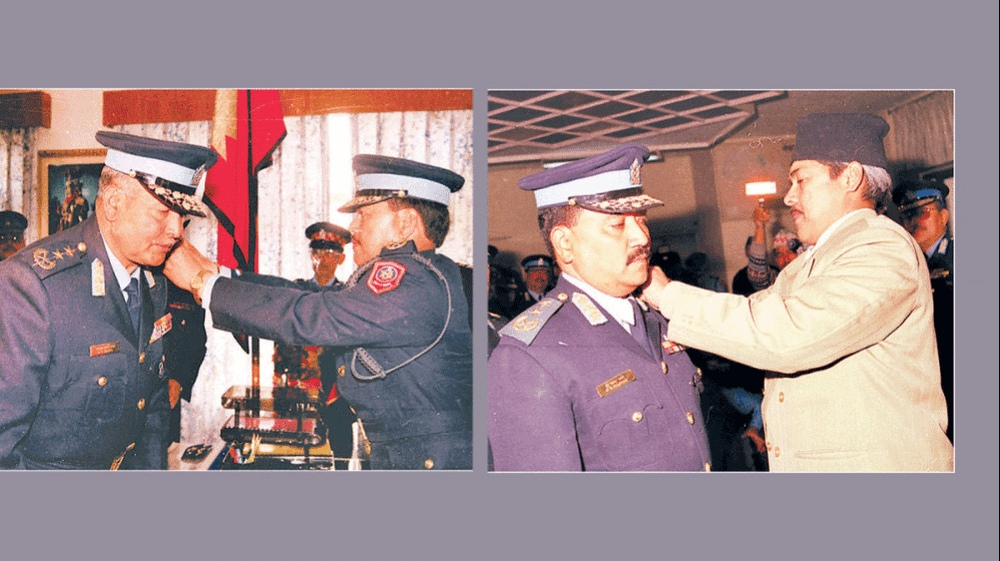
Uncharacteristically, after the change of IGP, the then government has been accused of 'opening the gold smuggling line from the airport'. Kharel went to the Supreme Court against the government's decision to remove him from the post of IGP. The Supreme Court refused to grant an interim order. The government changed without hearing the decision. In October 2054, Surya Bahadur Thapa of RPP became the prime minister after the fall of the Chand government. Wise Tamang came as Home Minister. The following month, the government was reconstituted and Khum Bahadur Khadka became the home minister from the Congress.
Reversing the previous government's decision, the Thapa cabinet transferred IGP Pradhan to the Prime Minister's advisor and reinstated Kharel. After some time, the chief resigned. Later he joined RPP politics. Pradhan is still a member of the House of Representatives from RPP. Even after Kharel's restoration, there was no '30-year provision'.
After the political changes of 2062/63, the then IGP Shyambhakt Thapa and AIG Rajendra Bahadur Singh were suspended. They were accused of suppressing the people's movement. After Thapa, Singh was on the roll of IGP. While both were under suspension, the government made Om Vikram Rana the IGP in August 2063. At that time, Girijaprasad Koirala was the Prime Minister and Krishna Prasad Sitaula was the Home Minister. Rana was given a tailor by the then Home Secretary Umesh Prasad Mainali. The Home Secretary is still in charge of appointing the IGP.
After the first election of the Constituent Assembly, Pushpa Kamal Dahal of Maoist became the Prime Minister and UML leader Vamdev Gautam became the Home Minister. At the same time, the regulations were amended and the provision that the government could extend the term of office was removed and a 30-year service period was established. Then Hem Bahadur Gurung became IGP in October 2065.
Due to his age limit of 58 years, he remained in police leadership for only about 5 months. Rameshchand Thakuri, who became IGP after Gurung, got involved in the Sudan scam case and was dragged to the prime minister's office. Rabindra Pratap Shah was made IGP in his place. Shah also retired due to 30 years of service.
Before IGP Shah retired, his associates including Madan Khadka went to the Supreme Court against the provision of retiring 11 officers from their service period. Shortly before retirement, in 2069, they went to the Supreme Court, and the following year, on 20 Chait 2070, an order was issued in the name of the government not to change the provisions of service and conditions. The Supreme Court called the decision to change the provisions of the service and conditions from the regulations as 'contradictory and arbitrary decision of the government' and ordered the Council of Ministers not to amend the retirement.
The Supreme Court had commented that the issue of frequent filing of writs related to service period and the need to set aside cases from the court was 'not a good thing'. Meanwhile, the Police Regulations 2049 were amended at least 30 times, including changes in the provisions of service and conditions.
"The thought of operating the administration mechanism of the service of a sensitive organ related to peace security under political or administrative discretion in an ad hoc and opportunistic manner is simply unacceptable." It should not be tampered with,' the Supreme Court said, 'It is seen that necessary efforts should be made without delay to keep things from entry into the police service to career development and retirement from service clearly defined, ensured and specified and to remove the confusion and make it clear.' In order not to increase the uncertainty in the process, the government issued a directive that, while setting the service period for retirement or retirement from service due to age limit, without taking the route of amending the regulations, it should be adjusted to make the necessary provisions in the Police Act itself. Since then, the provision of terms of service has not been changed from the regulations. But the government did not show caution to enact the law as per the order of the Supreme Court.
In August 2069, without this order of the Supreme Court, Shah retired and Kuwersingh Rana became IGP. He also retired in October 2070 due to the length of service. After that, Upendrakanth Aryal became IGP. Even then, the government tried to amend the rules to extend the tenure of IGP Aryal, who was going to retire after completing his service. For that, the then Attorney General Raman Shrestha and Chief Secretary Somlal Subedi and officials of the Ministry of Law sat down to draft the amendment of the regulations.
33 years ago the weight of service period, which institutionalized instability in the police
Then Silwal was not given the leadership of the police because he was involved in a case, the government did not prefer Aryal who was ranked second and Bhandari who was ranked fourth. After the appointment process became more controversial, Dinesh Chandra Pokharel, a doctor (Technical AIG) of Police Hospital was made Acting IGP, saying 'until further arrangements'. According to Senior Advocate Shrestha, who was also the then Attorney General, DIG Aryal was number one in performance evaluation and second in ranking. Even though Silwal was ranked first, there was a controversy when Congress tried to make Chand, ranked third, as IGP.
Congress was reluctant to make the person who is ahead in the performance evaluation as IGP, the position of the Congress was that Silwal, who was ranked first, would not be made under any circumstances. After that, Chand became IGP of the third rank, but after the court appointed him and canceled the appointment, the government proceeded with the process by revising the rules and continuing the IGP who was going to retire. At that time, the draft of the revision of the regulations had also been prepared, Aryal said that he did not want to extend the period in any case, so the technical AIG had to be dismissed. "I was on vacation, the next IGP was not decided. Since it was a coalition government, they probably had their own choice on who to make police chief,'' he says. I said that I want to retire through the natural process.
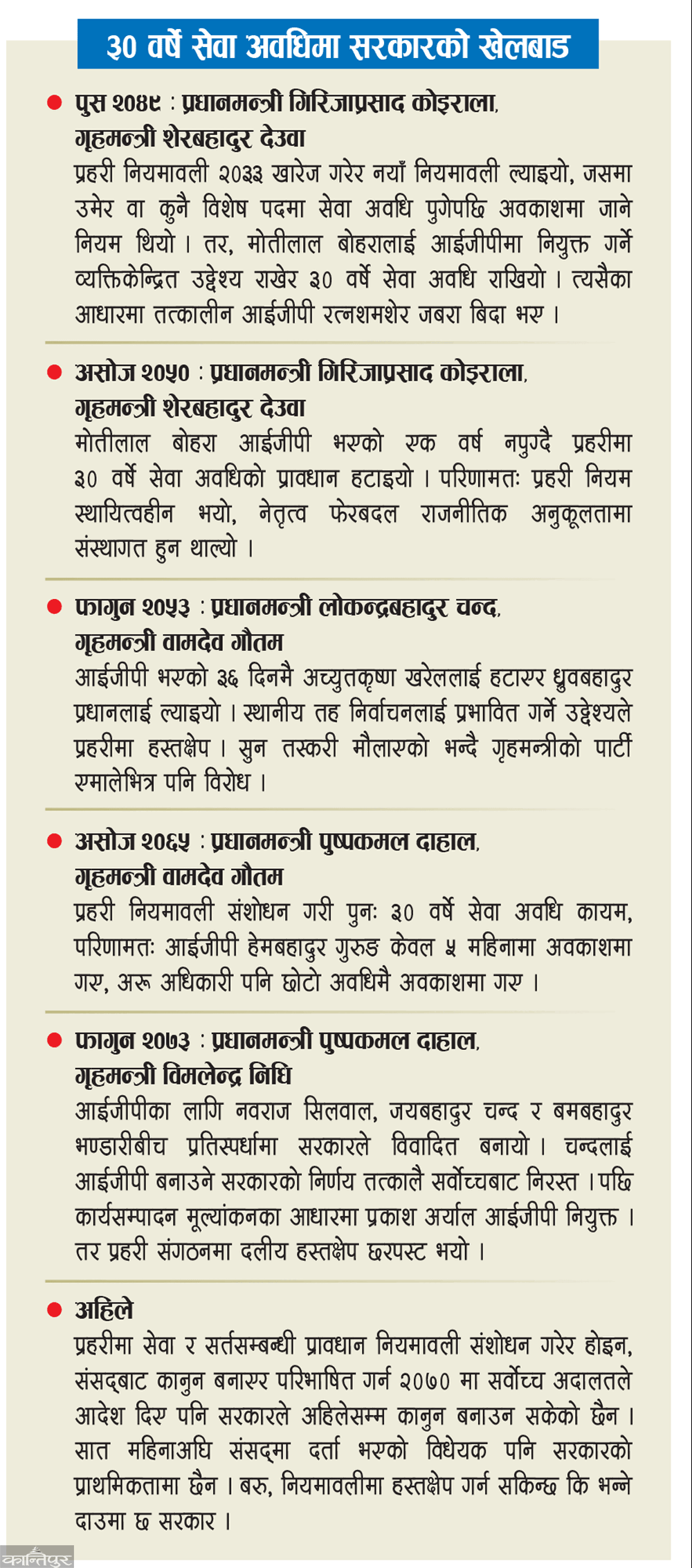
Based on the performance evaluation, the government made Prakash Aryal the IGP in Chait 2073. After he went to Sarlan Khanal, Thakur Prasad Gyawali, Shaileholdha Thapa Chhetri, Spring Ghawar Singh and Deepak Thapa Service. & NBSP; The provisions of the 30-year service period in Santi-BRAK East-Mahana Namimashi Police brought selfishly approval and comment on the whole improvement. "The provision of service period has been brought to lead," he said that the provision of service period, "he said that the police organization has been taken to cope with the age of the country," says the police-BREAK Nepal Police again
i, Bhoraj Pokhrel, Natural Nepal Police, Natural Nepal Police In order to select the leadership from the process and to prevent the arrangement of securely by forming the system of laws and will analyze playing. "According to political forces, according to the police, police employees were active in the political power, according to Story Pokhal. "Smugglers also appeared to the self-interest group on the transfer of self-interest groups. '



