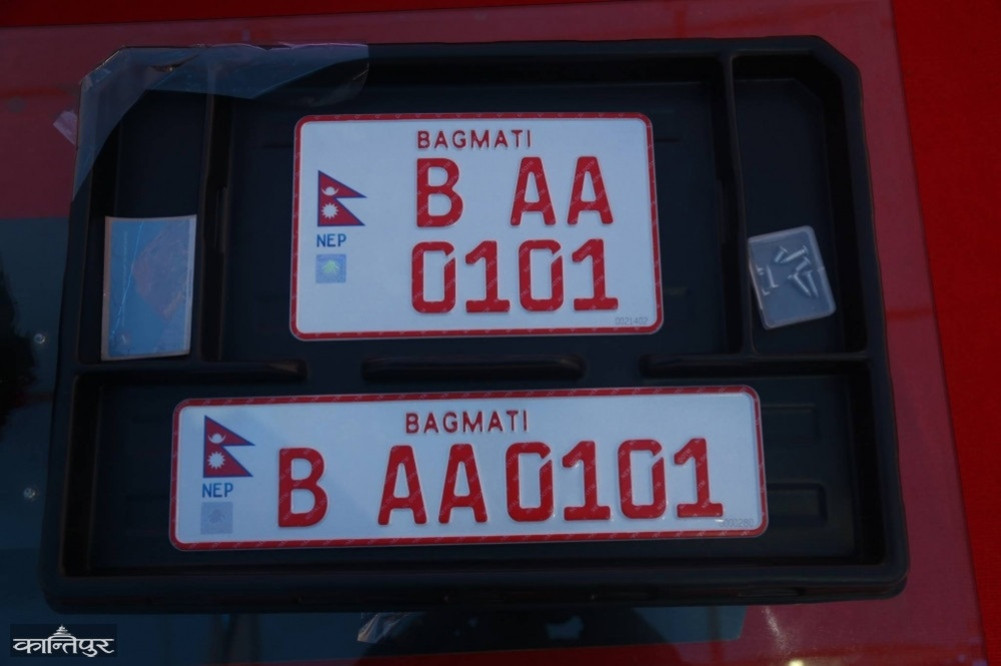
A contract was signed in 2073 to be able to work for 4 billion 68 crores, the company had to install 2.5 million embossed numbers within 5 years, but in 6 years after the contract was signed, only 25 thousand vehicles were installed with embossed number plates.
We use Google Cloud Translation Services. Google requires we provide the following disclaimer relating to use of this service:
This service may contain translations powered by Google. Google disclaims all warranties related to the translations, expressed or implied, including any warranties of accuracy, reliability, and any implied warranties of merchantability, fitness for a particular purpose, and noninfringement.
After the government made the installation of embossed number plates mandatory on 20 July 2082 with effect from 1 October, there has been a lot of protest from social media to the streets in recent days. The government's insistence on installation of embossed number plates has been questioned saying that it will cause suffering and harassment along with the suspicion of irregularities from the public level.
After public opposition to it, the government announced on Tuesday that it will be implemented procedurally rather than compulsorily from October 1. Even though the government appears to have backed down less than a month from its decision, it seems that the government has not been able to be transparent about connecting embossed numbers. As a result, the suspicion of corruption from the public level has increased.
It seems that even after the government tried to forcefully implement the 'embossed number reading' infrastructure at vehicle entry points without preparing it, it was opposed. The government had said that from October 1, all types of private and rental vehicles must be equipped with embossed number plates when registering, naming and renewing them.
According to the aim of 'digitizing' the country, the government claims that it has taken a policy to gradually make embossed numbers mandatory in order to strengthen and enable the transport sector. The government officials say that they will stop implementing the controversial embossed number connection decision.
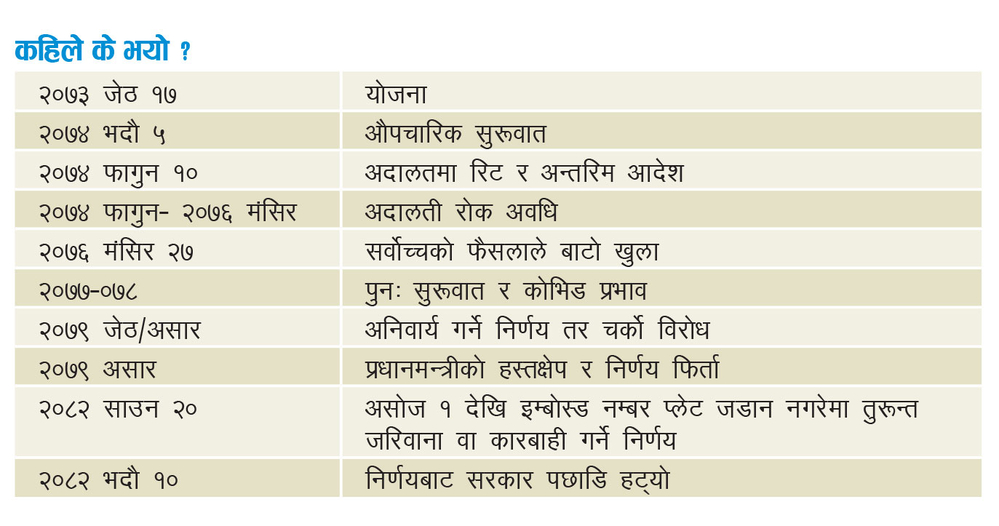
Embossed number connection topic started from 17th June 2073. But this decision has been stalled in protests and court proceedings for a long time. Some have suspected that there is financial manipulation in printing embossed numbers, while questions have also been raised about its necessity and justification. In particular, the embossed number is in English language, there is no confirmation of the rationale of applying it compulsorily for a long time, there is an intention to cause trouble to the internal management, the amount of revenue to be paid by the vehicle during connection is high, and other questions have been raised at the civil level.
Some have campaigned against the decision to implement embossed numbers. It is also constantly opposed on social media. On July 20, a meeting chaired by Physical Infrastructure and Transport Minister Devendra Dahal decided to make embossed numbers mandatory. Based on the decision of the Ministry, the Department of Transport Management published a notice to proceed with the embossed number connection process.
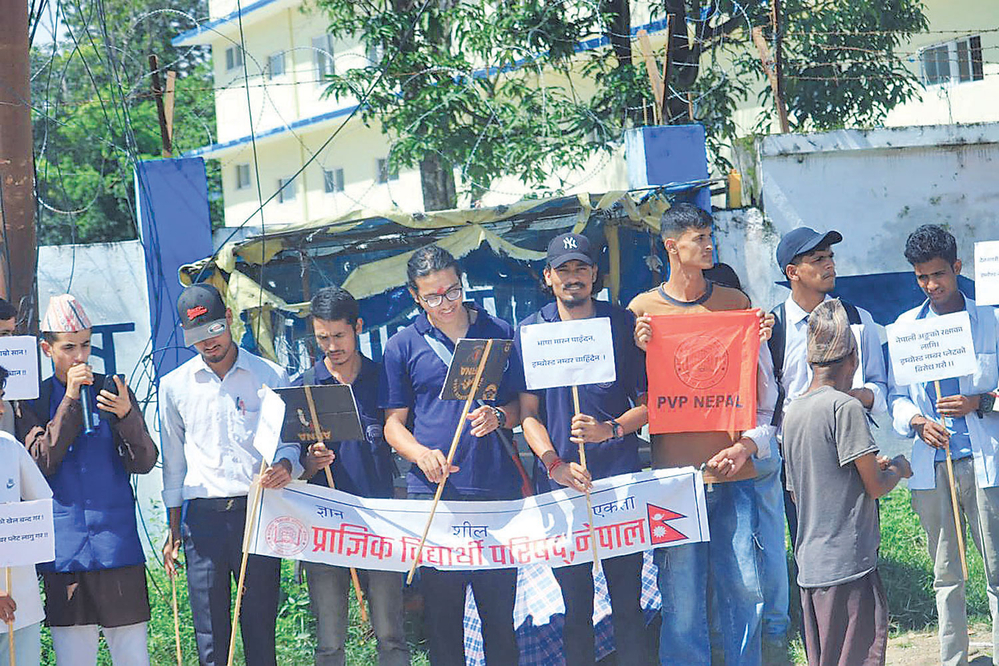
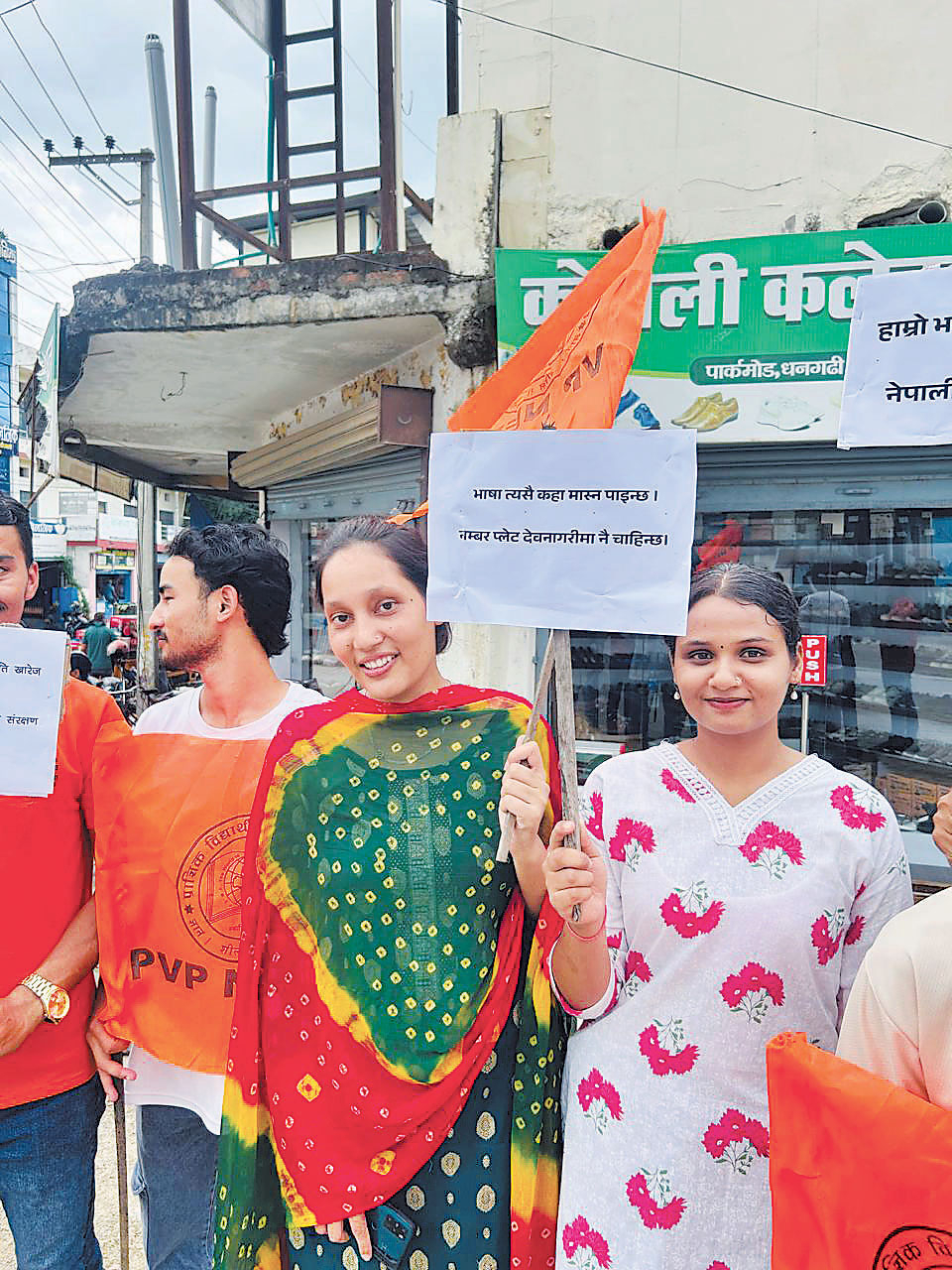
The Academic Students Council of Nepal has submitted a memorandum to the government through the district administration across the country against keeping the English language in the embossed numbers. The council has held corner meetings and demonstrations in major cities of the country. Council member Chitraj Neupane said that they are trying to wipe out the existence of Nepali language and will continue the protest.
From ordinary people to academics, the topic of language is being raised more and more. Senior advocate Tikaram Bhattarai has said that they are trying to erase the existence of Nepali language by releasing the video message itself. He also expressed dissatisfaction with the Supreme Court's decision on language and said, "The Constitution itself says that the language of government work will be Nepali, so let's run this campaign."
The government had jointly won the contract for number plates on 19th June 2073 by Bangladesh and America's Decatur-Tiger IT Company to install 2.5 million embossed numbers in 5 years. The company had signed an agreement to connect 2.5 million embossed numbers within 5 years. But till now 1.3 lakh embossed numbers are yet to be prepared and only 1 lakh vehicles have been installed. The Department of Transport Management estimates that there are 40 to 50 million vehicles across the country.
Number plate reading infrastructure is being prepared
With the stoppage of the installation of embossed number plates, the construction of the 'RFID tracking gate' was also stopped. The work has now resumed. The function of an RFID gate is to track the chips on the embossed plate attached to the vehicle. It was agreed that the Embossed Number supplier company would build such gates at 5 places entering the valley and 5 places outside the valley. Embossed number plates are installed on the vehicle at two places, front and rear. The sticker used on the same plate is called 'RFID sticker'.
" Before the issue of embossed number plates, let's guarantee that driving licenses will be given within two weeks. Even though we applied for smart licenses 2/3 years ago, the government has not yet been able to distribute them. Work on one side, Kumlo Boki thimtir!': Bishnuraj Upreti, professor and researcher "
This sticker can be captured by the 'Radio Frequency Identification Device' at the gate and all the details can be seen. Through this one can know the details of the vehicle. But when the problem of the number plate breaking and breaking started to appear, doubts arose as to why the reading device was not ready and implemented. This department is making itself. The process of making all the main points entering Kathmandu valley has started. There is a suspicion that the government has committed irregularities by forcing it to be mandatory when RFID is being developed. How much does
cost? According to the fee set by the
department, motorcycle and scooter users have to pay a compensation of 2,500 rupees. Similarly, owners of three-wheelers have to pay Rs 2,900 and four-wheelers i.e. cars, jeeps and vans and medium vehicles have to pay Rs 3,200. Owners of large and heavy vehicles have to pay a maximum of 3,600 rupees when installing embossed number plates.
The amount paid by the government to Decatur Tiger IT is $14.50 for two-wheelers, $17.50 for three-wheelers, $17.70 for four-wheelers and medium-sized vehicles, and $19 for large vehicles.
Nepali removed by court order?
Bharat Kumar Basnet, an advocate of Jaldhungamarg located in Kathmandu Metropolitan City-3, filed a writ in the Supreme Court on 10 February 2074, demanding to stop the distribution of such embossed number plates. It was filed with a demand that even if the embossed plate is to be kept, it should be written in Devanagari script. The then Chief Justice Cholendrashamsher Jabara's Ekaj Ijalas issued an interim order and banned the distribution and connection of embossed numbers till November 2076. After that, the project of installing embossed number plates became uncertain.
On 27 November 2076, the constitutional bench of the then Chief Justice Jabara, Judges Deepkumar Karki, Harikrishna Karki, Vishwambhar Prasad Shrestha and Prakashmansingh Raut dismissed the writ saying that there is no need to ban the use of English numbers on embossed number plates. After the court cleared the way, an attempt was made to open Embossed during the tenure of the then Physical Minister Vasant Nemwang. Due to covid, the process did not proceed immediately. Based on the order of the Supreme Court at that time, the notice of installation of embossed number plates has been published.
After the rejection of the petition with the demand to use Nepali language, the government is trying to make embossed number mandatory in English language. Even though the court decided the issue of Nepali and English, another writ was registered in the Supreme Court regarding the issue of embossed number. The reason for the said writ is only a show cause order. After that no other process has proceeded. In the writ, it has been mentioned that the company that got the contract has been blacklisted.
When did the embossed number start?
The government took a strategy to take the country to 'digitization' in 2066 itself. Based on the same decision, the government had put forward a plan to have embossed numbers in the financial year 2072/73. On 5 August 2074, the then Physical Infrastructure and Transport Minister Bir Bahadur Balayer announced that the installation of embossed number plates has started in the first phase.
He said at a public event that the installation of embossed number plates on government and diplomatic vehicles has officially started. At that time, it was arranged that vehicles registered in Bagmati Province could connect themselves. Tokaraj Pandey, the then spokesperson of the Department of Transportation, informed that embossed numbers will be attached to all private and rental vehicles within 5 years.
On 22nd October 2078, the Ministry of Physical Infrastructure and Transport published a notice in the gazette and issued a notice to install embossed numbers on vehicles that are registered at the Transport Management Office or that are still registered. It was mentioned in the gazette that it will be implemented in Bagmati, Gandaki, Karnali, Lumbini, Sudurpaschim. The rule was set from November 1, 2078 to June 2079, with separate dates for new vehicle registration, registration, distribution of new vehicle certificates.
But the government could not proceed with the installation of embossed numbers in the mentioned provinces. After 8 months of publishing the notification in the gazette, the Transport Management Department again published another notification advising the vehicle owners to install the embossed number.
When the said rule could not be implemented, the department again issued a notification to make the installation of embossed plates mandatory in Bagmati and Gandaki from 1st July. It was widely opposed after warning of action if not connected during this period. But again, the department has been flexible in its decision to make number plates mandatory and has not asked to make embossed numbers mandatory on all vehicles from July 1 and has continued the notification published in the gazette in November 2078.
Embossed number plate connection dispute passes 8 years
The printing of embossed number plates was officially started after Bangladesh and America's Decatur Tiger IT Company won the contract on 19th June 2073. According to the Department of Transportation, the contract was signed for 4 billion 685 million 52 million 62 thousand 500 rupees (4 million 37 million 87 thousand 500 dollars).
The company had an agreement to connect 2.5 million embossed numbers within 5 years. But in the six years since the contract was signed, only 25,000 vehicles were fitted with embossed number plates. After the contract expired in June 078, it was extended again for 28 months. According to the second contract, there was a condition that 24 lakh 75 thousand embossed numbers should be distributed within 16 months. By June 079, the company had taken payment of 3 crore 62 lakh 56 thousand 441 rupees.
We could not explain the benefits of embossed numbers to the public: Director General Pokharel
Director General of Transport Management Department Rajeev Pokharel, who has the main responsibility of connecting embossed numbers, said that during the 'digitization' of government services, priority has been given to connecting embossed numbers. He said that the main aim is to make the service reliable and trustworthy by keeping the data of the transport sector up to date. While the world is a 'global village', we are using English language materials in our daily life.
Pokharel claimed that the use of embossed numbers will make the transport system scientific, security, theft and tax collection will be easier. Director General Pokharel informed that there will be benefits such as the theft of vehicles will be stopped, the location can be tracked in case of crime and escape, Nepali vehicles can be easily identified in foreign lands, and the embossed plate number will be clearly visible even in the dark. He said that the 'record system' will be organized by constructing the vehicle tracking structure at various places.
Pokharel said that he will keep the embossed number and also make the tracking structure. He said that since the provincial government is responsible for transport management, there will be more support in the construction of structures. We have started the process after being cleared by the court and authorities. We did not say that we will take immediate action if we do not keep the embossed number. It means to do it gradually," he said. He said that because the government could not properly explain the reforms to the citizens, there was also confusion at the civil level.