72 years ago between Nepal and India. There was an extradition treaty in 2010, since the old treaty could not make a concrete contribution to solve the problem in the changing situation, the matter of a new treaty has been raised between Nepal and India, but the issue has not been turned into a formal document because Nepal is suspicious of India's intention to extradite citizens of third countries to each other.
We use Google Cloud Translation Services. Google requires we provide the following disclaimer relating to use of this service:
This service may contain translations powered by Google. Google disclaims all warranties related to the translations, expressed or implied, including any warranties of accuracy, reliability, and any implied warranties of merchantability, fitness for a particular purpose, and noninfringement.
Yasin Bhadkal, the "founding member" of the Indian "terrorist group" Mujahideen, Ahmad Siddababa and his associate Asad Dullah were arrested in Pokhara on 27 August 2013 (11 August 2070). Indian police came to Pokhara in coordination with Nepal Police to arrest Bhadkal.
After the arrest, Bhadkal and his accomplice Asad were handed over to the Indian police. However, the Indian government claimed that he was arrested from Birgunjpari Raxaul in Parsa, bordering the two countries. Bhadkal was charged with bomb blasts in Ahmedabad, Surat, Jaipur and New Delhi in 2008 and Mumbai in 2011. The police of both countries launched a special operation after information that Bhadkal, who is considered to be the main planner in these incidents, was hiding in Nepal. The then senior officials of Nepal Police said that Nepal Police helped arrest
Bhadkal. The then Home Minister of India Sushil Kumar Sinde responded that the Intelligence Agency had arrested Bhadkal from the Nepal-India border area.
...
Durga Prasai, a fugitive medical practitioner, was arrested on 28 March 2081 in Assam, India, after a violent incident erupted after a demonstration organized by the Rajawadi group at Tinkune on 15 March 2081. After absconding, Prasarin also released a video message claiming that he was in Nepal. However, the Nepal Police arrested them with the help of the Indian Police and brought them to Kathmandu from Assam through Kakadvitta in Jhapa. The case filed against Prasai in the Tinkune incident for offenses including sedition, organized crime and criminal nuisance is pending in the court. Prasain has been released on bail.
...
Bechan Jha, the suspect in the fake Bhutanese refugee case, was arrested in India on 14 July 2081 and brought to Kathmandu. Nepal Police claimed that Jha, who was arrested from across the border with the help of Indian security personnel, was arrested from the border area near Gaddachouki in Kanchanpur. Jha is currently in the Central Jail pending trial in the refugee case.
Guddu Patel, an Indian national who was involved in the murder of garment owner Lal Mohammad Ansari in Gothatar, Kathmandu, was arrested by the police on 18 February 2081 after being shot in the head. Sources say that Patel was arrested and brought from India, but the police claimed that he was detained from Tokha. Bablu Paswan, a suspect in Ansari's murder, was shot and arrested by Parsa police on 17 Baisakh 2081.
Ansari was shot dead on October 3, 2079. After that, Suter escaped to India and it is claimed that both of them were brought to Nepal with the help of Indian police, Patel Tokha and Paswan were arrested from Nepal-India border area. These are representative cases, many other people involved in crimes are arrested by the police of both countries in each other's country and claimed to have been caught from the border. Regarding the legal question, "both sides" have been insisting that they were arrested from the border area.
...
Both countries are ready to make a treaty/agreement to address this problem. The Nepali side does not agree with the proposal put forward by India to bring third country citizens and its own citizens under the scope of action according to the laws of other countries. Deviram Sharma, the former head of the National Investigation Department, says that Nepal's stance on the extradition treaty is appropriate and should stick to it.
"Be it a Nepalese person who has committed a crime here or an Indian citizen who has entered Nepal after committing a crime, they should be extradited if they are caught in each other's country. These are common problems for both countries. It is better to agree on this so that it is of common interest," says Sharma. If a crime has been committed in the country, it seems that the Indian side is determined to take action according to the laws of that country and extradite him for that. It is also necessary for the Nepali side to maintain its previous position.' Sharma's suggestion is that it should be amended.
He suggested that the government should clearly hold a discussion and debate with all the organs and the people on the issue of the extradition of Sharma, the former chief of Ravi. "It is necessary to take the matter mentioned in the treaty or MLA to the people's level, because such treaties/agreements are related to the sovereignty of the country, about which common citizens have the right to know/understand simply and easily," said Sharma, "If agreements are made at the political and administrative level but the citizens are informed only after the agreement has been reached, it will not benefit both countries." He says that the government is more criticized by the citizens because of the tendency to keep it secret and implement it at once.
What's in the treaty 72 years ago?
between Nepal and India 72 years ago. An extradition treaty was signed in 2010. After independence from British rule, India signed an extradition treaty with Nepal in 1953. On 16 October 2010, the then Prime Minister Matrika Prasad Koirala and Indian Ambassador to Nepal Bhalchandra Krishna Gokhale signed the treaty. This treaty is not being implemented in practice. Bilateral talks and discussions between the two sides to replace the old treaty and replace it with a new one have not reached an agreement since the beginning of 2000. In the old treaty, it is said that citizens of third countries cannot be extradited. India insists on revising the same subject.
12 counts of murder, conspiracy to commit murder, charge of murder, crime of grievous bodily harm/dismemberment, rape, robbery, burglary, violent robbery, burglary, aggravated burglary, theft worth more than 500 or theft of livestock are on the list. It is mentioned that those involved in crimes such as arson, absconding from the army, import/export of prohibited goods, embezzlement of government property, kidnapping, bribery of a national servant, escape from prison can be extradited.
It is mentioned in Article 1 that persons accused of a crime or convicted of a crime within the territory of one country can be extradited to each other's country under the terms of the treaty if they are found in the territory of another country.
It is mentioned in Article 2 of the treaty that both governments are not bound to hand over any person accused of desertion from military service (fugitive soldier) if he is a citizen of a third country. "If the accused person is not a citizen of the government requesting extradition, except for the offense mentioned in clause 10 of Article 3, both governments will not be obliged to hand over such person." Article 3 of the treaty contains a list of crimes. Article 10 of it mentions desertion from military service.
Former Home Secretary Govind Kusum says that the new treaty between Nepal and India is being raised because the treaty made a long time ago cannot make a concrete contribution to solve the problem in today's changing situation. He said that both
extradition and mutual legal assistance are complementary to each other. Every country makes these treaties with each other for crime control. It is only difficult for Nepal to manage its internal politics. It is necessary to control crime and bring the criminals,'' he said. It is better to explain to the respective country. If there is an extradition treaty between the two countries, criminals who have committed crimes in one country and are hiding in the other country can be formally brought into the legal net.
Efforts have been ongoing for 25 years
Although India has signed extradition treaties with 50 countries, it has not reached an agreement with Nepal regarding the issue of third-country nationals. The agenda of the extradition treaty has been kept from India during the visits of the Secretary, Minister or Prime Minister. When the then Prime Minister Sher Bahadur Deuba was on a visit to India on 7-12 Chait 2058, the issue of extradition treaty was on the agenda. Point number 7 of the joint statement mentions updating the extradition treaty.
At that time, a month before Deuba's visit, the Home Secretary-level meeting in Delhi decided to conclude the mutual legal assistance agreement as soon as possible and update the extradition treaty. Even now it has become a coincidence like 25 years ago. Before Oli's imminent visit, the Home Secretary-level mechanisms of both countries have agreed on the MLA and have agreed to proceed with the treaty as soon as possible. 21 years ago in January 2061, the Home Secretary-level meeting gave the final approval to the draft of the Extradition Treaty and the Mutual Legal Assistance Treaty. A meeting was held in Delhi on 6 and 7 January 2011. The
meeting finalized the handover and MLA draft. According to a statement issued by the Indian Ministry of External Affairs at that time, both countries agreed to formally sign it soon after completing the internal process. On behalf of Nepal, then Home Secretary Chandi Prasad Shrestha and India's Home Secretary Dhirendra Singh initially signed the draft. The
draft was soon passed by the Indian Cabinet. However, the political changes in Nepal did not advance this matter. King Gyanendra Shah started direct rule immediately after the agreement was reached during the government led by Sher Bahadur Deuba. A year later, democracy was restored in Nepal. "The signing at the secretary level required approval from the political level," says former home secretary Kusum, "the political situation in the country changed, but the treaty could not be signed due to the lack of stability in the government and apparent ambivalence in the decision."
After the restoration of democracy, India has been continuously proposing new treaties. He has also submitted his own draft to Nepal. The draft of the treaty prepared by the secretary level in 2061 was not made public. On 27th January 2065, the then Foreign Minister of India, Pranab Mukherjee, while speaking in the Rajya Sabha, said that the formal signature between the two governments is awaited on the draft prepared by the secretary level. Mukherjee had expressed in Parliament that it would be possible to extradite citizens of third countries after the signing of the new treaty. This statement also makes it clear that India is in favor of the new treaty only if third country nationals can be extradited anyway. Nepal is not ready for this matter.
In the recent secretary-level meeting, the Indian side has said that the discussion should start from the agreed point in 2061. According to an official participating in the meeting, India is in favor of adding to the list of technological crimes developed during this period and making it complete. "But we don't agree with that," said the official. Former Nepalese Ambassador to India Deepkumar Upadhyay says that India is trying to include in the extradition treaty the point that it wants to take citizens of third countries from Nepal. "That's why there is more problem," he said, "even we haven't been able to say no clearly on that matter."
A joint secretary in the Ministry of Home Affairs, the geopolitical factor, also says that the treaty has not been signed. "The same thing happened with the northern neighbor China, the same thing is happening with India," he said. An extradition treaty is not only needed by India or China, but also by us. However, we need clarity on whether to accept the condition or not. It is not possible to talk from the staff level.'
In October 2076, during the visit of Chinese President Xi Jinping to Nepal, extradition treaty between Nepal and China was about to be signed. However, it could not happen at the last moment. After the extradition treaty, the American and Indian side expressed interest at that time saying that the pressure from China to extradite the Tibetan refugees in Nepal would increase. Nepal had already decided to make MLA and treaty.
The Foreign Affairs Committee of the US Parliament wrote a letter to Prime Minister KP Sharma Oli and pressured him not to sign the extradition treaty. It is also said that Nepal backed away from signing the extradition treaty because it could not withstand that pressure. Uttam Subedi, the former Additional Inspector General of Nepal Police, says that the lack of extradition and mutual legal assistance treaty is causing problems in crime control and bringing criminals to justice. 'Our most problem is with India. There is more than the number of hides in India with crime in Nepal.
has not been able to bring them in a formal way. "He said, 'He said," Nowadays of both countries, the police have been supporting each other based on formal understanding. It is not a formal. 'It is said that even if police arrested from India, it has been said that Nepal's boundary market is covered. The same report is also made even when submitting in court.
has increased crime, not only in India but also other countries are required to have the conductor. "Terrorism, gold smuggling, human trafficking, drugs, drugs, involve citizens of different countries, 'This treaty is required to control such crimes. As the police investigatized. '
-Break Oli's visit is preparing for a formal tour of Prime Minister KP Sharma Oli Sharma Oli Funeal Visses of India. Oli is coming to Kathmandu in Kathmandu in 1 August, to invite the visit.
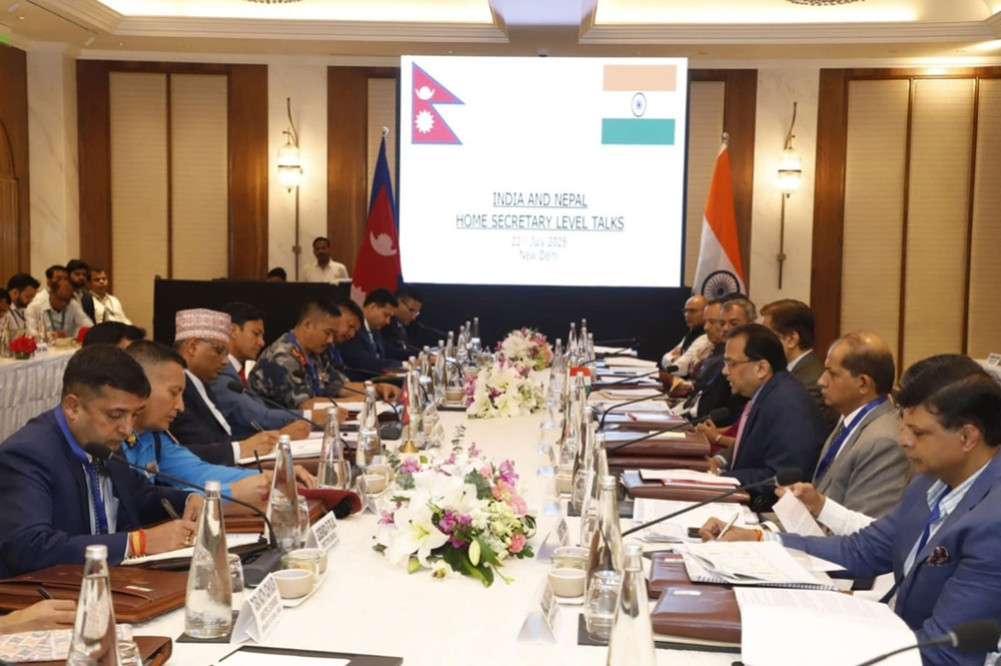
lived in New Delhi to New Delhi in July 6 and 7 last July 6 and 7. The meeting also agreed to negotiate "MLA '(MLA) to" MLA) for bosing crime and control and controlling and cooperation and information. Both countries have exchanged ML's draft.
got up the toping of 'delivery treaty' between two countries. The certainly available is not on it. The reason was the reason - two countries their psychology. Nepal has already been chasing this proposal. Nepali side does not agree on the Indian proposal to be able to handle in particular.
is the demand of the Indian side that the citizens of the third country involved in the third country involved in the third country involved in the third country engaged in the third country. There are involved in net notes and terrorist activities, engaging some Pakistani citizens and the Indian side of the Indian side of the Indian side of the Indian side that such a person would make Nepal a Celster. Such people, there is a strong manner in charge for the responsibility of being found in Nepal. However, Nepal has not agreed on this proposal. & Nbsp;
in 2016 BS at 2016, India audited in the old stand for raising the same issue. The mechanism became like a paradise for a 9 years. Nepal recently sitting in Delhi, which has been reluned in Delhi in Delhma, has received formalities under the agenda of the construction of Nepal in Delhi, India in Delhi and India's agenda. Which has included the "shared documents 'of the" shared distributed documents' after the meeting. The meeting of the meeting is covered in number 14 and 15, the final final draft is also exchanged. & Nbsp; According to the statement of the
'Agreement and Treaties, Santoki has been conducted on the final draft of Mutual assistance. Modern and revised delivery I agree to the importance of the treaty on the ribs, informed that the Indian side was not under political comments presented. & Nbsp;
HAPTER SECTIONS and MIRNAGESTIONS AND STUNITIONAL STUDITION AND STUNITIONAL SPRITIONAL DRAGE and Survival / Outrition / A surrounding body and monitoring, drug-controlled / monitoring, the prosecutive intrude, radical activity, A regular meeting between treaty / agreement / agreements, bilateral training and capacity building and capacity mechanism The subject was focused on.
in which the Indian side had raised the individual in the third country in Nepal. Dronutions, civilians of the third country's citizens, had emphasis on Nepal, including illegal intrudition, human trafficking, and India. After becoming a review of all these issues, both the parts were ready to MLA to address it. Perhaps the Oli will be signed in MLA in Oli. A secretary of the government has a secretary comments that can strategy on the Indian side stabilization in this visit as an agenda in this visit as an agenda. Those secretary says, 'The Indian side can emphasize the Indian side, not the best time to discuss it in MLA.'
Oli is the first time coming to India for the first time. Oli is decided to come to Kathmandu in Kathmandu in August 1, a Foreign Chief Minister Mandi 1 in August. After long effort, both countries have reached a decision regarding bilateral legal assistance. However, the issue of the Indian side has not been openly discussion on the Indian side about treaties and on it. Both countries are in the open border. It is easy to both on both to come to each other. This is the effect of this facilitation in each other in a country for a crime running and difficulty bring them into the reserves of action.
18-19 in 2071, USA, Indian Prime Minister of Indian Prime Minister Narendra Modi mentioned in joint statement about delivery. In 14 numbers points in the United States 'is agreed to finalize both sides to the end of the construction of the Sapphire and MLA quickly.' Next year, Nepal began to fall to the crap in relation to India after the issue of the constitution from the Constituent Assembly from 2072. Then Nepal has faced Indian blockade. Without reaching a cold relationship, India issued his map in the Kalapani area. Nepal arranged for a map and more cramps after the map of India, including Blappaviucia, and Limplake and Limplech and Limpletaras. Then the media was obedient.
is a crime in one country and the problem of hiding in another country and the problem of legal action is 'shared challenge' for both Nepal and India. Such criminal and accused are "legal questions' to describe the concerned country in the abilities of the confirmation and MLA Agreement.
is that the two countries of the country were arrested by both such people's people, "held secret to each other." Both the borders, who had been arrested from the border area, to avoid "the crime," he said. In fact, it is claimed to avoid legal questions that can come into issues in the issue. This problem is repeatedly rising the issue of a long-term solution and the issue of building a treaty. However, the two countries involved in the treaty 'are' taking place with each other.