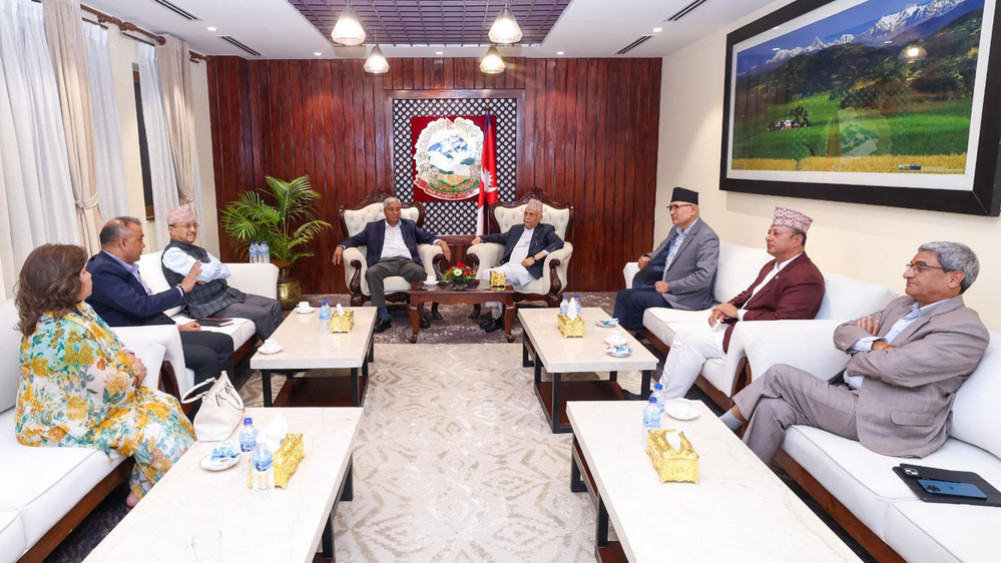
After UML filed an amendment in the National Assembly to remove the provision of two-year 'cooling off period' from the Civil Bill, Congress is suspicious, if UML does not reconsider, Congress is in favor of passing the bill together with the opposition parties.
We use Google Cloud Translation Services. Google requires we provide the following disclaimer relating to use of this service:
This service may contain translations powered by Google. Google disclaims all warranties related to the translations, expressed or implied, including any warranties of accuracy, reliability, and any implied warranties of merchantability, fitness for a particular purpose, and noninfringement.
The Prime Minister's insistence on moving the Land Bill, which has a lot of public concern and interest, on the 'fast track' and the UML's amendment proposal to remove the 'cooling off period' from the Civil Bill has started a fight between the ruling Congress and the UML.
Opposition parties, including the Congress, are adamant that the land bill should be taken to the parliamentary committee for discussion. But Prime Minister KP Sharma Oli is in favor of passing it through the 'fast track' without going to the parliamentary committee.
The proposal put by UML in the National Assembly to remove the provisions related to the 'cooling off period' in the Civil Bill has made the Congress most suspicious of the rift in the alliance.
The bill report was passed by the plenary committee with the provision of two-year 'cooling off period' from the state order and good governance committee. But after the bill was passed by the House of Representatives by adding a clause to deactivate the provision of 'cooling off period', the parliamentary special committee headed by MP Jeevan Pariyar is investigating to find out 'where and by whom did the cheating take place?'
 UML, led by the government itself, has registered an amendment proposal of UML to question the validity of the parliamentary committee's investigation. The ruling Congress is divided over this. If the UML withdraws from the two-year 'cooling off period' passed unanimously by the committee, the Congress has started an informal dialogue on the option of establishing the committee's report with the support of the opposition.
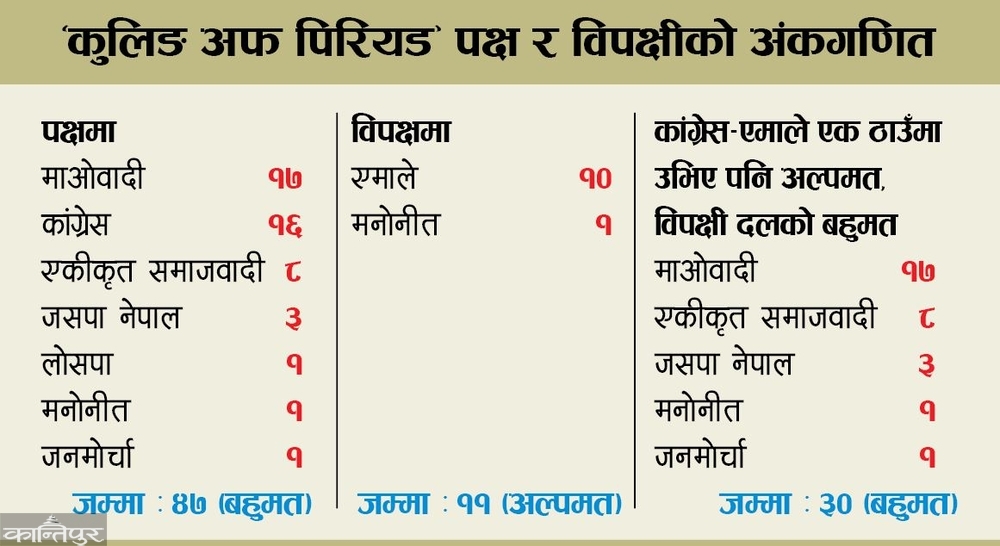
For some reason, even though the Congress stood in the place of the UML in the end, as the majority of opposition parties in the National Assembly, it does not seem possible to remove the 'cooling off period' and pass the bill. After JSP Nepal withdrew its support to the government on July 2, the government is in a minority in the National Assembly. In the 59-member National Assembly, only 28 MPs are in favor of the government, including 16 from Congress, 10 from UML, 1 from LOSPA and 1 from Nominee.
30 MPs are needed for a majority. In the National Assembly, the opposition front has 30 MPs including 17 from the Maoists, 8 from the United Socialist Party, 3 from Jaspa Nepal, 1 from Nominee and 1 from Jan Morcha. As there is no consensus between the Congress and the UML, there is a possibility that the resolution regarding the three-year 'cooling period' put forward by the Maoists will be passed. Jaspa Nepal President Upendra Yadav has said that they will support only if the government brings a good proposal.
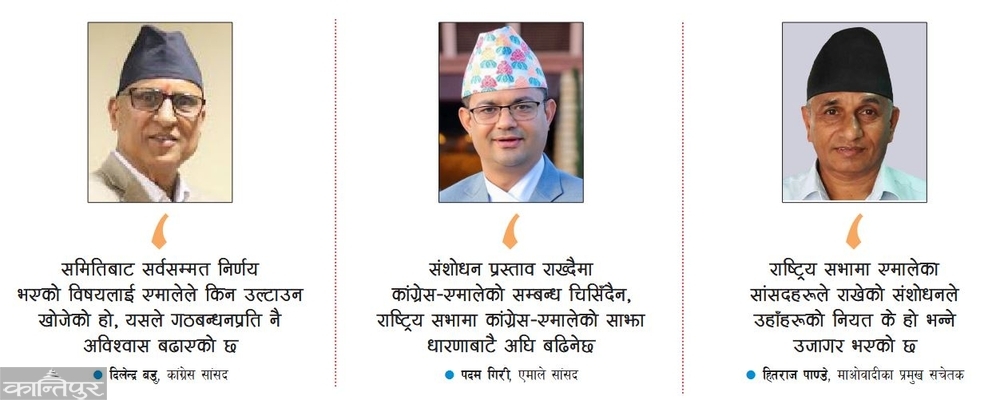
Maoist's Chief Whip Hitraj Pandey said that since the State Arrangements Committee agreed on a cooling off period of at least 2 years, efforts will be made to convince the parties including the Congress in the National Assembly to extend it by one more year. At the time of making the law in the Parliament, there was an agreement with all the parties including the Congress in the House of Representatives, there was an agreement with the UML, Congress, RSVP, RPPA, and the United Socialist Party. "Now in the National Assembly, the parties discuss the issue of cooling off period," said Pandey. "The amendment proposal put forward by the UML MPs in the National Assembly revealed how they view this bill." We have unanimously decided to request the National Assembly to correct the system of cooling off period in the meeting of the State Arrangements Committee on June 18. The MP of UML also spoke in favor of it, but now it is clear where the deception came from," he said.
In the National Assembly, Jaspa Nepal MP Mrigendra Kumar Singh said that for the time being, an amendment has been put in place to remove the loophole in the state system on the 'cooling off period.' There is a constitutional provision that even if rejected by the National Assembly, it can be sent for verification after repeated approval by the House of Representatives.
But the Congress leaders say that if the committee did not discuss it and if it was rejected in the National Assembly and passed again by the House of Representatives, the message would not be positive. UML has prepared to hold a discussion with all parties concerned before putting it on the agenda of the Parliament. However, Jaspa Nepal President Yadav is in favor of proceeding only after taking it to the parliamentary committee and consulting with experts.
There are amendments by half a dozen parliamentarians including two Congress chief ministers in the land bill. Maoists and Jaspa Nepal also have amendments. On June 25, the government put it on number three of the agenda of the parliament to be passed by the House of Representatives. After being removed from the agenda of the Parliament on that day due to the opposition of the Congress, the UML wants to proceed with the passage of the next meeting on July 7. In this regard, Prime Minister Oli has held several discussions with Congress President Sher Bahadur Deuba and Home Minister Ramesh Utkar. Also discussed is putting the amendment together on Monday.
 Since the 'loop hole' bill includes the right to sell and distribute vacant land that has been kept in the name of various companies including agricultural companies, but has not been used, the Congress has amended it with the demand that it should be clearly explained. He is of the opinion that land should be given to unorganized people only by scientific mapping. Congress General Minister Gagan Thapa and Bishwa Prakash Sharma have demanded that the current proposal should stop the way of re-mapping of forest and intermediate areas as well. They have demanded that the re-mapping should be carried out in a scientific way only in the affected areas.
has proposed an amendment to section 12 (g) of the original Act. By adding 12 (h) to the said section, it is mentioned that the restrictive phrase after sub-section 4 should be clearly interpreted from keeping the title on special provisions regarding exemption of limitation of real estate business. It is their proposal that the restrictive phrase should be made more clear so that the land in excess of the limit cannot be used for any purpose other than the purpose for which it was taken.
Similarly, there is a demand to amend 52 (b) of the Act as unorganized residents have been 'intruded'. There is a question as to why this 'word' has been inserted in the section other than that, since the provision of irregular residents is in section 52 (c).
There is also an amendment in the National Parks and Wildlife Protection Act 2029, saying that there should be more clarity in the provisions of the law that may be misused even when giving land to unorganized residents. Like them, Badu and other MPs of the Congress have also amended these sections. Even if forest and Bhutan have been marked on the land map where there are landless Dalits, squatters and unorganized residents, the current government bill has made provision for re-mapping and distributing them in the name of the government.
During the distribution of land, General Minister Thapa and Sharma have revealed the proposal to provide ownership of land only after scientifically analyzing the economic condition of landless Dalits, squatters and unorganized residents, the nature of the land, area, valuation, avad, period of tenure and whether there is a household in other urban areas.
Under the State Order and Good Governance Committee, the sub-committee led by MP Hridayram Thani unanimously passed the Authority Bill on 4th December, Prime Minister Oli, who has been stuck for 6 months, does not even want to discuss the Land Bill in the committee. But the UML is trying to convince the Congress with the plan to pass the land bill in the parliament meeting on July 7.
Minister of Land Management, Cooperatives and Poverty Alleviation Balram Adhikari and Chief Whip of UML Mahesh Bertaula came to the Congress parliamentary party on Monday for discussion on the issue of passing the bill through 'fast track'. A long discussion was held with the amenders including Chief Minister Thapa, Home Minister Writer, Chief Whip Shyam Kumar Ghimire, MP Dilendra Prasad Badu, who were also the amenders of the bill. During the discussion, the Minister Adhikari conveyed the message that the Congress General Ministers Thapa and Sharma's joint amendments can be accepted as well as other amendments made by the Congress. However, UML had a disagreement about taking it to the parliamentary committee.
Chief Minister Thapa reiterated that it would be appropriate to take the bill to the parliamentary committee as it has become an issue of public concern and interest. In the order given by the Supreme Court in the case of Giribandhu Tea Estate, it was mentioned that ``a sensitive issue like land is not only a matter of union'', Thapa argued that it should also be taken to the parliamentary committee for discussion with the state government. The UML minister argued that taking the bill to the parliamentary committee would take years and the land commission would not be able to work.
Congress MP Badu said the two bills have increased distrust within the ruling coalition. He said that the Congress was suspicious of the UML's amendment proposal to remove the 'cooling off period' and the stance that the land bill should not be taken up for discussion in the committee. Within the Congress, pressure is increasing on Speaker Deuba not to be more flexible on these two bills. Leader Shekhar Koirala, who is increasing the political race with the idea of finding an alternative to alliance with UML, is increasing pressure on Deuba saying that the party's stand on the Land and Civil Bill should not be compromised. The Congress leaders are also arguing that Koirala's efforts to change the alliance within the Congress will gain more strength if the UML does not reconsider its stance on these two bills.
UML leader Padam Giri said that the alliance will not be affected due to the differences of opinion seen in the discussion and amendment of the bill. "The Sovereign National Assembly is considering whether to maintain the cooling-off period or what to do. Various amendments have been made. I don't think the relationship with the Congress has soured over the amendment," said Giri. An amendment proposal has been filed stating that the period of two years should be removed. Congress has taken it as the official opinion of UML. "If not, UML should answer to the parliamentary committee, parliament and the general public," said Badu.
The other MPs from UML who registered the amendment are Sonam Gelzen Sherpa, Sumitra BC, Indira Devi Gautam, Rukmani Koirala and Anjan Shakya, the MP nominated by the UML party president. In their amendment proposal, it is mentioned that the provision of 'cooling off period' of section 82 (4) of the bill to be added by the State Arrangements Committee of the House of Representatives should be removed.
The largest party, Maoist, which is also the main opposition in the National Assembly, has filed an amendment proposal to keep the 'cooling off period' for 3 years. Maoist whip Gangakumari Belbase, parliamentarians Krishna Prasad Adhikari, Renu Chand and Manrupa Sharma have also proposed that the 'cooling off period' should be kept for three years and sub-section 5 of Article 82 should be removed to make the provision ineffective. They have also demanded that legal action should be taken against making the 'cooling off period' system ineffective in the House of Representatives.
Congress chief whip Krishna Bahadur Rokaya and MP Anand Prasad Dhungana have filed an amendment proposal to keep the 'cooling off period' for two years in the National Assembly. JSP Nepal's Mrigendra Kumar Singh, Mohammad Khalid and Pooja Choudhary have also filed an amendment proposal that the 'cooling off period' should be two years.