We use Google Cloud Translation Services. Google requires we provide the following disclaimer relating to use of this service:
This service may contain translations powered by Google. Google disclaims all warranties related to the translations, expressed or implied, including any warranties of accuracy, reliability, and any implied warranties of merchantability, fitness for a particular purpose, and noninfringement.
More than 50 billion rupees go abroad from Nepal every year for cooking gas import alone. According to Nepal Oil Corporation, 25 lakh 1 thousand 800 tons of gas worth 2 trillion 64 billion rupees has been imported in 5 years. In the meantime, it has been confirmed that there is gas storage in Dailekh's aquifers, which has raised hopes that gas imports can be replaced and even exported.
Compared to 2078/79, gas import decreased in 2079/80 but increased in other years, according to the corporation. "Gas use has expanded to villages, and along with the increase in consumption, imports are also increasing," says Chandika Prasad Bhatt, executive director of the corporation, "In 5 years, 2 trillion 64 billion rupees have been spent on gas import." 5 lakh 14 thousand 717 tons of gas was imported in 2079/80. But due to the increase in the price of raw materials in the international market, the amount of gas import has increased to 58.1 billion. Similarly, in 2078/79, 536 million 22 tons of gas worth 65 billion 5 million were imported.
According to Manoj Thakur, spokesperson of the corporation, cooking gas is consumed 48,500,000 tons per month. After the corporation issues a 'product delivery order', the gas industry imports from Paradip, Barauni, Haldia, Mathura refineries in India. It is also imported from India's Durgapur depot.
Industrialists transport 5/7 of India's transporters through bullets. At present, around 700 Indian bullets are transporting gas. Indian shippers take in more than Rs 6 billion a year for transporting gas. This sequence has been going on for about 44 years.
After billions of rupees are withdrawn from gas transportation every year, the corporation has also planned to build an LP gas pipeline in Motihari-Pathalaiya-Sarlahi. Indian Oil Corporations Limited (IOC) has started the detailed engineering survey and submitted the report. The corporation says that transportation costs will be saved when there is a pipeline.
1 billion 120 million cubic meters of methane gas in Dailekh, when will it be mined?
corporation, also says that methane can be processed and used as cooking gas. He said that a refinery plant should be built for that. "Gas is not to be used as such, it has to be purified by removing various mixtures, the cost is also according to the mixture in the gas," says Bhatt, "After receiving a detailed report, a processing plant can be set up and put to use." According to the corporation, LP gas is a gas with low pressure. The pressure of methane gas is high. He says that
has some options. "It can be supplied through a pipeline or can be sent to the market by making cylinders that can withstand high pressure, it can also be consumed for industrial purposes," he says, "The government is planning to build a chemical fertilizer factory." Currently, more than 28 billion is being spent annually on the purchase of fertilizers. The best option is to run a fertilizer factory with methane gas.
Apart from these, cylinders can also be used for cooking. But he says that the cylinder will cost twice as much. This gas can be converted into cooking gas, but because of the high pressure, the cylinder is expensive. The government will proceed according to the modality. A detailed report should come for this.'
000
'Oil can also be found while digging'
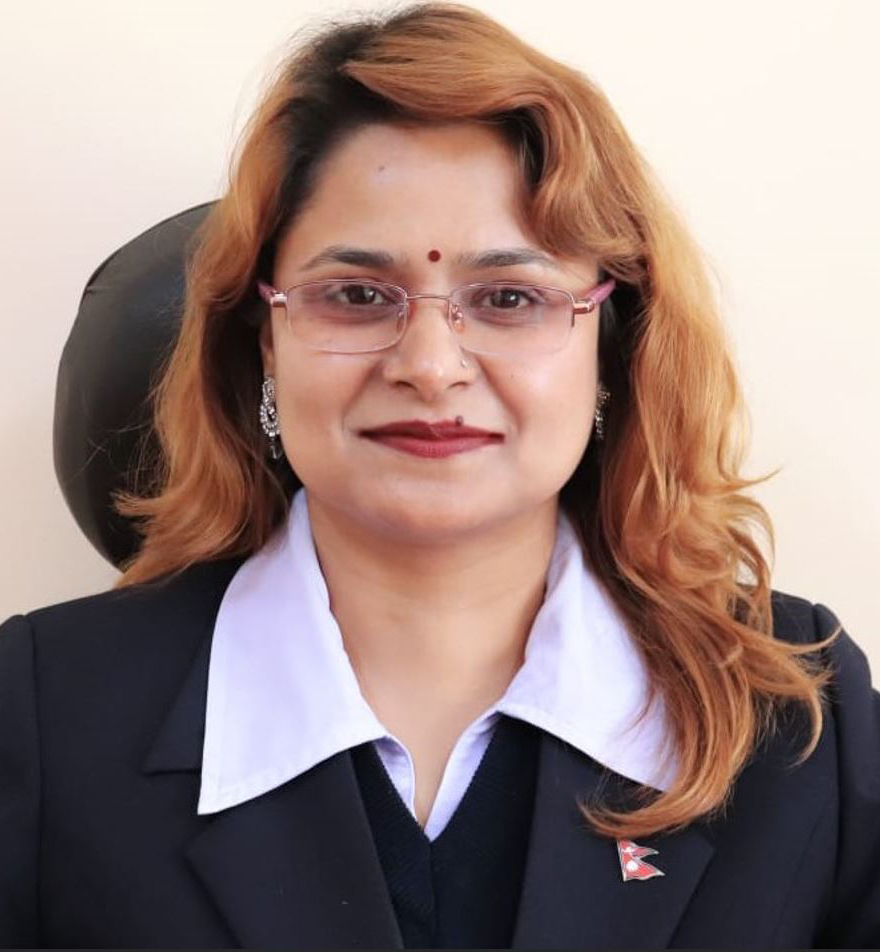
- Monika Jha, Director General, Mines and Geology Department
In 2044, the American oil company 'Sail' started research work including 'drilling' at a cost of about 8 million dollars, saying that there is gas in Morong's Bahuni. After drilling about 3,500 meters, the work was stopped because there was no oil. Only on Thursday, the report that a large amount of methane gas was found in Dailekh has been published. In this context, a conversation with Monika Jha, Director General of Mines and Geology Department:
How much methane gas was found in Dailekh?
The preliminary report says that there are 112 billion cubic meters of methane gas. It is said that the Chinese expert team and the company will give its detailed report by December. It is very happy to find this amount of natural gas.
How long do you have to wait for excavation?
After the detailed report comes out, further study is required. An economic feasibility study should also be done on post-production markets and consumption in the context of gas extraction. A project may have to proceed only after cost estimation and production calculations. In the event that Nepal cannot afford it, it may also have to take financial assistance from a country.
Has there been any study on whether it can displace petroleum imports after extraction and processing?
It has now been confirmed that there is natural gas based on about 4,000 meters of drilling. The quality of the gas is known only after the detailed report. Further studies also confirm whether petroleum products (oil) are present. If methane gas is more, the modality of its production and distribution system is different. If the amount of propane and butane is found in excess, we can also use LPG as cooking gas. The amount that is said to be found now is very encouraging. This will greatly help in boosting Nepal's economy.
What to do if the amount of methane is found to be high?
If the amount of methane is found to be high, the modality of 'bulk consumption' should be adopted. Industry can be established in Dailekh as it is not densely populated. Also electricity and alternative energy can be produced. If the amount of methane is high, it is difficult to fill it in small cylinders as cooking gas and deliver it from house to house. More can be said only after the sample and full report of all the areas are available. Oil may also be found during excavation.


