As climate change causes more suffering to marginalized and vulnerable communities, climate justice reduces the risks to human life: Anand Mohan Bhattarai, Former Judge, Supreme Court
We use Google Cloud Translation Services. Google requires we provide the following disclaimer relating to use of this service:
This service may contain translations powered by Google. Google disclaims all warranties related to the translations, expressed or implied, including any warranties of accuracy, reliability, and any implied warranties of merchantability, fitness for a particular purpose, and noninfringement.
In the 'Sagarmatha Samvad 2025', which aims to draw the attention of the world community to the effects of climate change in mountainous countries like Nepal, the topic of 'climate justice' did not receive much priority, although the discussion focused on climate change, mountains and the future of mankind.
The term 'climate justice', which is being used globally, is new to Nepali society as it is in many other places. What is climate justice? "This is environmental justice in a way," former judge of the Supreme Court said. Anandmohan Bhattarai says, "The approach of climate justice is global and it makes the benefits and losses from climate change accountable in an equitable way according to the involvement of countries." Bhattarai said that climate justice will reduce the risk to human life as climate change will cause more suffering especially to marginalized and vulnerable communities.
For that, the climate justice theory maintains that the burden of climate change and the responsibility of mitigation efforts are according to the capacity of the countries. It addresses equality, human rights, collective rights and historical responsibility through policy change and advocacy. According to the UN, climate justice prioritizes the rights of vulnerable communities, indigenous peoples and future generations.
There are mainly three basic documents of climate justice internationally. The first is the United Nations Framework Convention on Climate Change issued in 1992. It established a framework for global cooperation against climate change. The treaty aimed to stabilize greenhouse gas emissions and mitigate the effects of climate change. It created a policy of prioritizing vulnerable countries, laying the groundwork for climate justice.
The Kyoto Protocol, drafted in 1997, is another important document, which entered into force in 2005. It took legally binding action against climate change. It sets a binding target for developed countries to reduce greenhouse gas emissions by an average of 5 percent between 2008-2012 compared to 1990 levels. The Kyoto Protocol introduced innovative financial instruments such as carbon trading and the Clean Development Mechanism (CDM). It promoted the concept of sustainable development in developing countries.
Similarly, the 2015 Paris Agreement is the third and most recent document on climate justice. It has an ambitious goal of limiting global temperature rise to below 2°C (and if possible to 1.5°C). The agreement calls on all nations to submit emission reduction and adaptation strategies through voluntary national contributions.
The Paris Agreement places special emphasis on the principle of equity in climate justice, which was not present in previous documents. This principle focuses on strengthening the capacity of the weak and vulnerable to protect them from the impacts and harms of climate change.
Anandmohan Bhattarai, former judge
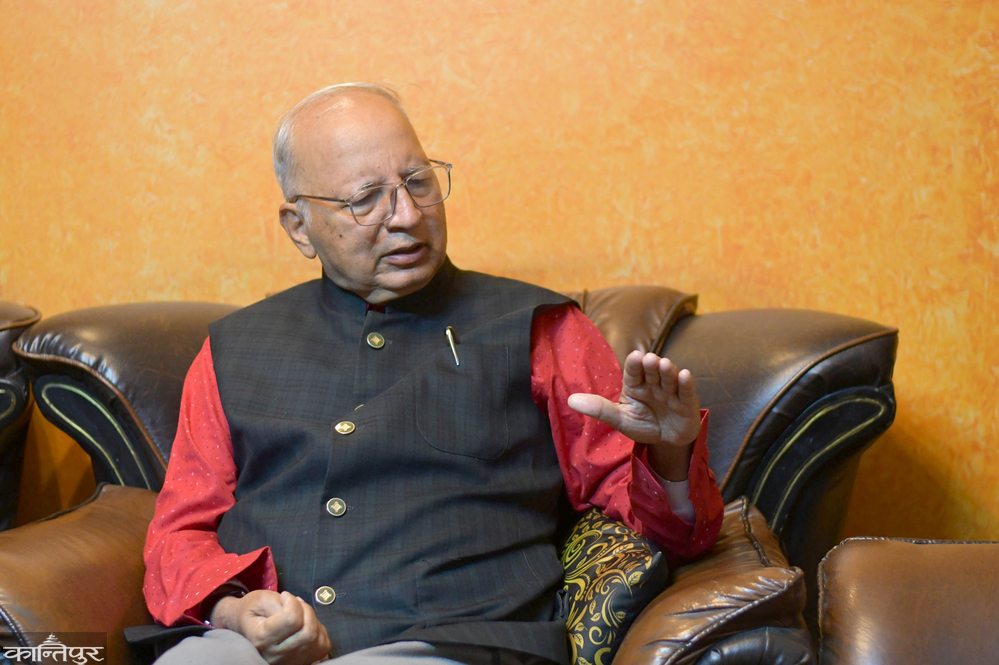 "These three international climate justice documents have a common principle, that is, countries have a common but separate responsibility to protect the environment," said Bhattarai, "this means that the responsibility of the countries that emit carbon to increase the effect of the greenhouse is different from that of the countries that do not emit, but they both have the responsibility to prevent it." It also emphasizes the fact that there are differences. Bhattarai said that Nepal is between the first and third among the world's three biggest polluters, China, America and India, and although it contributes very little to pollution, it is a country that has been greatly affected by the effects of pollution, so it is necessary to raise the issue of climate justice and apply it to the structures within the country as well.
In particular, Nepal's mountains are rapidly melting due to rising global temperatures and Nepal is trying to put it on international forums. This effort of Nepal is related to the global impact of climate justice. The principle of climate justice, developed on the basis of international practice and international documents, also provides the right to help countries that are affected by pollution without being weak or polluting.
In recent years, judgments and orders passed by many courts around the world in favor of climate justice have contributed to its theory formation. The judgment of 'Urgenda vs. Government of the Netherlands' in 2015 is considered to be leading in this matter. In 2013, the Urgendo Foundation and 886 Dutch citizens filed a lawsuit against the Dutch government, claiming that it had violated its citizens' human rights by not taking enough steps to stop climate change.
In 2015, the court ruled in favor of the petitioner, ordering the government to cut emissions by 25 percent by 2020. Although the government appealed, the Court of Appeal in 2018 and the Supreme Court of the Netherlands on December 20, 2019 upheld this decision. The Supreme Court held that climate change poses a serious threat to human rights and that the government has a legal obligation to mitigate this risk.
This was the first such case in the world, which forced governments to cut emissions on the basis of human rights. The Court of Nepal has also made dozens of decisions on environmental protection inspired by this decision and the three principles of climate justice that Nepal is a party to. As a
, in the case of the Council of Ministers against Padma Bahadur Shrestha, the Supreme Court issued a decision in 2076 and issued a mandate to bring environmental laws separately considering all aspects of the Paris Agreement. As a result, separate chapters on climate change and hazardous wastes have been included in the amendment to the existing Environmental Protection Act.
Similarly, after the government introduced the policy of exporting gravel and sand from the Chure area in the budget speech of 2077, the Supreme Court ordered the government not to carry out any development work that would cause 'ecocide' i.e. general destruction of the environment.
"The courts of India and Pakistan have also made many such decisions, which have contributed to the development of the theory of climate justice," said Bhattarai, "Human rights cannot be protected if the climate is not healthy, that is why it is of great importance."

