Consent to appoint 60% teachers from internal competition and 40% from open competition
We use Google Cloud Translation Services. Google requires we provide the following disclaimer relating to use of this service:
This service may contain translations powered by Google. Google disclaims all warranties related to the translations, expressed or implied, including any warranties of accuracy, reliability, and any implied warranties of merchantability, fitness for a particular purpose, and noninfringement.
According to the agreement between the government and the Federation of Teachers, the parliamentary sub-committee has prepared a report addressing most of the issues. No agreement has been reached regarding the operation of private schools and early childhood development classes (ECD).
The sub-committee has an agenda of submitting the quarterly discussion report to the committee on Sunday, keeping the topics that are not agreed upon.
It has been agreed that there will be no SEE exam, no district education office, 60 percent of teachers will be appointed from internal competition and 40 percent will be appointed from open competition, principals will be appointed through competition from the state and private schools will be regulated on scholarships.
Similarly, it has been decided that the transfer of teachers will be done only in 5 to 7 years, that there will be 2 specific categories of teachers in each province, that the ranks of school employees will be maintained and that teachers will be promoted periodically.
The committee formed an 11-member sub-committee on March 8 under the coordination of MP Chabilal Vishwakarma to discuss the school education bill quickly. The sub-committee started weekly discussions from 18 March.
The deadline for submitting the report was set within 35 days from the start of quarterly discussions. According to Vishwakarma, the sub-committee held 39 meetings in 30 days and discussed the bill. A 10-day deadline was extended to the sub-committee to write a report. The sub-committee said that the writing of the report was completed on Friday.
MPs say that the matter of private schools and ECD operations will be decided in the committee. In the bill, it is mentioned that private schools should be operated under the company model in the current state. The ruling and competing MPs who amended the bill have been saying that it should be taken to a non-profit model (guthi) after setting a certain period.
The MP participating in the discussion says that the government has not come up with a clear opinion on this matter and there is a difference of opinion among the MPs on how many years it will be taken to Guthi.
'There is a provision in the bill not to force private individuals to go to Guthi, some MPs are in favor of continuing the same provision,' says one MP, 'Some have taken the stand that they should be transferred to non-profit (Guthi) after a certain year.'
During the discussion, the MPs pointed out that there is a provision of the Medical Education Act to take the private medical college to a non-profit system for a period of 10 years. Some parliamentarians argued that private institutions opened in the company model should not be taken to Guthi, while some insisted that leaving private schools in the current state would increase the enrollment of private schools. The
bill has completely banned the establishment of private schools in the company model. The member of the sub-committee says that the government has not come up with a clear view on keeping the ECD class within the school structure and making it two years. The parliamentarians are unanimous in making ECD two years to be the same in private and public schools. The Ministry of Education is not ready to say that ECD within the school structure and making it two years will increase the expenditure burden on the government.
"The parliamentarians have almost agreed to make arrangements to enroll in ECD in 4 years and to enroll in class 1 only after completion of 6 years," says one of the parliamentarians. Private school owners who have been conducting pre-primary classes under different names for 3 years also do not agree to make the same two years. They are also dissatisfied with the arrangement of going to Guthi. In
sub-committee, since the school level is Class 12, it has been agreed that the SEE examination of Class 10 will not be conducted at the national level. Another MP said that the school will conduct the class 10 exam. According to the agreement in the bill, there will be no district education office. Some MPs filed amendments saying that they should keep the office. In the bill, one of the complicated issues of temporary and relief teacher management has also been resolved.
It has been arranged that 60 percent of teachers will be appointed through internal competition and 40 percent through open recruitment. The government had agreed with the Teachers Federation to make 75 percent of teachers permanent through internal methods. But the MPs concluded to make it permanent on the basis of 60 and 40 percent. MPs say that if you fail the
exam, you will be dismissed with facilities according to the prevailing rules including 'golden handshake'. There are 45 thousand teachers of relief/temporary nature. The said number of teachers will be converted into posts and internal competition will be conducted.
Similarly, the selection of principals in public schools will be done by the state-level teachers service commission. It has been arranged that teachers from all over the province will be recommended by a competition and appointed by the local level. "It is said that the principal will not be a subject teacher," says an MP.
The issue of regulating private schools by tightening scholarships has also been decided. Although there is a provision to provide 10% scholarship to private schools, it has not been implemented effectively. The bill also provides for transfer of teachers only after 5 years. It will be done at the local level in 5 years and will be transferred to the provincial level only after 7 years. There are 2 special category teachers in each province. Until now, there was only a system of teachers up to the first grade. Arrangements have also been made for periodical promotion of
teachers in 10 years. The bill has decided to fix the positions of school employees. Under the chairmanship of the parents, there will be a 7-member school management committee in the basic school and an 11-member school management committee in the secondary level. Provision has been made that the association may remain as an umbrella organization at the national level of management committees. There is a provision to continue the Teachers' Federation of Teachers.
In August 2080, 161 MPs registered 1,758 amendments to the bill registered in the House of Representatives. The Federation of Teachers had promised to pass the school education law after 29 days of road demonstrations in Kathmandu demanding the issuance of the School Education Act.
Committee Chairman Ammar Bahadur Thapa, Congress Whip Shyam Kumar Ghimire and UML Whip Mahesh Bertaula have committed to pass the bill by the House of Representatives within June 15. With their commitment, the movement was suspended after some demands related to the professional development of teachers were addressed by the cabinet.
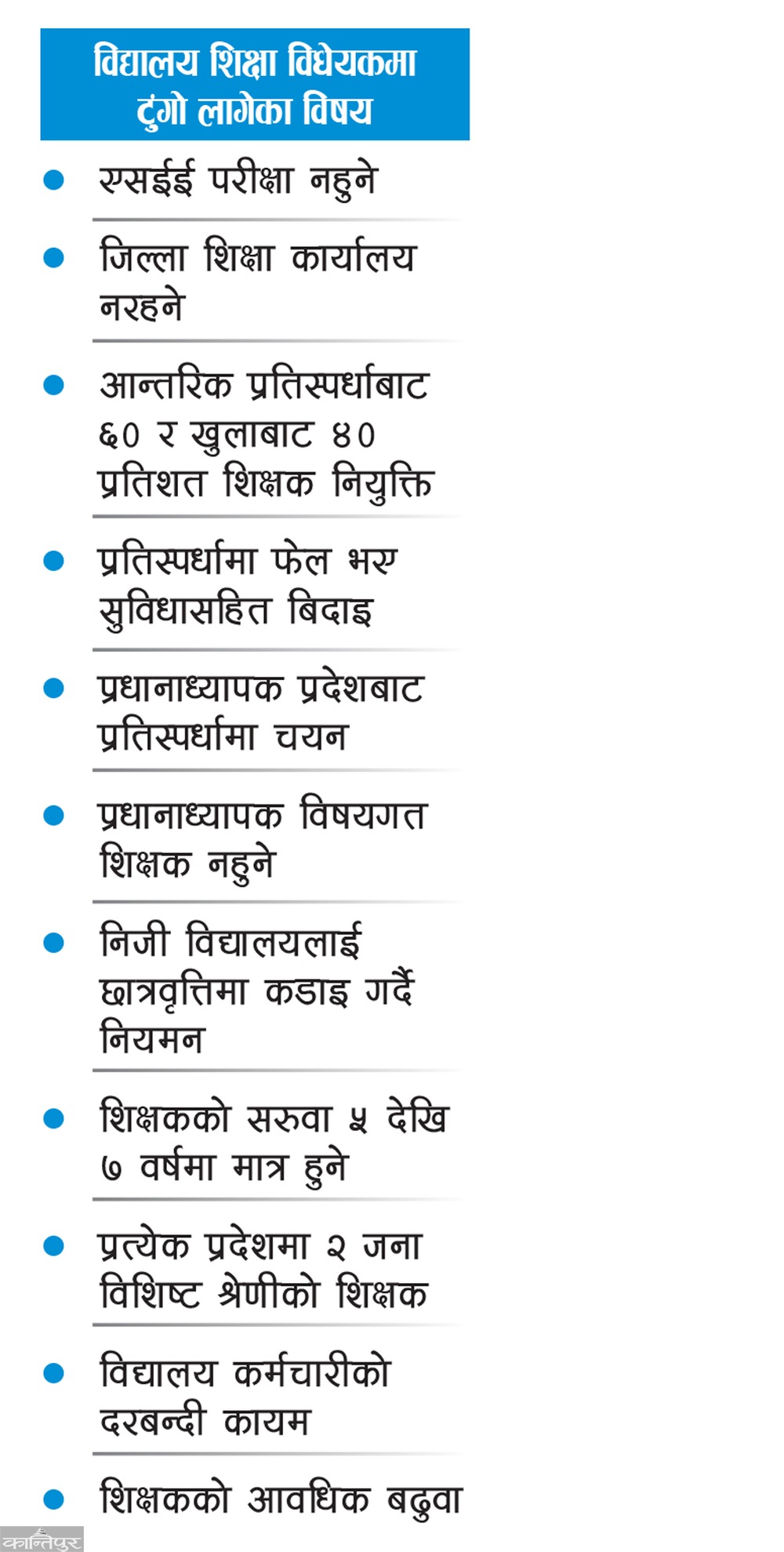
Matters resolved in the school education bill
- no SEE exam
- no district education office
- 60 percent of teachers appointed from internal competition and 40 percent from open competition
- farewell with benefits if they fail in the competition
- selection of principals in competition from the province
- principals will not be subject teachers
- regulation of private schools by tightening scholarships
- transfer of teachers will take place only in 5 to 7 years
- 2 special category teachers in each province
- School staff positions maintained
– teacher's periodical promotion

