The tunnel will be put into operation by October, preparing to levy a fee to cover the operating expenses
We use Google Cloud Translation Services. Google requires we provide the following disclaimer relating to use of this service:
This service may contain translations powered by Google. Google disclaims all warranties related to the translations, expressed or implied, including any warranties of accuracy, reliability, and any implied warranties of merchantability, fitness for a particular purpose, and noninfringement.
The government is ready to complete the construction of the Nagadhunga-Sisnekhola tunnel by October and start the vehicle operation. The process of determining vehicle fees has been started to collect about 35 crores annually required for operating the tunnel. The road department proposed the fee according to the cost of tunnel operation and sent it to the Ministry of Physical Infrastructure and Transport. The Ministry has sent the fee proposal to Road Board Nepal. The board has prepared to send the fees to the office of the Prime Minister and Council of Ministers by Thursday for approval.
Ganesh Bahadur KC, executive director of Road Board Nepal, said that the fee will be determined after the Cabinet approves it. "There was a discussion in the physical infrastructure ministry about the fees set by the road department," he said, "We will send the council of ministers by Thursday to approve the fees set by the department."
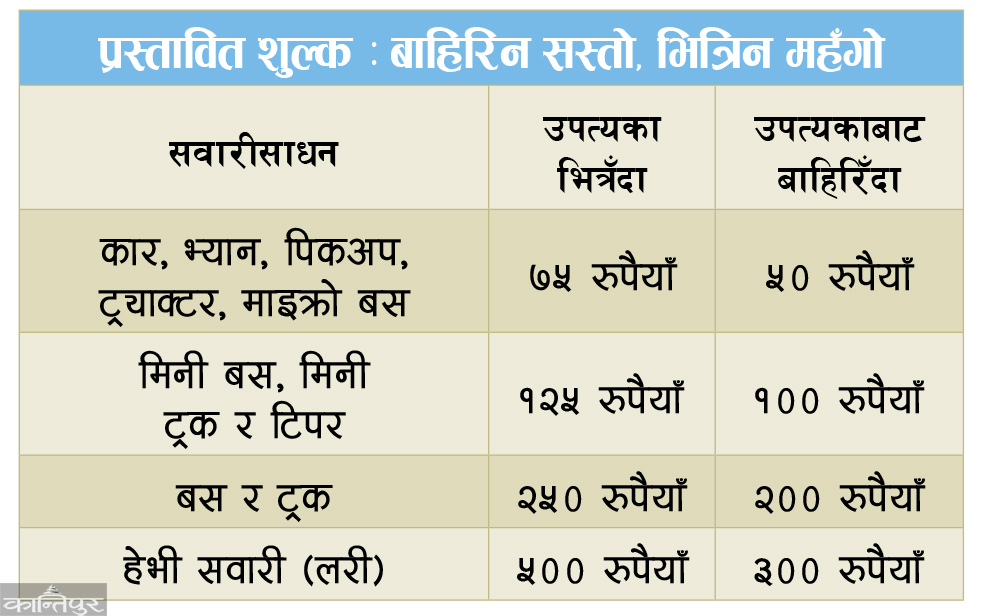
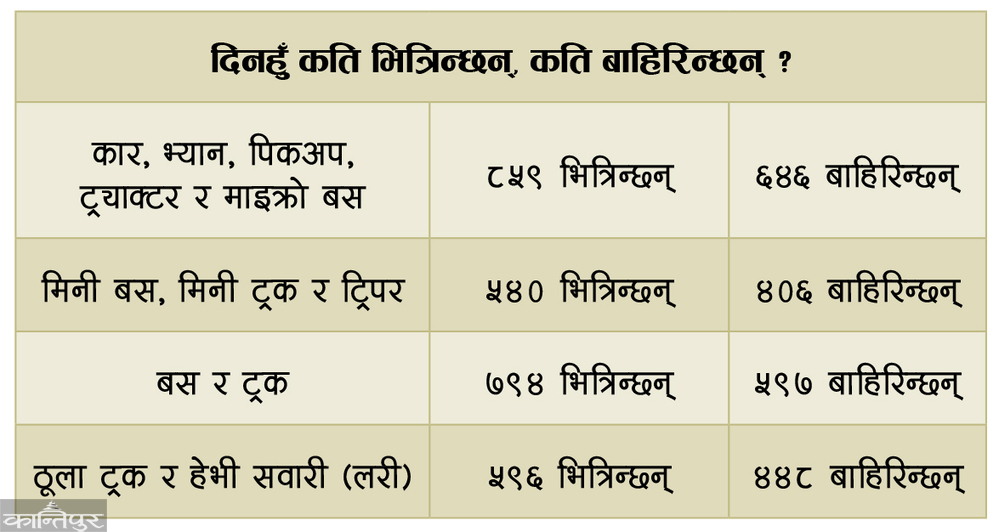
The fees sent by the ministry to the board are different depending on the vehicle. Cars, vans, pickups, tractors and microbuses are charged Rs 75 for entering the valley and Rs 50 for exiting. It is estimated that such vehicles will enter in the number of 859 and leave in the number of 646.
Mini buses, mini trucks and tippers will be charged Rs 125 when entering the valley and Rs 100 when leaving. It is estimated that these vehicles will enter the valley in the number of 540 and leave the valley in the number of 406.
Buses and trucks will be charged Rs 250 when entering the valley and Rs 200 when exiting. The project office estimates that 794 such vehicles will enter and 597 will exit. Big trucks and heavy vehicles (lorries) will have to pay a toll fee of 500 rupees when entering the valley through the tunnel and 300 rupees when exiting the valley.
The project estimates that there are 596 inbound and 448 outbound vehicles per day.
Currently, 60 percent of the vehicles traveling on the main highway use the tunnel, said Vijay Jaisi, head of the Development Assistance Implementation Division of the Road Department. We have fixed the toll fee to cover the maintenance and operation expenses of the tunnel. The fee will be approved by the Cabinet in a few days, he said. He says that when coming to Kathmandu via the main highway from Naubise, there is more uphill and there are more vehicles, so different fees are set for entry and exit.
According to the road department, a third party will be selected and entrusted with the operation of the tunnel. For this, the department has prepared "Guidelines for Procurement of Operation, Management and Maintenance Services of Public Infrastructure through Service Providers-2081" and sent it to the Ministry of Physical Infrastructure and Transport. "Now the material reaches the Public Procurement Monitoring Office, from that office it is sent to the office of the Prime Minister and the Council of Ministers, after it is approved by the Council of Ministers, it will be implemented," he said.
Nagadhunga-Sisnekhola Tunnel Traffic Operation Guide, 2081 has already been issued. According to the guidelines, pedestrians, two-wheelers, three-wheelers and non-motorized vehicles will not be allowed to enter the tunnel after the tunnel is operational. Vehicles carrying diesel, petrol, gas and highly flammable substances and explosives will also be prohibited in the tunnel.
It is said that vehicles larger than 18 meters in length or 2.5 meters in width cannot be driven inside the tunnel. Vehicles carrying loads exceeding the capacity prescribed by the Cargo Vehicle Load Regulation Guideline, 2074 and the Road Department and Transport Management Department guidelines are prohibited in the tunnel.
Work in police protection for months and days
The tunnel has been under police protection for a month. When the construction work was in the final stage, the residents of Tutipakha located in Chandragiri Municipality-2 stopped the work from March 3 to 30 last March saying that the project did not meet their demands. After repeatedly calling for talks, the project resumed the work that had been stopped under police protection through the District Administration Office, Kathmandu.
At this time, under police protection, the flyover, road, work inside the tunnel and the mountain improvement work at the mouth of the tunnel towards Dhading are going on in Balambu's Kisipdi. Sanjay Panthi, Senior Divisional Engineer of the Nagadhunga Tunnel Construction Project said that 90 percent of the construction work has been completed. "Even now, work is being done under the watch of the police, the Chandragiri municipality should coordinate to solve the problems of the locals," he said, "but the municipality has not called the locals."
Now the work of lighting, firefighting, ventilation and concrete road construction in the tunnel has reached its final stage. The work of connecting electricity to run the equipment placed inside the tunnel has started. Jaisi, the head of the Development Assistance Implementation Division of the Road Department, said that the work of 'testing commissioning' of the tunnel will be carried out from now on. He said that the work of connecting the toll plaza and the internet is still pending.
It is claimed that the project is working to bring the tunnel into operation by October 2082. The construction of the tunnel started on October 4, 2076 and was supposed to be completed within 42 months. But the work is not finished even after 66 months. The project claims that the completion of the project was delayed initially due to covid and later due to local obstacles. The road department has informed that the work has been delayed due to frequent obstructions by locals.
The project says that it will take 33 minutes to reach Balumbu from Sisnekhola via Nagadhunga road and 23 minutes from the exit. But after the tunnel is operational, the project has said that the KCPD will reach Balambu from Sisnekhola within 7 minutes. Since the project started, 3 underpasses, 4 box culverts, 1 overpass, 3 bridges have been constructed. From Kisipdi in Balambu to the entrance of the tunnel to Tutipakha, the 2.307 km two-lane road has been paved.
The main tunnel is 2,688 meters long and the emergency tunnel is 2,557 meters long. The total contract amount of the project is 22 billion rupees, which includes a concessional loan of 16 billion rupees from Japan and an investment of 6 billion rupees from the Government of Nepal. The Japanese company Hazma Endo Corporation is working on the construction of the tunnel.

