When Britain fanned the flames of Hindu-Muslim conflict by adopting a policy of 'divide and rule', it shattered the old identity of harmony and coexistence in the lead up to the 1947 war of independence.
We use Google Cloud Translation Services. Google requires we provide the following disclaimer relating to use of this service:
This service may contain translations powered by Google. Google disclaims all warranties related to the translations, expressed or implied, including any warranties of accuracy, reliability, and any implied warranties of merchantability, fitness for a particular purpose, and noninfringement.
India and Pakistan, the big countries of South Asia, are in conflict. The history of blood relations between them is as old as these two countries. The relationship between these two countries, divided by a common history, is filled with mistrust and revenge.
Before 1947, the territory known as India, Pakistan and Bangladesh in today's world was one. The territory under British colonial rule was geographically one country.
India itself was a colorful world, with ancient temples and centuries-old mosques standing side by side. Hindus and Muslims worshiping and praying in those temples and mosques and their culture was the identity of British India.
When Britain stoked the fire of Hindu-Muslim by adopting the policy of 'divide and rule', it shattered the old identity of harmony and coexistence towards the freedom struggle of 1947. Exhausted by World War II, Britain left the colony and returned from India. But freedom was not easy. The Indian National Congress, led by freedom struggle leaders like Mahatma Gandhi and Jawaharlal Nehru, dreamed of unity. But the Muslim League, led by Muhammad Ali Jinnah, envisioned a separate country.
At that time, the Muslim community accounted for a quarter of the total population of India. It was Jinnah who led the opinion that there is a need for a separate country because Hindu-majority countries are oppressed. In 1940, Jinnah said in a speech in Lahore, which is now in Pakistan, "Muslims are a nation by any definition, they must have their own homeland, their own territory and their own state."
Within seven years of that, i.e. on 3 June 1947, Britain announced that the Hindu-majority region would become India and the Muslim-majority northwest and eastern regions would become Pakistan. On that day, Jinnah said in the declaration meeting of the new country, 'We start from this basic principle that we are all citizens of one state, equal citizens.'
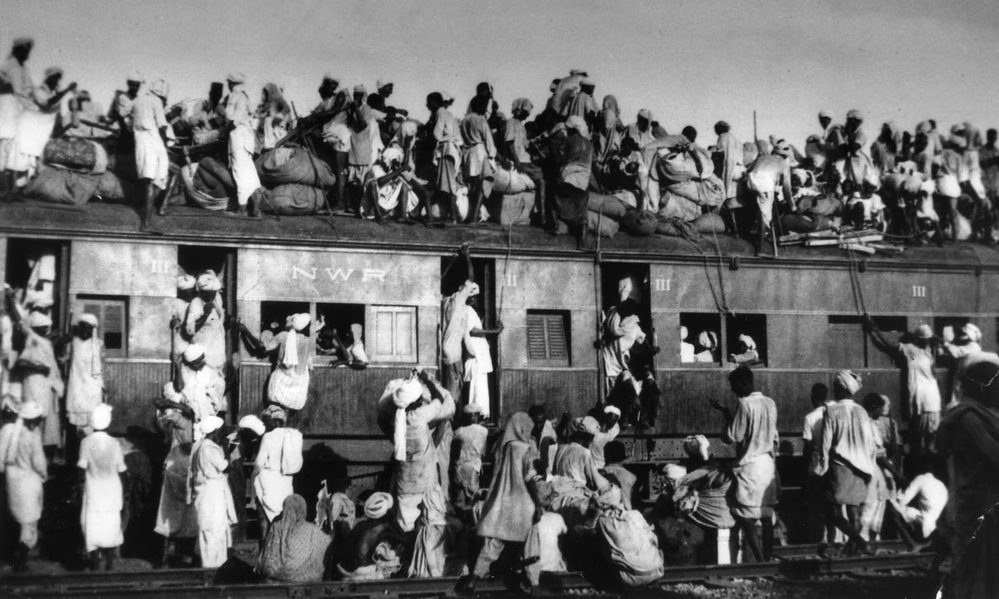
The next day India became independent. Nehru then proclaimed in Parliament, “At midnight, when the world sleeps, India will wake to life and freedom.” Freedom? It was bloodshed. A line bisected Punjab and Bengal. Hindus and Sikhs fled to India, Muslims fled to Pakistan. Mobs armed with knives and torches burned cities. Trains full of corpses came from India to Pakistan and from Pakistan to India. About 2 million people lost their lives in this incident alone, 15 million were displaced. This was the largest forced migration in history.
The heat and discord of this migration is still alive today somewhere in the relationship between the two countries. And Kashmir? A Muslim-majority kingdom with a Hindu king was on fire. Attacked by Pakistan-backed fighters, Raja Hari Singh allied with India. This led to the first war between the two countries from October 1947 to 1949.
The separation of India and Pakistan was not just separation, it was the beginning of generational enmity. Due to this enmity, India and Pakistan have fought four major wars so far. Just as every war brings bloodshed and destruction to human life, so did the lives of the citizens of India and Pakistan. Let's talk about these wars.
The Kashmir War of 1947-48 was the first manifestation of mutual distrust. Over the fate of Kashmir, the Indian and Pakistani armies fired at each other on the mountain peaks. Nehru roared in the Indian Parliament, 'We will not tolerate an attack on our land.' And, to maintain peace in Kashmir, a line of control i.e. 'Line of Control' (LoC) was drawn. Accordingly, India got two-thirds of the territory of Kashmir, and Pakistan got the rest. The dispute remained with you. About 5 thousand people lost their lives in that war.
After 16 years in 1965, war broke out between India and Pakistan. This war was a risky bet for both countries. Pakistan sent fighters to foment insurgency in Kashmir. In response Indian tanks raced into Punjab, jets roared across the sky. Nehru's successor, Lal Bahadur Shastri, addressed the nation and said, "India will answer a bullet with a bullet and we will be victorious." On the other hand, the then President of Pakistan, Ayub Khan, warned, "Our army will trample the dead bodies of the enemy and protect our sacred soil." A month later, a UN-initiated ceasefire was reached, by which time 7,000 people had died. The war had destroyed the economy of both countries.
Another war in 1971 shook the world. Because it gave birth to a new country – Bangladesh. India was adamant that there should be a separate country for Bangla speakers. In the same initiative, Indian Prime Minister Indira Gandhi said on December 6, 1971 in Parliament about Bangla speakers, "We have no quarrel with the people of Pakistan, but we cannot remain silent on the pain of millions." Because Pakistan was born in 1947 with two wings – West Pakistan (today's Pakistan) and East Pakistan (today's Bangladesh). They were separated by 1,600 kilometers of Indian land. East Pakistan was dominated by Bengali speakers who were controlled by the language, economy and governance of West Pakistan.
Although they are Muslims, the Bangla speakers claimed that they belong to a different country and a different identity because they belong to a different language and land. It became more pronounced in the 1970s. Sheikh Mujibur Rahman's Awami League won the elections in Bangladesh but was not given power.
On 25 March 1971, the Pakistani army launched 'Operation Searchlight' and started violence against the Bangla speakers. 3 million Bangla speakers were killed in it, 10 million citizens became refugees to India. Mujibur gave a message before his arrest, 'This may be my last message. From today Bangladesh is independent. I call on the people - resist the attack.'
India's Indira Gandhi saw an opportunity. She trained the Bengali rebel Mukti Bahini. On 3 December 1971, Pakistan dropped a bomb on an Indian air base. Gandhi gave a message to the countrymen, "This war has been imposed on us, but it is also a war of justice." Pakistani President General Yahya Khan replied, "We will fight until the last man lives."
Around 90,000 Pakistani soldiers surrendered to India in the middle of the war. This turned out to be a major setback for Pakistan. Finally, on 16 December 1971, Bangladesh was born. After the partition of Pakistan, the map of South Asia changed. The new country, Bangladesh, became India's friend and continued to give shocks to Pakistan. India became the mighty tiger of South Asia. But that war fueled Pakistan's anger toward the nuclear race.
In 1999, the Kargil war broke out between India and Pakistan. It shocked the whole world. Pakistani fighters captured India's Kargil hills. India put out the fire and took back its territory. The then Prime Minister Atal Bihari Vajpayee told the countrymen, "We will not yield, our army will chase the intruders." The previous year in 1998, both countries had conducted nuclear tests. The threat of using deadly weapons in war was deep.
One war after another made the flame of enmity between the two countries more intense. Both countries spend billions of rupees on defense. Pakistan spends 4 percent of GDP on defense and India 2.5 percent. Meanwhile, schools and hospitals in both countries need major improvements.
There was no major war after 1971 but the fire never went out. The Kargil war of 1999 was close to a major threat. Even after that, small battles are happening regularly along the LoC. In 2001, there was a terrorist attack on the Parliament of India. The then Prime Minister Atal Bihari Vajpayee, blaming it on Pakistan-based groups, warned, 'This is a war against terrorism, we will root it out.' Millions of soldiers from both countries were stationed on the border, but skilful diplomacy averted war.
In 2019, a suicide bomb blast in Kashmir's Pulwama killed 40 Indian soldiers. Then Indian Prime Minister Narendra Modi's response was, 'The blood of our martyrs will not be wasted.' Pakistan shot down an Indian jet. Pakistani Prime Minister Imran Khan said on television, "Let's avoid miscalculation, let's find a way of peace." His restrained expression reduced the fear of war, but with great difficulty.
On April 22, a terrorist attack took place in Pahalgam, Kashmir, in which 25 Indians and a Nepali tourist lost their lives. After that, Indian Prime Minister Modi said in the Parliament, "We will chase these terrorists from any corner of the earth."
Two weeks after the Pahalgam incident, on Wednesday morning, India launched "Operation Sindoor" and attacked Pakistan. In the middle of the night after the Indian missile fell on the Kashmiri territory, Pakistan responded, 'This is an act of war and Pakistan will not yield.' Now the 'LoC' has become a war zone, where guns roar and soldiers parade each other. Pakistan's Defense Minister Khawaja Asif told the BBC, "We haven't done anything yet. When Pakistan attacks, everyone will know.'
In the meantime, India canceled the Indus Water Treaty and closed the 'lifeline' of Pakistan's water. The abrogation of the Indus Treaty is an ax in Pakistan's heart because the water that flows through it is the lifeblood of its agriculture.
Indian Prime Minister Modi is under pressure from Hindu nationalists to avenge blood with blood. On the other hand, there is one type of analysis that between the weak economy and instability forces Pakistan's army to seek unity in anti-India slogans, while the other type believes that with Chinese support, it will attack India.
As both of them have nuclear weapons, there is a danger of causing a major tragedy if the matter escalates. Pakistan with a weak conventional military can play the nuclear card. A war on the other hand could destroy India's world trade. There is also a danger that America and China can fight a proxy war with India and Pakistan at such a time. Currently, there is no diplomatic contact between these two countries. There is a storm of anger on both sides. And, a small mistake in one of the two can lead to a huge disaster.
Do they return from the war front? If we look at history, we can see that the crises of 2001 and 2019 were averted by diplomatic skills. Can turn now. Restoration of the Indus Treaty can be the first step for that. But, it takes a miracle to happen.
Both India and Pakistan have a common root. The unwavering hatred that has grown over it has spread panic at the moment. If this fire is not extinguished by trade, negotiation or understanding, the peace of South Asia, which is everyone's concern, will soon be more disturbed. Small skirmishes continue between India and Pakistan, and occasionally they fan the flames of hostility. That's what happened now.
India calls Pakistan a hotbed of terrorism. Pakistan accuses India of oppressing Muslims in Kashmir. Especially after the autonomy of Kashmir was taken away in 2019, this allegation is heard more. Thousands of soldiers and civilians have been killed in Kashmir so far. The economy is bleeding. And, there is a very real risk of a nuclear threat. Studies say – India-Pakistan war could kill 50 million people, cause worldwide starvation. This is not just a regional conflict, it is a global conflict.
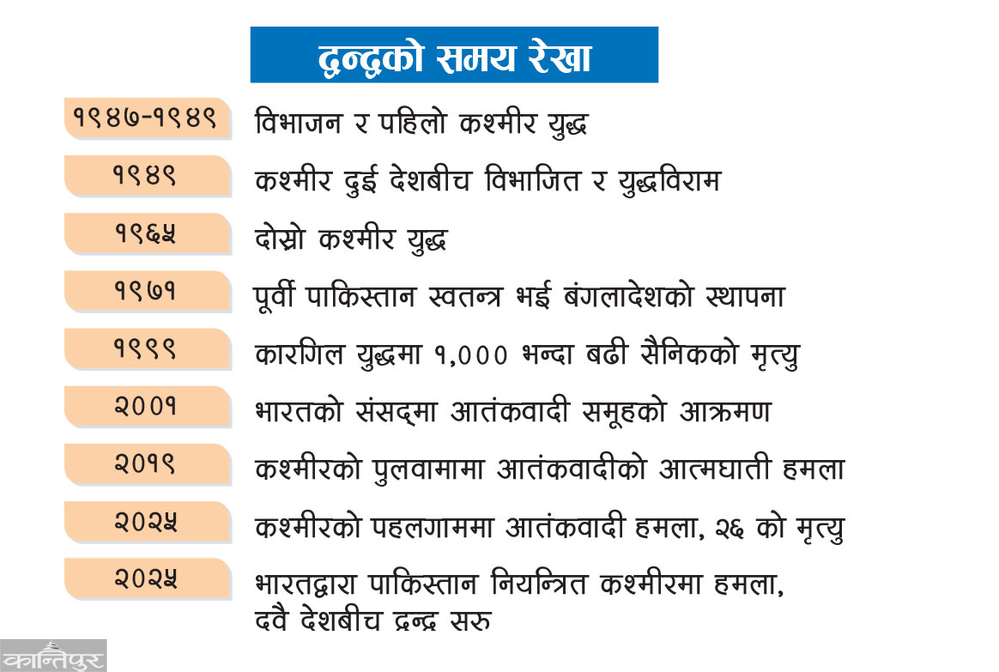
conflict timeline
1947-1949 : Partition and First Kashmir War
1949 : Kashmir divided between two countries and ceasefire
1965 : Second Kashmir War
1971 : Independence of East Pakistan and establishment of Bangladesh
1999 : More than 1,000 soldiers died in the Kargil War
2001 : Terrorist attack on Indian Parliament 2019 : Terrorist suicide attack in Kashmir's Pulwama
2025: Terrorist attack in Pahalgam, Kashmir, 26 killed

