Malnourished children are deprived of nutrients, essential medicines like vitamin A and additional nutrients.
We use Google Cloud Translation Services. Google requires we provide the following disclaimer relating to use of this service:
This service may contain translations powered by Google. Google disclaims all warranties related to the translations, expressed or implied, including any warranties of accuracy, reliability, and any implied warranties of merchantability, fitness for a particular purpose, and noninfringement.
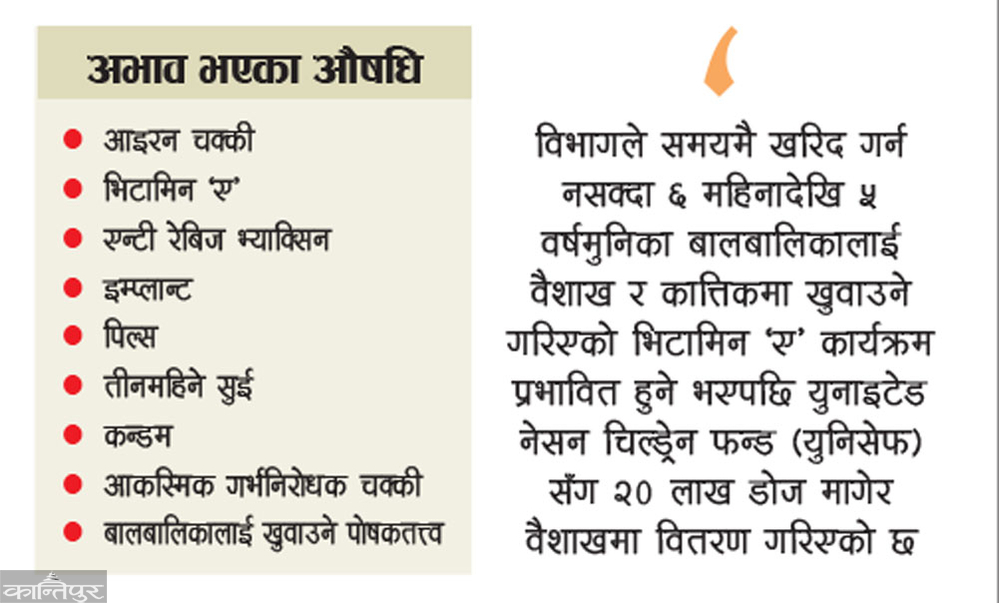
Controversy in the procurement process has led to shortages of iron pills, nutritional supplements for malnourished children, essential medicines like vitamin A and additional nutrients across the country. Temporary means of family planning including pills, anti-rabies vaccine have also reached a situation of shortage.
The process was stopped due to a dispute when the Department of Health Services tendered for the purchase of medicines.
Since the vitamin 'A' program, which is given to children under the age of 6 months to 5 years in Baisakh and October, will be affected due to the department not being able to purchase it on time, two million doses have been requested from the United Nations Children's Fund (UNICEF) and distributed in Baisakh. These drugs are among the 98 types of drugs distributed by the government for free.
When the Department of Health Services tenders for the purchase of medicines, sometimes the National Conditional Center gives instructions to stop it, sometimes a complaint is filed with the Commission for Investigation of Abuse of Authority. Sometimes, only one company tries to get the contract at a price higher than the tender amount due to the collusion of the contractor.
In the recent tender for the purchase of nutrients to feed malnourished children, Revachi International Company was awarded only one contract. The company increased the contract amount by 40 percent. The Health Service Department had canceled the contract saying it would cause a dispute.
Dr. Vivekalal Karna, Head of the Family Welfare Division of the Department of Health Services, says that due to the inability to distribute nutrients to malnourished children in time, it is necessary to think of an alternative solution. "We only need to manage the budget and provide technical support to purchase medicine," he says, "The work of purchasing belongs to the management division under the department."
Dr. Pawanjung Rayamjhi, director of the management division of the health service department, says that the procurement process is long and complicated. "Sometimes the contractor submits a tender for an amount higher than the market price, so they cannot accept the contract," he said. "We are making an agreement soon for the purchase of temporary family planning tools like condoms and anti-rabies vaccine," he said, "we are in the process of tendering for the purchase of three-month needles." The Ministry of Finance will spend 130 million rupees in the current financial year to purchase anti-rabies vaccine, 41 million rupees for the purchase of nutrients, 767 million rupees for the purchase of temporary family planning devices, implants, food pills, three-month needles, condoms, emergency contraceptive pills, and iron. About 3 crore rupees to buy pills separated.
Currently, due to the lack of iron pills in government health institutions in the Far West, women who come for prenatal check-up are forced to return disappointed, while in Sarlahi, due to the lack of free rabies vaccine, local residents have to pay 650 at a private clinic.
According to gynecologists, iron pills must be taken from the fourth month of pregnancy to one and a half months after delivery. It improves the growth and development of the fetus. Iron pills are given to girls in the age group of 10 to 19 years to reduce anemia in adolescents. Senior gynecologist Dr. According to Meera Hada, iron deficiency in pregnant women can increase the risk of miscarriage. "Blood deficiency can be anemia," she said.
According to the data of the Ministry of Health, 33 percent of children under 5 years of age are anemic. The government aims to reduce it by 10 percent by 2030. The rate of anemia in women of reproductive age is 25 percent in Nepal. The government aims to reach 10 percent by 2030 to achieve sustainable development goals.
According to the Department of Health Services, iron pills were given to 2.3 million teenage girls last year, while 65 to 70 percent of pregnant women in Nepal have taken iron pills. Leela Vikram Thapa, head of the nutrition branch of the family welfare division of the health service department, said that some provincial health supply centers are in the process of purchasing iron pills.
"Local level and hospitals can also purchase by estimating the previous balance and current needs," he said, "Two years ago, the department purchased when the provincial supply center delayed the purchase. That's why even now there is confusion at the local level that the department buys and sends them. However, the local level complains that the health service department only communicates at the last moment and not in time to purchase essential drugs.
Under the Epidemiology and Disease Control Division, the head of the Communicable Disease Control Branch, Dr. Hemant Ojha said that there is a lack of vaccine because the target person to be bitten by the dog is not known and the budget is not received as requested. Recently, everyone is aware of rabies. Earlier, only the risk group used to get this vaccine,' he said, 'Now, because all the people designated by the dog are vaccinated, its consumption is increasing.' According to Epidemiology and Disease Control Division, more than 100 people die from rabies every year. 95 percent of them get rabies from dog bites. The remaining rabies is transmitted by the bite of animals such as foxes, beasos, monkeys, and around 300,000 people across the country are affected by the bites of animals including dogs.

