We use Google Cloud Translation Services. Google requires we provide the following disclaimer relating to use of this service:
This service may contain translations powered by Google. Google disclaims all warranties related to the translations, expressed or implied, including any warranties of accuracy, reliability, and any implied warranties of merchantability, fitness for a particular purpose, and noninfringement.
Education Minister Vidya Bhattarai has resigned after differences with Prime Minister KP Sharma Oli on addressing the demands of the teachers' movement. The officials of the ministry said that he was forced to leave the post due to his dissatisfaction with Prime Minister Oli, despite showing health problems in his resignation letter.
Bhattarai resigned after the Prime Minister disagreed with the 7-point proposal submitted by Bhattarai to the Council of Ministers to meet the demand by communicating with the protesting teachers' federation representatives. She prepared a proposal to address the demands of the teachers' movement, including the passing of the school education bill. But after the meeting with Baluwatar failed to reach an agreement on Monday, she submitted her resignation to the Prime Minister and instead of going to the Minister's residence, she went directly to her private residence in Chabhil.
She was not even present at the cabinet meeting on Monday. "The prime minister was not positive about the teachers' movement and demands, and there was no effective discussion in the parliamentary committee about moving the bill forward," says an official of the Ministry of Education. "Symptoms of infection are starting to appear again, the problems of the ministry have not progressed positively, non-cooperation is increasing more than cooperation," said the official, "I decided to resign because I could not give time, the issues of dissatisfaction have already been made public."
Bhattarai has not given a formal response immediately after his resignation. In the Cabinet meeting held on Monday evening, the Prime Minister said that he had 'no information' about the resignation of the Minister of Education.
Bhattarai prepared a 7-point agenda after communicating with the representatives of the protesting teachers' federation for three weeks. She sent the proposal on Sunday to be passed by the Cabinet on Monday. However, the Prime Minister and the Finance Minister disagreed saying that if the teachers' demands were agreed upon, financial resources would not be provided.
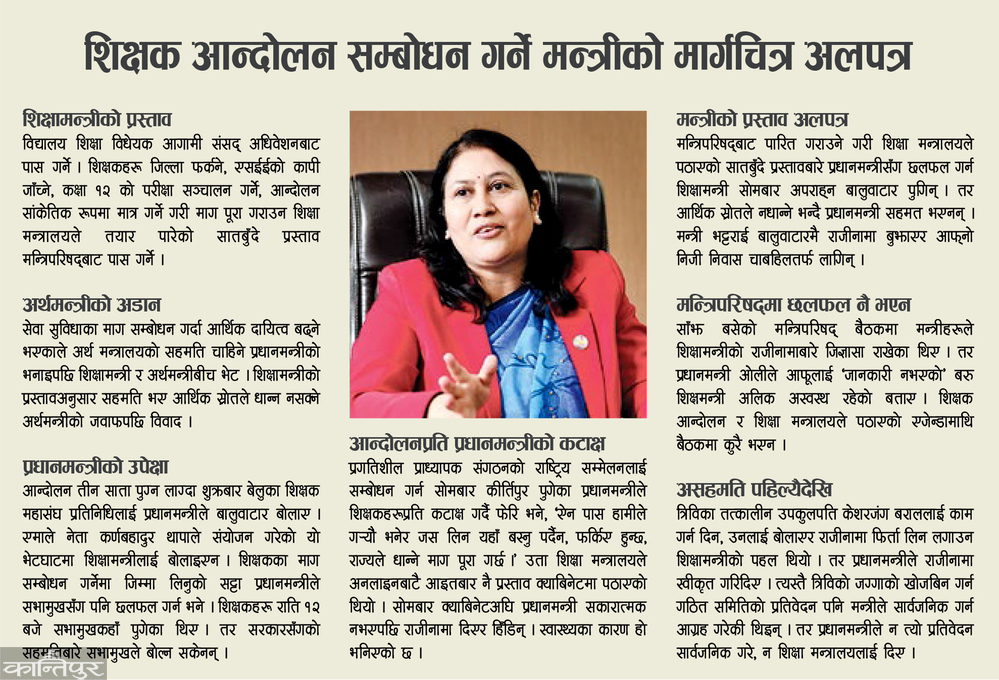
The Minister of Education proposed that decisions can be made by the Council of Ministers, such as maintaining the dignity of teachers, arranging the treatment of teachers in civil hospitals, providing temporary teachers with sick leave after retirement, providing minimum wages to child development teachers, providing teachers with civil servants or sixteen grades, and including them in social security. But the Prime Minister's Office and the Ministry of Finance are not positive about the proposal, said an education official. "The Ministry of Finance was not positive on the 7-point proposal. He called Minister Vishnu Paudel and told him that he would leave his post if Finance did not cooperate," said the official. "When the matter of teachers was discussed in the Prime Minister's Office, it was seen that the Minister of Education was oblivious," says the official. Prime Minister Oli, while addressing a conference of the UML-related progressive professors' organization, said on Monday that the state can only meet the demands of teachers who can afford it. He said to the teachers, 'There is no need to stay here (in protest) because we have passed the law, the state will only fulfill the demand.'
On the other hand, the teachers have been protesting for 20 days with the stance that they will return to school only if the school education law is promulgated. But the education and health sub-committee formed under the coordination of UML secretariat member and MP Chabilal Biswakarma has not been able to effectively proceed with the discussion on the bill. "The Minister of Education had promised to pass the bill in the last winter session, the session ended without a quarterly discussion, he was in a moral crisis," says an official of the ministry, "now even in the quarterly discussion of the bill, no agreement has been reached on the controversial and complicated points." It is becoming as if the meeting of the sub-committee is held only to show the teachers who are in the movement.'
Although the Council of Ministers called a Parliament meeting from May 12 to pass the School Education Bill, a member of the Secretariat said that Minister Bhattarai was angry because Speaker Devraj Ghimire analyzed it differently. "The Minister of Education's plan was to immediately take a decision from the Council of Ministers to suspend the movement and pass the bill," said the member.
Prime Minister Oli and Education Minister Bhattarai have different opinions on the complicated and controversial sections of the bill, including teachers and private school management. Education Minister Bhattarai was in favor of implementing the Compulsory and Free Education Act as per the provisions of the Constitution while increasing investment in public education. After becoming a minister on June 31, she has put forward the draft of the Compulsory and Free Education Act. He was of the opinion that private schools should be run on a welfare/non-profit concept as per the blueprint.
She had talked to Kantipur last December and also mentioned the 'modality' of making private schools more serviceable. "There is a commitment to move forward according to the constitution, if my commitment weakens, I will not sit in office," she said at that time. Demanding amendments to the bill, the ruling and opposition MPs are of the opinion that private schools should be made non-profit within 5 to 20 years. But Prime Minister Oli seems to be in favor of running private schools in the current profitable 'company model'. Addressing the Pabson Convention last February, the Prime Minister requested the administrators to increase investment saying that private schools would be run in a profitable manner.
Although the latest background teachers' movement and the Education Bill are seen as the reason for the resignation, the events confirm the growing differences between the Minister of Education and the Prime Minister. The higher officials of the Ministry of Education used to complain about the lack of coordination between the Prime Minister and the Minister of Education in informal discussions.
Territorial University Vice Chancellor Kesharjung Baral submitted his resignation on March 15. Education Minister Bhattarai was of the opinion that her resignation should be withdrawn. She even called Baral and requested him to withdraw his resignation. But the Prime Minister had a different opinion. The Prime Minister accepted Vice Chancellor Baral's resignation two weeks later. Even after accepting the resignation, the prime minister, who was the chancellor, did not immediately appoint the acting vice-chancellor. It took more 5 days for this.
Other events created in the background of Baral resigning from the post saying that there was non-cooperation and interference of the Prime Minister and Chancellor Oli were increasing the distance between the Minister of Education and the Prime Minister. Even though the report on land embezzlement of University was submitted to Prime Minister Oli, he has not made it public. No further investigation has been carried out based on the report. Education Minister Bhattarai was also dissatisfied with this matter.
In formal/informal dialogue, Education Minister Bhattarai used to complain about 'non-cooperation from her own side' when trying to do some reform work. Education Minister Bhattarai also disagreed with the appointment of Vice-Chancellor of Kathmandu University. He did not even sit in the recommendation committee for the appointment of the vice-chancellor. According to a source close to him, Bhattarai refused to sit in the committee after finding out that the ruling coalition had already decided who would be the vice-chancellor and formed a recommendation committee. One of the professors of the university commented, "In all the cases, the minister of education understood that the Prime Minister had interfered in the university."
In the first week of last August, after the officials of Teriyaki refused to go to the university showing insecurity, Education Minister Bhattarai publicly demanded security from the Home Minister.
It was also commented that there is a lack of coordination in the same cabinet. Employees of the Ministry of Education say that the prime minister has been pressuring him to appoint a member secretary of the University Grants Commission, even when he tried to transfer funds to rebuild the flood-damaged schools. A member of the Secretariat of the Minister of Education says, "The Minister of Education was fed up with the Prime Minister and the Ministry of Finance, and the support of his own staff organization was not visible." Pass the seven-point proposal prepared by the Ministry of Education to meet the demands of teachers to return to the district, check the copy of SEE, conduct class 12 exams, and make the protest symbolic only.
Finance Minister's stance
Meeting between the Minister of Education and the Minister of Finance after the Prime Minister's statement that the agreement of the Ministry of Finance is needed because the financial liability will increase when addressing the demand for service facilities. Controversy after the Finance Minister's reply that if the proposal of the Minister of Education is agreed, the financial resources will not support it.
Prime Minister's neglect
Prime Minister's sarcasm towards the movement
The Prime Minister, who arrived in Kirtipur on Monday to address the National Conference of the Progressive Teachers' Organization, took a dig at the teachers and said again, 'We don't have to stay here to get the law passed by us, we will return, the state will fulfill the demand.' The Ministry of Education sent the proposal to the cabinet online on Sunday itself. After the prime minister was not positive before the cabinet on Monday, she resigned and walked away. It is said to be due to health.
Minister's proposal stalled
Minister of Education reached Baluwatar on Monday afternoon to discuss with the Prime Minister about the seven-day proposal sent by the Ministry of Education to be passed by the Council of Ministers. But the Prime Minister did not agree saying that financial resources will not pay. Minister Bhattarai submitted his resignation in Baluwatar and went to his private residence Chabahil.
There was no discussion in the cabinet
In the cabinet meeting held together, the ministers raised questions about the resignation of the education minister. But Prime Minister Oli said that he had 'no information' but rather that the Education Minister was a little unwell. There was no discussion on the agenda sent by the teachers' movement and the Ministry of Education.
Disagreement from earlier
It was the initiative of the Education Minister to let the then Vice-Chancellor Kesharjung Baral to work, to call him and force him to withdraw his resignation. But the Prime Minister accepted the resignation. Similarly, the minister also requested to make public the report of the committee formed to search for the land of the University. But the Prime Minister neither made that report public nor gave it to the Ministry of Education.

