If the continuous hearing is not resolved before Wednesday, the hearing will not be held for two weeks as the Chief Justice will go on a foreign trip.
We use Google Cloud Translation Services. Google requires we provide the following disclaimer relating to use of this service:
This service may contain translations powered by Google. Google disclaims all warranties related to the translations, expressed or implied, including any warranties of accuracy, reliability, and any implied warranties of merchantability, fitness for a particular purpose, and noninfringement.
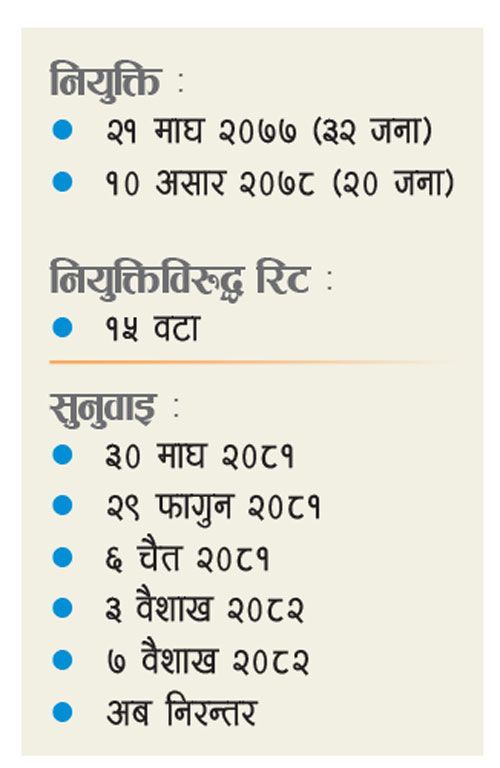
After four years, the Supreme Court has started the daily hearing on the petition regarding the appointment of 52 officials in the constitutional bodies by amending the Act through an ordinance. The hearing started by the five-member constitutional bench headed by Chief Justice Prakashman Singh Raut will continue until the writ is finally decided.
The Supreme Court started the hearing on 30th of January by putting together all the 15 writs filed against the appointment based on the Ordinance. In the hearing held on 29 February, 6 Chait and 3 Baisakh, more than two dozen advocates argued on behalf of the petitioner.
Attorney General Ramesh Badal delivered the entire argument on the first day of the continuing trial, which began on Sunday. He continued the counter debate on Sunday, which started half an hour before the end of the constitutional session on Wednesday.
Attorney General Badal presented an argument in favor of why the then Prime Minister KP Sharma Oli's decision as the Chairman of the Constitutional Council was right. "The then Speaker of the Assembly, Agni Sapkota, did not follow the constitution, did not fulfill his obligation to attend the meeting of the Constitutional Council and showed a fair role, so the government had to bring an ordinance and make a constitutional appointment to avert the constitutional crisis," he claimed.
In the court, Attorney General Badal said that the constitutional body which has been vacant for a long time cannot be appointed without bringing an ordinance to make it active. He claimed that since the government has complied with the obligation to bring the ordinance, the writ filed against it is in the process of being dismissed. After the appointment, the ordinance is no longer alive, it has been repeatedly declared by the Supreme Court that there is no need to debate about the dead ordinance. There are more than a dozen such examples,' he argued.
While hearing the petition filed by senior advocate Chandrakant Gyawali against the ordinance implementing local self-governance, the Supreme Court explained in 2061 that since the ordinance is dead, no further decision should be made. Similarly, in the writ filed by Praveenata Pokharel against the President's Office, the Supreme Court, while giving its verdict in 2071, explained that it is the right of the government to issue ordinances.
In the writ filed by Somkant Mainali in relation to the ordinance itself, the Supreme Court ruled in 2063 that there will be no legality test on the defunct law. Attorney General Badal presented this example. Spokesman of Attorney General's Office Suryaraj Dahal said that Monday's debate will also be big.
A team of 9 people including Badal has been deployed from the attorney general's office to defend the constitutional appointment. Since the writ petitioner took four days earlier, it is seen that it will take the same amount of time from the side of the government. However, a constitutional bench comprising of Chief Justice Raut along with Justices Sapna Pradhan Malla, Manoj Kumar Sharma, Kumar Chudal and Nahkul Subedi has directed both parties to manage the time on Sunday to have a thorough debate and not to repeat what has already been said.
An official of the Supreme Court said that although the bench tried to manage the time by giving the attorney general's team one day and the 52 officials of the constitutional bodies one day to spend the remaining day in counter argument, the debate did not proceed accordingly. After the Attorney General alone debated for three days, the remaining eight also took two to three more days, and the government made a strategy.
The 52 constitutional officers who have been made the opposition are fielding two to eight legal professionals in their defence. "It will take at least another four/five days to finish the debate on behalf of all of them," said senior advocate Lalit Basnet, who is preparing for the debate on behalf of some officials of the Public Service Commission and the Abuse of Authority Investigation Commission. After hiring many lawyers, it will take time.'
Basnet says that since this is one of the special cases, a large number of lawyers have gathered in the debate and it is natural that it will take time. "Previously, there was a lot of advocacy on the issue of dissolution of parliament, then this is a big issue in terms of the number of people speaking on both sides," he says. "As the court said, if everyone accepts the delay in the debate, this matter will be concluded this week," says one of the petitioners, advocate Omprakash Aryal, "If the case goes on for a long time, there is a possibility that manipulation and conspiracy will increase, which is not good." According to the Supreme Court, Chief Justice Raut is leaving for a two-week long European tour on Wednesday. First he will visit the Supreme Court of Turkey and then from there he will reach London on 15 Baisakh. He is scheduled to return home on 23 Baisakh. If this matter is not resolved before Wednesday, the next hearing will be held at least after 24 Baisakh.
The presence of 5 of the total 6 members of the council constitutes a quorum and the decision of 4 out of the quorum is a majority, so the leader of the then main opposition party Sher Bahadur Deuba and Speaker Agni Sapkota boycotted the meeting. The then Prime Minister KP Sharma Oli-led government brought an ordinance and recommended that the presence of the majority of members including the chairman would constitute a quorum.
Prime Minister Oli, who is also the chairman of the council, the then Chief Justice Cholendra Shamsher Jabara and the then Speaker of the National Assembly Ganesh Prasad Timilsina recommended the appointment to the Constitutional Council. In this way, a writ was filed in the Supreme Court saying that constitutional appointments cannot be made on the basis of ordinances.
The Constitutional Council chaired by Oli recommended 32 posts of 13 constitutional bodies on 30th November 2077, but due to the dissolution of Parliament on 5th December, the appointments were made on 21st January after 45 days without a parliamentary hearing. Similarly, 20 more posts were recommended for appointment on 26 Baisakh 2078. But since the parliament was dissolved on June 8, he was appointed on June 10 without a parliamentary hearing.
If there is no parliamentary hearing within 45 days of the recommendation, the appointment will not be hindered by the then President Bidya Devi Bhandari. 15 writs were filed in the Supreme Court against the recommendation and appointment of both times, including that of the then Speaker Sapkota.

