Leaving work without the company's consent is considered illegal in Malaysia, residence visa is not renewed, rescue and treatment must be taken seriously.
We use Google Cloud Translation Services. Google requires we provide the following disclaimer relating to use of this service:
This service may contain translations powered by Google. Google disclaims all warranties related to the translations, expressed or implied, including any warranties of accuracy, reliability, and any implied warranties of merchantability, fitness for a particular purpose, and noninfringement.
Located near Jalan Ampang in Kuala Lumpur, the capital of Malaysia, is Kotraya Market. The Nepali Embassy is located in the Bisma Paradise building here. The embassy has leased 1st, 3rd and 9th floors. The rest of the building has offices of Nepali restaurants, travel agencies, manpower and other companies.
There is a railway station near Bisma Paradise. The Nepali Embassy has not moved to another building because of easy access by bus, train and taxi from various places in Malaysia.
On Chait 4, 38-year-old Rajan Rai from Siraha was brought to the embassy by his colleagues and left. He was sick. The body was drying up. The abdomen was swollen. He was not able to speak properly. He was in undocumented (visa-free) status wherever he worked. That is, Rai did not have a valid 'working visa' to work in Malaysia. As his residence was not in legal status, the company brought him to the Nepali Embassy for treatment through a colleague.
He arrived in Malaysia four years ago to work in the plantation sector. He was working as a security guard elsewhere after leaving the company after the contract expired. Thus, it is considered illegal to leave the job and go to another company without the consent of the company. Resident visas for such departures are not renewed. When his health condition worsened, the employing company did not take him to the hospital. He brought it to the door of the Nepali Embassy and left it.
The embassy could not take him to the hospital that day (Chait 4). "We will take you to the nearest government hospital. Patients taken by the embassy are not admitted there,' an official of the embassy told Kantipur,
'Because the bill for the treatment of visa-free Nepalese who are in charge of the embassy is very large, it has not been paid.' He says that because the government did not send the budget for such treatment, the bill could not be paid. It is difficult to ask the patient's relatives. Some patients' families are not in contact and problems arise, he said.
A temporary shelter has been informally set up on the third floor of another building attached to Bisma Paradise. A search was started for his colleague who took charge of Rai in the hospital.
He breathed his last on Wednesday, two days after being laid there. It was difficult for him. We called an ambulance. He died in the shelter before the ambulance arrived," said Hom Bahadur Nepali of Madane Rural Municipality-3, Gulmi, who was staying in the shelter, "The police came. We were taken in for questioning. The police asked questions like what the patient had eaten, how he came here, what medicine he was taking, why he did not go to the hospital.'
His body is kept in the hospital. In this incident, the police released the shelter occupants after general questioning. Two months ago, in the case of Uday Singh Magar of Sunkoshi Rural Municipality-3, Okhaldhunga, two employees of the embassy were interrogated for 8 hours. Magar was also visa-free.
He was found seriously injured under a tree in an open field in Butitingki. Some Nepalis were rescued and taken to a nursing care center. He was taken to a local hospital for further treatment. However, Magar died during treatment.
In this, when the police proceeded with the investigation process, all those who played a role from rescue to the hospital were arrested. In that, everyone, including the embassy staff who called nursing care, was investigated. One more Nepali is being investigated, he is in custody.
It is very difficult to rescue visa-free Nepalis in Malaysia. It is too risky to take humanitarian aid on your own. If there is anything above, we are afraid that we will be investigated," says Purna Bahadur Limbu, coordinator of the Overseas Nepali Coordination Committee (PNCC) Malaysia, which coordinates with the Nepali Embassy and facilitates the rescue work.
42-year-old Padam Bahadur Basnet of Kerabari-5, Morang, lived on a bridge in front of the Nepali Embassy. He had not returned home for 14 years and had been on the streets for a year and a half. Four weeks ago, he was hit by a vehicle and broke his leg in three places. He was not admitted to the hospital as the surgery cost 15,000 ringgit. Instead, he stayed on the street. His life was supported by the food provided by the local organization.
'I didn't want to go back home. Livelihood was going on by begging. After being injured in an accident, we had a conversation at home," said Basnet, "I had no money to go to the hospital after being injured. He had to stay on this bridge.'' The process proceeded after his family applied to the Immigration Information Center and the Consular Department to bring him to Nepal.
At the request of the embassy, PNCC picked him up from the street and took him to a hotel in Kotraya on Chait 3. As he does not have a visa, the family sent 3100 ringgit (154,000 rupees) to the embassy through the Ministry of Foreign Affairs to be paid to the Immigration Office of Malaysia as a fine. According to the embassy, the paperwork including fingerprinting has been done at the immigration office to send to Nepal.
Mudita Vajracharya, the deputy head of the Nepali Embassy, said that funds are not coming from the Foreign Employment Board for the care and rescue of visa-free workers. "We have very little resources. Funds do not come from the board to supervise such workers,” she said.
According to the rules of the Malaysian government, insurance has been arranged for migrant workers to get treatment facilities up to 20,000 ringgit. However, it is not available for visa-free workers. Their medical expenses should be paid by themselves or the responsible person.
27-year-old Kushal Mahara of Sunil Smriti Rural Municipality-5, Rolpa is also one of the victims. He said that he did not receive treatment due to lack of funds. He has a serious illness related to stomach. Bhumiputra paid three lakh rupees to Foreign Employment Service Pvt Ltd and went to Malaysia to do furniture work. ``1500 ringgit came to get the minimum salary.
I worked here for 6 months but the company did not run well. It was difficult to repay the loan. I was forced to leave the company," he said. "There was no regular salary. Eating was the problem. I am seriously ill now. He was taken to the hospital by Saroj Ghising of Udaipur. The hospital asked for his passport. All bills must be paid tomorrow. I was scared when you said that you should take responsibility if something happened downstairs,' Ghising said, 'I don't want to sit and watch Kushal's actions. Instead I can pay his fine, hostel and food here, air tickets. If something happens tomorrow, it will be very difficult to take full responsibility.'
Netraprasad Timsina,
Nepalese Ambassador to Malaysia
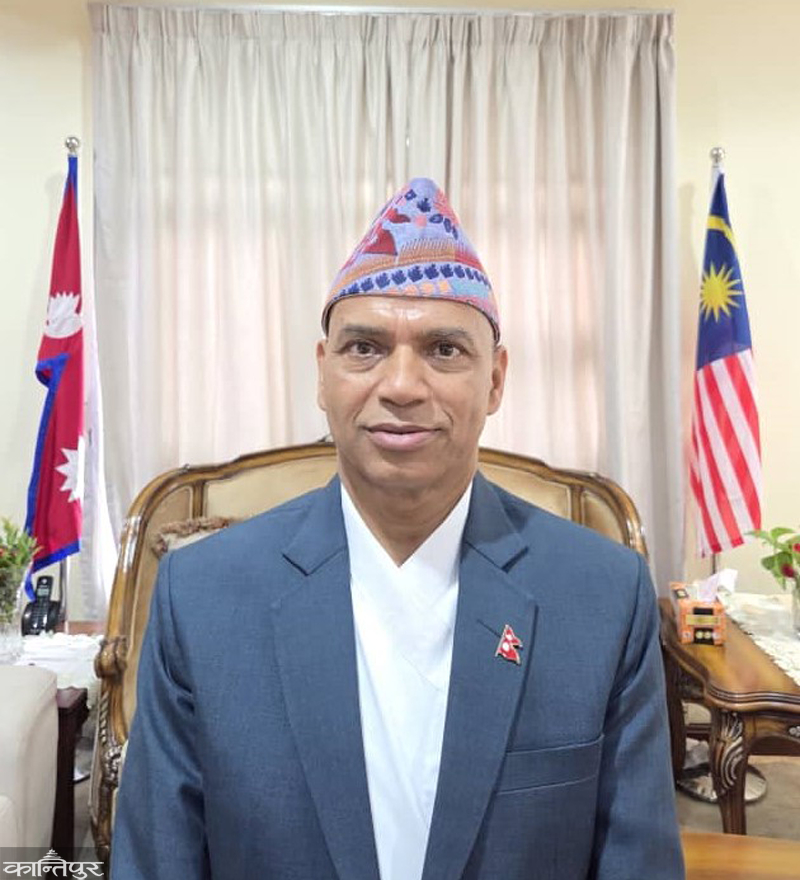
Rajan Rai has been brought and left below the embassy (under the building). The person who brought it ran away. He had no passport, visa or any other documents with him. We started searching for his identity. After making the documents, we went to make a police report. He said he was going to the hospital. Abdominal swelling at night. We tried to get the money to make the papers and take him to the hospital, but he passed away at night. If he had the documents, the hospital would also accept him. The embassy made several attempts to save him, without success. Ambulances do not even take undocumented workers. There are many problems of this nature. Even after he died, the ambulance did not come. Only after filing a complaint with the police, the body the vehicle came.
The embassy has no budget to treat undocumented workers. There is little budget for those who are in prison and need to be rescued. There is an obligation to get money from the family. In case of death of an undocumented worker, the family has to bear the cost of sending them to Nepal. As there are many such cases, the budget of the embassy does not cover it.

