It is the responsibility of the Secretaries of the Ministry of Law and General Administration to find a basis for determining the opportunity to take the examination as per the proposal of the Public Service Commission
We use Google Cloud Translation Services. Google requires we provide the following disclaimer relating to use of this service:
This service may contain translations powered by Google. Google disclaims all warranties related to the translations, expressed or implied, including any warranties of accuracy, reliability, and any implied warranties of merchantability, fitness for a particular purpose, and noninfringement.
The Parliament is going to make a law so that the public service commission exam can be given only up to 6 times. In the 'Bill to regulate the formation, operation and conditions of service of the Federal Civil Service', which is being discussed in the State Order and Good Governance Committee of the House of Representatives, a limit is set on how many times a person can take the public service examination.
The sub-committee under the committee has given responsibility to the Secretary of the Ministry of Law, Udayraj Sapkota and the Secretary of the Ministry of General Administration, Ravilal Panth, to make preparations so that they can take the exam only up to 6 times.
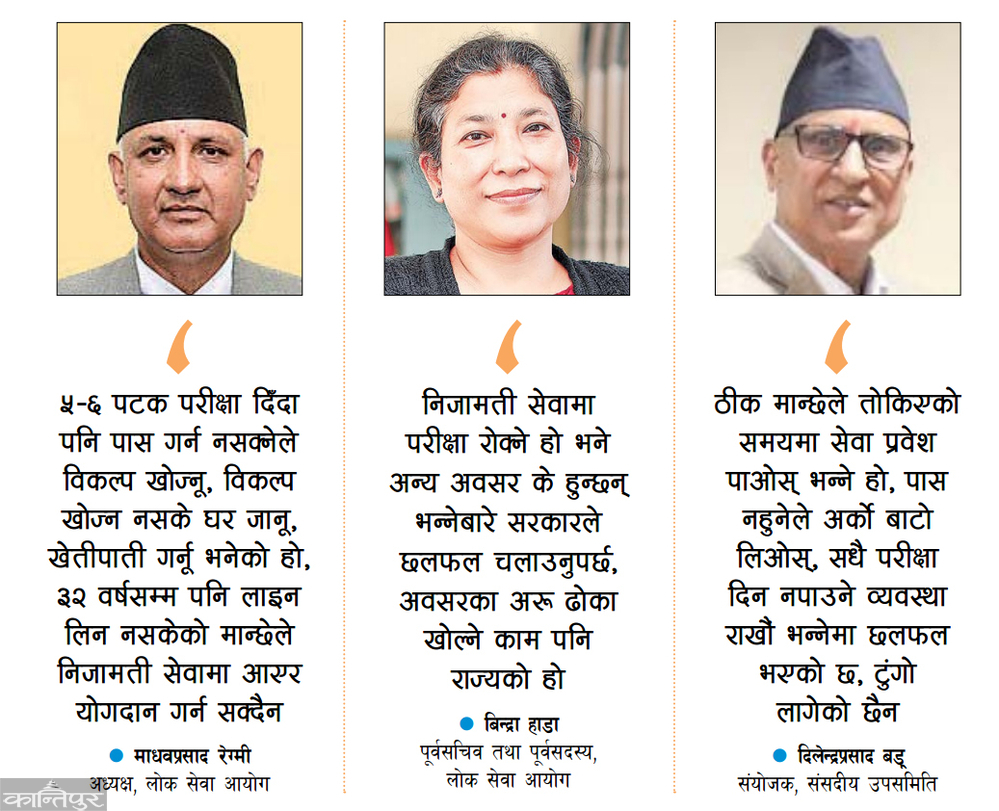
Earlier, Chairman of Public Service Commission, Madhav Prasad Regmi, who was present at the committee's meeting on 19th of August, said that it is not necessary to allow people who have failed five times to participate in the examination. He said that the state should encourage people to go there because there are barren fields in the village.
Chairman of the State Arrangement Committee, Ramhari Khatiwada, said that the two secretaries of the government have been asked to do their homework to find the basis for the arrangement according to the proposal of the commission chairman, Regmi. The Public Service Commission said that there is a provision in India that you can take the exam only four to five times. We have discussed that we should make arrangements to give the exam 6 times for open candidates and one more time for reservation candidates, seven times," he said.
Chairman of the commission Regmi told Kantipur that he made a statement to the parliamentary committee about the examination after studying the countries of South Asia. "Those who can't pass the exam 5-6 times should look for an alternative, if they can't find an alternative, go home and do farming," he said. Qualified person will pass in 3-4 times. My opinion is that you should not waste your life by persisting in this direction.'
Commission Chairman Regmi also argues that employees who pass the exam many times cannot contribute to the civil service. He says that the age limit for entering service should be 32 years for men and 37 years for women. A person who has not been able to take a line even for 32 years cannot contribute to the civil service. There are family obligations and social integration. It is our belief that young people who are not polluted anywhere in the society should enter the service," he said. Currently, there is a provision that men can take the public service examination up to the age of 35 years and women up to the age of 40 years. Civil service entry age is at least 18 years for Khirar and Naib Subba and 21 years for Branch Officer.
Administration experts have objected that the Public Service Commission and the Parliamentary Committee are trying to shorten the period of the examination without doing any work on civil service reform. Ex-Secretary Khemraj Regmi says that setting the time to take the exam will violate the right given by the constitution to compete. Why did you have to tell the examinee that you can only take the test so and so many times? As long as he thinks he can pass the exam and until the specified age limit, he gives the exam, if he can't, he leaves himself," he says. People taking the exam should not be discouraged in that way.
Congress MP Dilendra Badu, the coordinator of the sub-committee under the State Administration Committee, said that the meeting discussed about making a provision that the employee can participate in the public service exam only up to six times as the work of the service recipient is affected by taking the exam. There was a discussion on whether to keep the system of taking the exam up to 6 times, but it has not been decided. It was also said that employees should be banned from taking open exams, but arrangements will be made to allow them to participate in open exams," he said. According to Badu, there has been a discussion about having a system where outsiders can only be given up to 6 times as
employees participate in the examination for higher positions. How long can an outsider take the exam? If we do less than that, then the right person will enter the service at the appointed time. It was discussed that those who don't pass should take another route, we should have a system that we don't always give exams, but it hasn't been decided,' he said. UML MP Raghuji Pant, who is in the
sub-committee, said that after studying the civil service system of India and other countries, there was a discussion about having a system where the exam can be taken only up to six times.
Former Secretary Regmi said that the argument that the employee's work was affected by taking the exam is not strong. "If the employee leaves the office and takes the exam, departmental action will be taken," he said. He said that not being able to get a job after passing the exam is a weakness of the officials of the relevant office. It is a weakness of public service to say that those who come like that will not work. We Nepalese thought of banning everything.
Bindra Hada, a former member and former secretary of the Public Service Commission, said that Parliament should make a law to solve the problems seen in the civil service. In the Civil Service Act, it is necessary to arrange how to distinguish between working and non-working employees. There should be laws on how employees are recruited, employed and for how long they are employed. It is a matter of the person's right to take the exam 6 times or 10 times," she said.
Hada suggests that the Public Service Commission and the Parliamentary Committee should be involved in making laws to prevent the transfer of revenue employees to the Sports Ministry and the administration employees to be made finance secretaries. He suggested that the government should hold a discussion on what are the other opportunities if the civil service examination is to be stopped. "Opening other doors of opportunity also belongs to the state," she said.
The Civil Bill is being discussed in secret in the sub-committee. The sub-committee has kept the meeting confidential at the request of government officials including Prime Minister's Office Secretary Phaninder Gautam, Law Ministry Secretary Sapkota, Administration Ministry Secretary Panth, Public Service Commission officials and secretaries. A member of parliament of the sub-committee said that he had to hold a secret meeting because the government officials pressured him to hold the meeting without the presence of media persons saying that the statement he made during the weekly discussion would be made public. So far, 12 meetings have been held in secret on the Civil Bill. At the beginning of that meeting, controversial issues of the bill were discussed. On Sunday, weekly discussion has started.

