”America's actions and the rest of the world's response have fueled a trade war that has challenged economic liberalization and free markets, protectionism under the guise of economic nationalism, increased government intervention in global trade and supply chains, and undermined the very structure of a competitive open market economy.”
We use Google Cloud Translation Services. Google requires we provide the following disclaimer relating to use of this service:
This service may contain translations powered by Google. Google disclaims all warranties related to the translations, expressed or implied, including any warranties of accuracy, reliability, and any implied warranties of merchantability, fitness for a particular purpose, and noninfringement.
With the start of the second term of Donald Trump's presidency in the US, the global trade chain has become tense. Contrary to the concept of economic liberalization, open market economy and World Trade Organization (WTO), Trump is imposing heavy import taxes on foreign goods. In response, other countries have also started raising taxes on American products. According to the analysis of experts, not only the business, but also the current economic model is in danger of being destroyed.
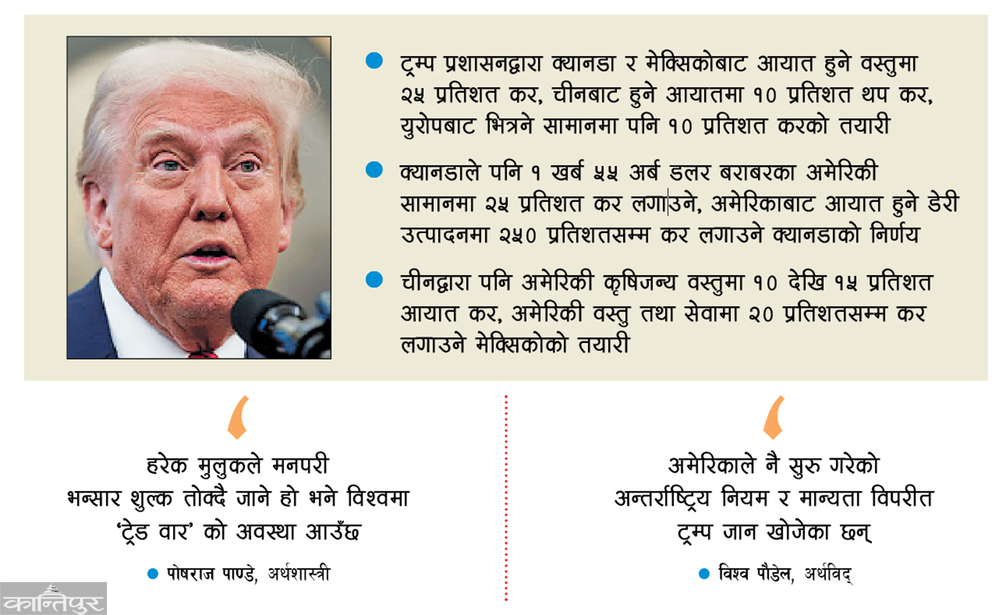
The Trump administration has imposed a 25 percent import tax on goods imported from Canada and Mexico since last Tuesday. Trump has imposed steep import taxes on Canada and Mexico for failing to curb illegal immigration and the smuggling of illegal fentanyl. Canadian energy imports are subject to a 10 percent tax. A 10 percent tax has been added to imports from China. Trump has also said that he will impose a 10 percent tax on goods imported from the European Union. Similarly, Trump has also warned that dairy products imported from Canada will be taxed up to 250 percent.
On the other hand, Canada has announced a 25 percent import tax on US goods worth 1 trillion 55 billion dollars. Canadian Prime Minister Justin Trudeau has said that the tax will be imposed immediately on $30 billion worth of goods, and the tax on $1.25 billion worth of goods will come into effect two weeks later. China has imposed a 10 to 15 percent import tax on American agricultural products.
Not only Canada, Mexico and China, but also Japan, South Korea and India, fellow passengers of the American economic model, Trump has been seen as unfriendly. Other countries have been imposing import taxes against us for decades. Now it's our turn. Have you heard of the European Union, China, Brazil, India, Mexico and Canada? They charge us high taxes. It's very unfair," Trump said while addressing a joint session of Congress on Tuesday.
Economist Poshraj Pandey's reaction is that US President Trump's decision to impose customs duties on the import of goods and services from certain countries is against the purpose and principle of WTO. "If we continue like this, the WTO will not work," he said.
He says that as these trends increase, the world economy will move towards protectionism.
Trump is claiming that his tax policy will make America great and rich again. According to Economist Vishwa Paudel, the clear message given by President Trump's recent decisions is that other countries were given many facilities for doing business before. It seems that Trump wants to start his new regime by disagreeing with many decisions made by the previous ruler. This can lead to a very scary situation, because being a powerful country, there is a fear of what will happen if we say we will use weapons tomorrow when there is a problem in business," he said.
Economist Paudel says that Trump is trying to go against the international rules and norms started by America in the past in terms of world trade. According to his analysis, inflation will increase in the US if customs duties are imposed on imports from other countries. America's decision will not have a big impact on Nepal because we have not been able to sell goods despite providing facilities for a long time. The trade war with the main trading partners China, Mexico and Canada will increase the prices for American consumers, while those countries will look for markets for their products elsewhere, says Paudel. But Trump claims that his tax policy will create and protect domestic jobs. "Now American workers don't have to worry about losing their jobs," he said.
Economist Keshav Acharya also says that President Trump's decision to impose customs duties is against the principle of WTO. He says that Trump's latest decision has had a big impact on the rule of law in the world market. Acharya said that it seems that the US may withdraw from the International Monetary Fund and the World Bank. "President Trump has said that if we don't accept what he said, he will withdraw from the United Nations, the United States has withdrawn from the World Health Organization (WHO) and the World Labor Organization (ILO)," he said.
Economist Acharya said that there is a possibility that the feeling of international brotherhood and exchange of sorrows and joys, helping poor countries will gradually disappear. "Nepal liberalized widely since 2049. Later it slowed down. Progress up to 2000 was very good due to liberalization. At that time there was an economic growth of more than 5 percent. In the last two decades, such an increase is only 4 percent on average," he said. "We were saying to be flexible with America, European Union, etc., now that situation is unlikely to happen."
In recent times, regional business blocs have emerged while production centers have shifted to convenient locations. Economic activity is beginning to shift beyond North America and Europe to Asia Pacific, Africa, Latin America and West Asian cities. According to the International Monetary Fund, these four regions now account for 45 percent of global gross domestic product (GDP).
Trump imposed a 25 percent tariff on steel and 10 percent on aluminum imports from Canada, Mexico and the European Union during his previous term. Before that, the US used to give tax exemptions to steel and aluminum imported from Mexico and Canada under the North American Free Trade Agreement. The agreement was replaced by the United States Mexico-Canada Agreement. In response to the Trump administration, the European Union imposed tariffs on exports of more than $3 billion worth of American goods.
Trump imposed tariffs on Chinese goods worth more than 3 trillion 60 billion dollars in the previous term. In response, China imposed tariffs on more than $1.1 trillion worth of American products. As of 2018, more than 20 percent of US imports were Chinese, but currently less than 15 percent, according to the BBC. As of 2023, Mexico has become the largest exporter of goods to the US. Mexico exports $4.76 billion to the US and China exports $4.27 billion worth of goods. Many car manufacturers moved to Mexico to take advantage of the open trade agreement with the US and lower manufacturing costs. In 2023, Mexico became the world's seventh largest car manufacturing country.
Analyzing this overall situation, experts have said, "The trade war started by US President Donald Trump has challenged the basic principles of economic liberalism and open market." It is economic nationalism that has given way to protectionism. The Trump administration has dismantled the framework of a traditional and competitive open market economy by increasing government intervention in trade and supply chains.'

