In 2011, Nepal was also on the ”Grey List” and came out in 2014 after committing to create a law. In the meantime, the law was also made, but the international body ”Financial Action Task Force (FATF)” put it on the ”Grey List” again, saying that it did not do enough in implementation, amendment, investigation and prosecution.
We use Google Cloud Translation Services. Google requires we provide the following disclaimer relating to use of this service:
This service may contain translations powered by Google. Google disclaims all warranties related to the translations, expressed or implied, including any warranties of accuracy, reliability, and any implied warranties of merchantability, fitness for a particular purpose, and noninfringement.
Nepal has been included in the "grey list" due to the neglect of the political leadership in the investigation and implementation of laws related to prevention of money laundering. The second General Assembly meeting of the Financial Action Task Force (FATF), an international organization that monitors money laundering and terrorist activities, in Paris, France, on Friday evening, placed Nepal on the "grey list".
In a press conference held after the General Assembly, FATF President Elisa de Anda Madrazo has announced that Nepal will remain on the "grey list" for the next two years.
"In this plenary session, the People's Democratic Republic of Laos and Nepal have been added to the list of jurisdictions under more surveillance," she said, "Countries under more surveillance should make an action plan with a commitment to improve within the specified time." According to their progress, it will be decided how long the monitoring will be. Laos has been included in the "grey list" list along with Nepal, while the Philippines has been removed from the list after two years.
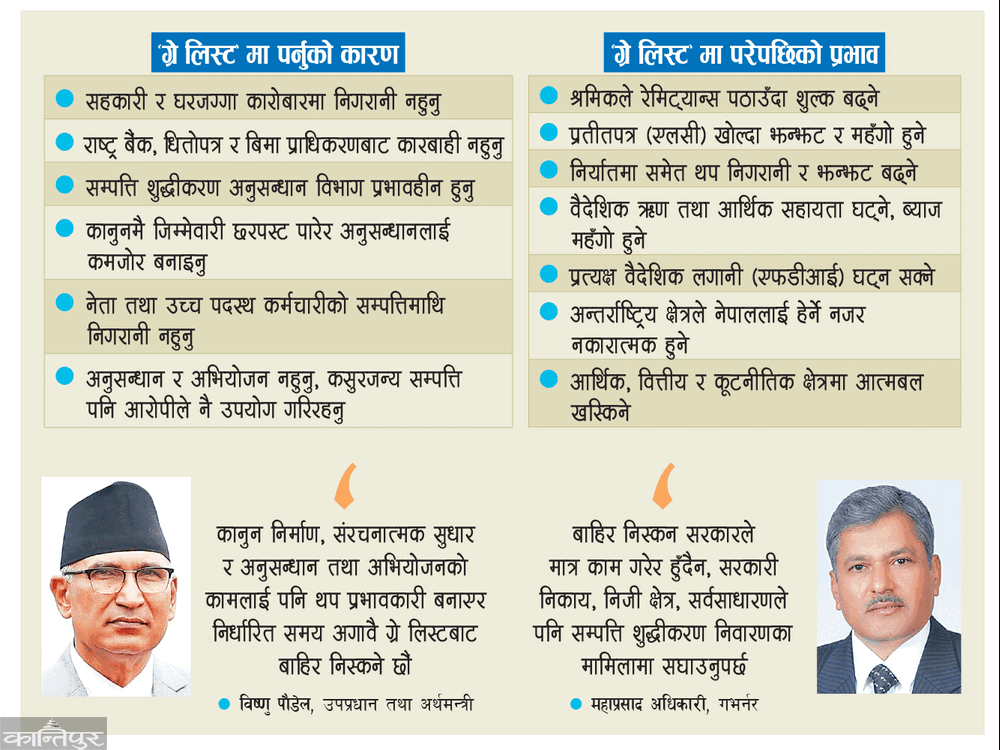
In 2011, Nepal was also included in the 'Grey List' and was removed in 2014. At that time, it came out of the "grey list" after saying "we will create laws". This time, the government officials said that because of the failure to improve and implement those laws, they are on the 'grey list'. Nepal being on the FATF's 'grey list' will mainly affect three areas namely economic, financial and diplomatic. There will be a direct impact on imports and exports under the
economic impact. Costs will increase as banks and related agencies will have more monitoring. Imports will become more expensive as costs rise. Exporting will become more difficult. International trade may be affected as countries including India, where Nepal trades a lot, will be 'viewed with suspicion'.
Being on the 'grey list', now traders may have to take a guarantee from another bank of a third country when they open a letter of credit (LC), and banks and financial institutions and companies will have to pay higher interest rates when taking loans from abroad,' said an official of Rashtra Bank. They will think.' The official said that the impact of the expensive economy as a whole will reach the country's gross domestic product (GDP).
Under the financial impact, the World Bank, International Monetary Fund, Asian Development Bank and others will reduce loans and financial aid and subsidies. Getting a loan will be difficult and the interest will be expensive. Some donors do not give grants and aid to countries on the negative list. Foreign direct investment will also be affected. Under the influence of diplomacy, the international sector will look at Nepal negatively.
Nar Bahadur Thapa, former executive director of Rashtra Bank, says that Nepal has been placed on the negative list for the second time because financial crimes could not be controlled. "The main goal of FATF is to ensure that the resources of the financial sector are not used for laundering black money," he says.
Mentioning that Nepal was spared from being blacklisted in 2012 due to the commitment of the International Monetary Fund (IMF), Thapa suggested, 'In order to avoid being blacklisted, the reform of the financial sector suggested by the IMF should be followed effectively.'
The most important international trade policy should be made effective. "If the financial sector is used in the name of making the economy run, FATF will get angry, if precautions are not taken, the period of 'Grey List' will be extended," he says, "It is necessary to strictly implement the recommendations of the IMF and implement them effectively." On behalf of Nepal, Secretary of the Prime Minister's Office Fanindra Gautam and Director of Nepal Rastra Bank Hari Nepal, Head of Financial Intelligence Unit (FIU) Vasudev Bhattarai participated in the meeting.
'We defended a lot but our progress did not support us,' said a member of the team, 'now the political leadership should think more about how to get out of that list by making improvements as quickly as possible.' "But it is not certain that the action plan will be completed, political leadership and additional activation of implementation level organizations is needed," said an officer participating in the General Assembly.
Nepal has to regularly report the work progress to FATF according to the action plan. He said, "If there is no progress according to the action plan for two years, Nepal will be put on the 'dark-gray' list." If that situation occurs, it will be very difficult for Nepal, so now we must take initiative to prevent a worse situation from happening.'
Every 3-3 months you should keep asking FATF with your progress to get out of the 'grey list'. "The maximum time we got is that we will improve within two years," said the official, "If we work effectively, we can get out of this list even in one year but speed is necessary for progress."
Deputy Prime Minister and Minister of Finance Bishnu Paudel said that this situation has arisen due to the inability to complete the scheduled work on time and that the mistake will be rectified. "Nepal has made an action plan for reform, submitted it to FATF, and that action plan has been approved by the General Assembly," he said. Minister Poudel said that more emphasis will be placed on making investigation and prosecution more effective, especially in asset laundering.
Rashtra Bank Governor Mahaprasad Adhikari says that since Nepal has been included in the 'Grey List', how will it happen now? To get out of the 'grey list', we have made a two-year action plan based on their suggestion,' he says, 'now we have to get out of it as soon as possible.' ``This is a good opportunity for us to improve and improve the system, so we should work as an opportunity rather than a problem,'' he said. "Recently, the Financial Action Task Force has been doing mutual evaluation of countries every 10/10 years, according to which it should be done in 2020 after 2010, but due to Covid, it was evaluated in 2022. The report was given in 2023, when our performance was not good. "That report was from 2010 to 2022," he said, "in that report was asked to be kept under surveillance for a period of one year." We did what we could, but Nepal came under intensive monitoring.'
In the public mutual evaluation report of APG under the FATF in August 2018, it was pointed out that 'there is a high risk of Nepal being on the 'grey list' due to the absence of urgent legislation and almost zero achievements in investigation and action. The standards to be followed by countries including Nepal were divided into two parts, law enforcement and research aspect (effective rating) and law making and institutional aspect (technical compliance rating).
The 'Technical Compliance Rating' has 40 criteria. The standard compliance status in this group is divided into four categories as 'Highly Compliance' (Full Compliance), 'Compliance' (Compliance), 'Partially Compliance' (Partial Compliance) and 'Non-Compliance' (No Compliance). Among those standards, Nepal's situation is 'Highly Compliance' in 16, 'Compliance' in five, 'Partially Compliance' in 16 and 'Non-Compliance' in three.
In order to avoid the 'grey list', at least 21 of the 40 standards in this group have to be 'compliant' or 'highly compliant', which Nepal has completed. At least 31 criteria under this group have been fulfilled after the passage of the bill to amend some Nepal Acts last year by the Parliament and the confirmation by the President. This does not mean that Nepal is on the "Grey List" because of the "Technical Compliance Rating". As they could not meet the criteria under 'Effective Rating', they were placed on the 'Grey List'. 11 criteria were specified under
'effective rating'. These standards are evaluated with four indicators, namely 'high compliance', 'substantial compliance', 'moderate' and 'low'. In order to avoid the 'grey list', a country like Nepal needs to achieve 'high compliance' or 'substantial compliance' in at least 3 of the 11 standards of this group. But Nepal has only received medium evaluation in 4 and low evaluation in 7.
Due to the lack of improvement in the 'effective rating', the Nepali team had a face-to-face discussion at the APG meeting held in Manila, Philippines last January. In the talks, the Nepali side claimed to have improved many indicators, but it was judged that it was not enough.
Nepal was under close surveillance of FATF since July 2008. After committing to improve all the necessary areas within the specified time, FATF gave one year time for reforms while keeping a close watch on Nepal. That time ended last October. After not being able to make the expected improvements during that period, Nepal has been included in the "grey list".
After Nepal is now in the negative list, we have to look at the work done during the period from 2010 to 2024 October. In these 14 years, since the interim constitution was issued in Nepal, it was tried to transform it according to the new constitution with republic. It cost us a lot of labor, energy and budget. In some sectors, such as cooperatives and monitoring of land transactions, there was no clear division of labor between the three levels. The regulatory bodies, especially the National Bank, the Securities and Insurance Authority, did not take much action against the index organization.
According to an official, the Money Laundering Investigation Department has also become known as a 'hotbed of bargains' as it should focus on larger and higher-risk cases. The 2064 Amendment to the Asset Clearance Act was submitted only in 2076 and passed only in 2080 Chait. In that too, the investigation was weakened by spreading the responsibility. The official says that there is no understanding of what kind of crime money laundering is and what should be done to prevent and control it.
"Nobody understood the leader and the staff, the prosecution was not enough, even in the prosecution, there was no decision," he says, "The accused continued to use the criminal property that was determined by the decision." He did not come under the government's dukedom. This is the reason why Nepal is now on the negative list.'

