Project implementation of about 3 billion rupees in 9 years after the program was approved, constant questions about expenditure transparency
We use Google Cloud Translation Services. Google requires we provide the following disclaimer relating to use of this service:
This service may contain translations powered by Google. Google disclaims all warranties related to the translations, expressed or implied, including any warranties of accuracy, reliability, and any implied warranties of merchantability, fitness for a particular purpose, and noninfringement.
The government has issued a circular to the district administration offices across the country to study the investment, expenditure and returns of all the projects run through national-international non-governmental organizations (NGO-INGO).
Ministry of Home Affairs has instructed all 77 district administration offices on Sunday to submit a report after accounting for all the projects run by NGOs and INGOs.
Home has instructed the district administration office to study how much aid funds are being used by the non-governmental organizations operating in the district from which development partners in which areas, what is the modality of aid mobilization, and what is the status of the program/project.
The impact of aid mobilization on the economic, social, cultural and environmental sectors is also said to be included in the report. According to the letter written by the House, it is requested to conduct a study and analysis in coordination with other thematic agencies and to send a report on the operation of programs/projects run by USAID and the impact on the community.
With the assumption of power by Donald Trump for the second term, through an 'executive order', the United States has stopped the grants given to various countries through the International Development Assistance Agency (USAID).
Home is going to study the transparency of expenditure and project justification of various NGOs including USAID. INGOs associated with various countries including America, Britain, Germany, Finland have been conducting programs worth billions of rupees annually with the approval of the Ministry of Finance and Social Welfare Council.
Although the grants received through the Ministry of Finance are spent on the basis of government priorities, questions are being raised about the transparency of expenses and priorities in the case of organizations registered in the council. According to the details of the financial year 2080/81, there are 135 INGOs and about 57 thousand NGOs registered in the council. The Auditor General's Office has been raising questions every year saying that both NGOs and INGOs are spending against the programs approved by the council and that there is lax monitoring and regulation by the government.
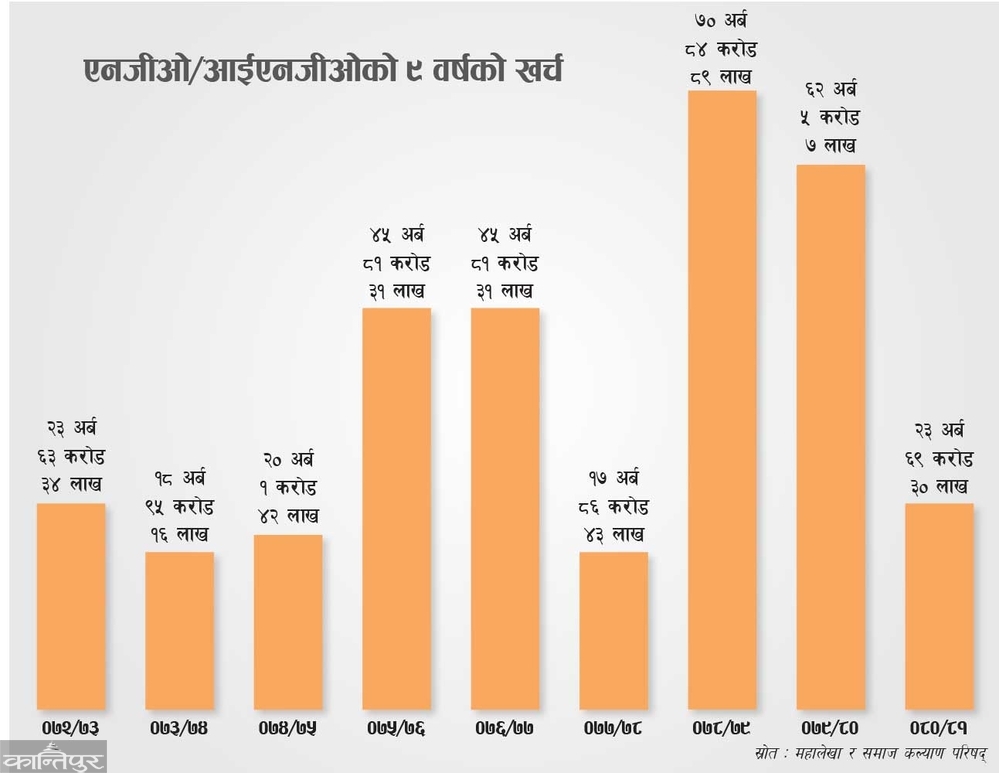
According to the data of the last nine years, during this period, NGOs and INGOs have implemented projects worth about 3 trillion rupees after receiving programs from social welfare. However, various agencies of the state have been raising questions about its expenditure transparency. It is also mentioned in the 61st annual report of the General Account that the programs run by non-governmental organizations should be in accordance with government priorities and national interest.
Spokesman of the Ministry of Home Affairs, Ramchandra Tiwari, said that the effectiveness of the work done by the non-governmental organizations and the current overall situation should be studied and documented, and the district administration offices across the country have been instructed to investigate and study it and submit a report.
'The amount of aid mobilized by non-governmental organizations is going to be collected for the purpose of evaluation and study of the overall impact it has had on our country, this is also a matter of concern for the home administration,' Spokesman Tiwari told Kantipur, 'That is why profiling of gases is going to be done as it is also a matter of concern with its impact, our needs and security, the circular issued on Sunday is one aspect of that.'
In the year 2076, the government formed a commission under the leadership of former judge Mohanaram Bhattarai to investigate the financial irregularities in the Social Welfare Council and the activities done by non-governmental organizations by deceiving the government mechanism. The Bhattarai commission also suggested to the government to bring the funds brought in by Gasus in the name of subsidy to be embezzled and used against the national interest.
A chief district official said that when INGOs get approval from the government, they show one thing and spend it on other priorities. Although the INGO has approved the program from the council, the expenditure has been done through the NGO and some of them themselves.
On October 6, 2034, the non-governmental organization was established as the 'Social Services National Coordinating Council', but after the 'Social Welfare Act, 2049' came in 2049, the right to spend was opened to INGOs by directly approving the program from the Ministry of Finance and the Council.
Former Secretary Jayamukund Khanal says that the problem has arisen because the government is unable to mobilize the foreign grants coming in through non-governmental organizations through a one-door policy. "Organizations that came in from abroad to work under various projects should have been allowed to spend through the one-door policy, but since the way to spend by registering with the Social Welfare Council apart from the Ministry of Finance has been kept open, the question of transparency has arisen. Whatever funds have been mobilized so far, they should be studied and reviewed and now go through the one-door system. This is in the interest of the country," says Khanal. Khanal says that the policy taken by the government in the future to improve the operations of gasses will be helpful for the country if it works according to the circular of the House.
According to the General Accountant and the Council, it seems that in the year 2080/81, GASS has received approval from the Council to run a program worth 23 billion 693 million rupees. 62 billion 50 million in 2079/80, 70 billion 84 million 89 million in 2078/79, 17 billion 86 million 43 million in 2077/78, 45 billion 81 million 31 million in 2076/77, 45 billion 81 million 31 million in 2075/76, 20 billion 1 million 42 million in 2074/75, 18 billion 95 million 16 million in 2073/74 and 2072/73 It seems that programs worth 23 billion 633 million rupees have been conducted.
In the year 2079/80, there were 55,576 non-governmental organizations registered in the Council, and in one year, 2,000 were added to reach 57,000. It seems that only 10 to 12 percent of these projects are renewed every year.
The Accountant General has instructed to 'establish coordination with banks/financial institutions, Ministry of Finance, relevant Internal Revenue Office and organizations that renew the registration of organizations that do not register organizations but receive foreign currency on organizations that are run with foreign grant support and bring them into the scope of renewal of affiliation'. In addition to this, such organizations are spending by taking subsidies from abroad against the law.
National and international non-governmental organizations have been mobilizing grant funds by showing programs including health, education, community development, women, children and senior citizens, persons with disabilities, Dalits, Muslims and backward classes/communities and targeted relief-rescue and reconstruction. An official of the General Account said that every year questions are raised about the transparency and program selection of the grant as a large part of the amount received is used for general expenses.
The council has arranged to regulate gasses imported with subsidies through the 'Guidelines on Project Agreements 2071'. Similarly, there is a provision that the assistance received from international agencies should be mobilized in the areas of national priorities determined by the Development Assistance Policy 2076 in such a way that concrete achievements can be seen. However, the official of the General Account says that the regulation has not been done accordingly.
The Auditor General's Office, during the 3-year operational audit of gasus from the year 2072/73 to the year 2074/75, discovered the fact that more than 1 trillion 2 billion was hidden in various banks through 29 thousand 860 bank accounts by defrauding various government mechanisms.
It was found that the INGO had hidden the amount in 28 commercial banks by showing false expenditure details to the government. After the banks refused to give the details of the hidden amount, the Accounts General sought the details through the Rashtra Bank. However, the government did not confiscate the amount found that way. The instructions given by the Accountant General to bring that money to the government treasury and to take action against those hiding the money were not followed. Now, the Ministry of Home Affairs through the District Administration Office is looking for gas accounts.
There is a provision that non-governmental organizations must be registered at the district administration office. Last time, after the introduction of three levels of government system namely union, state and local, it is possible to register organizations at the state and local level as well. The Social Welfare Council and the District Administration Office have the right to regulate it. District administration office can take action against the director of the organization if it is found to have violated the terms and conditions of registration and the agreement. According to former secretary Khanal, both agencies have the right to check the records, expenditure details and transparency of gass operations, and if they are vigilant accordingly, misuse of the subsidies brought into the country can be prevented.
Non-governmental organizations are running a 'shadow economy' by using government funds and regulating it and mobilizing such aid through a one-door system. Even though there are legal provisions such as Gasus Project Organization Registration Act and Regulations, 2034, Social Welfare Act and Regulations, 2049, Company Act, 2063, Development Assistance Policy, 2071, Council's Project Agreement Guidelines 2071, Grants, Supervision and Evaluation Guidelines of Social Organizations 2071, the lack of implementation has not curbed opaque spending.
Suggestions such as implementing a one-door system for aid coming from INGOs, operating accounts under the direct control and supervision of the National Bank, maintaining access of the council and the National Bank to the aid management information system of the Ministry of Finance have not been implemented.
The Bhattarai Commission has mentioned in its report that it is necessary to look at the amount of money brought in from abroad through GASS from the point of view of national security. It is important to pay attention to the fact that the sources of funds received through INGOs may be connected to ISIS, Al-Qaeda or any other terrorist organization. Otherwise, there may be a danger that the project coming from such intentions may spread religious, ethnic or communal incitement in Nepali territory and push the state towards disintegration,'' the report said.
commission said that INGO's program, its purpose, nature of work, partnership organization and national needs should be approved only after study/research by the Ministry of Finance, Foreign Affairs or Women, Children and Senior Citizens. The
commission has also asked the government to conduct the programs of INGOs only through a one-door system. Stating that most of the recommendations of the report have not been implemented, the home official made it clear that the last circular issued to the administration was based on the recommendations of the Accountant General and the Commission of Inquiry.
Gasus' entry appears to have been institutionalized in the year 2034. The National Coordinating Council for Social Services was formed in 2034. In order to strengthen the council in the year 2038, the government named the Social Service National Coordinating Council under the Ministry of Labor and Social Welfare and included the minister as an ex-officio member. At that time, the number of such gasses in Nepal was 27. There were 80 in 2040 and 249 in 2046, which has increased sharply since 2049. Currently, the money received through the three institutions is spent through NGOs and directly.

