We use Google Cloud Translation Services. Google requires we provide the following disclaimer relating to use of this service:
This service may contain translations powered by Google. Google disclaims all warranties related to the translations, expressed or implied, including any warranties of accuracy, reliability, and any implied warranties of merchantability, fitness for a particular purpose, and noninfringement.
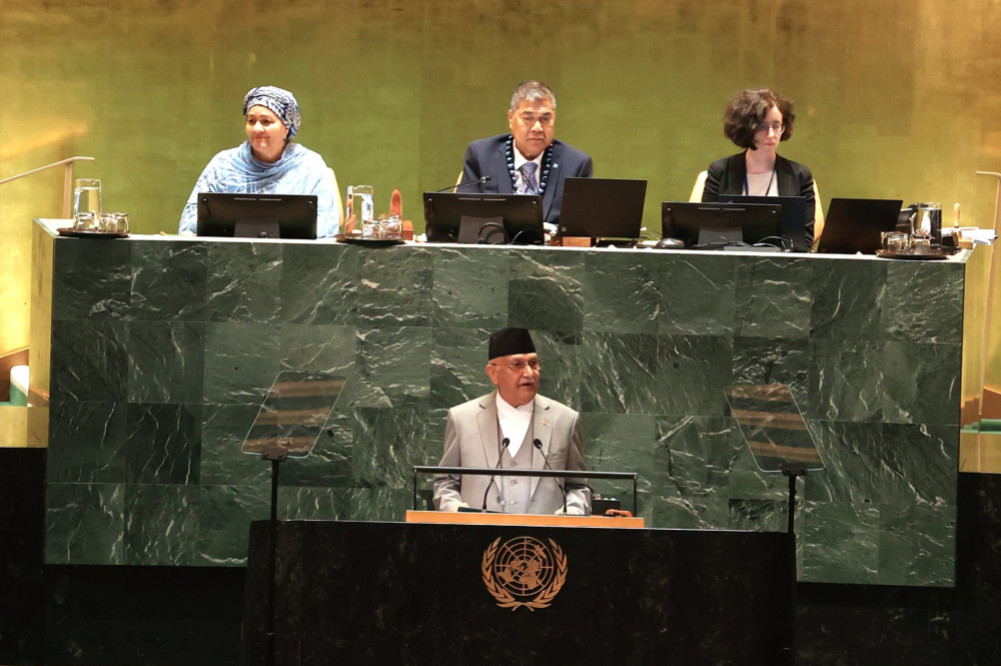
Prime Minister KP Sharma Oli addressed the high-level discussion of the 79th General Assembly of the United Nations on Thursday and raised the issue of compensation for the effects of climate change on Nepal.
Prime Minister Oli said that climate change has emerged as the biggest threat to the earth, people and prosperity. Oli told the world community that his own country Nepal is more affected by climate change. "We stand as one of the most vulnerable countries to climate change and are listed as the 20th most disaster-prone country in the world," he said.
Prime Minister Oli said that the Himalayas have stored snow and provided water for billions of people beyond the borders of Nepal. Nepal is making a great contribution to the health of our planet through its forests, mountains and rivers. Despite that, we continue to suffer from climate change. In this context, we call for climate justice," he said.
Prime Minister Oli made it clear that the mountains play an important role in managing the climate and ecosystem of the oceans. He mentioned that the snow-laden rivers of the Himalayas flow into the oceans and said that the Himalayas of Nepal, as a natural climate stabilizer, help maintain a cooling system in the region located in the hottest region of the planet between latitude and longitude.
Prime Minister Oli commented that it is necessary to pay attention to the agenda of the Himalayan region in the climate talks, taking into account all those issues. "Nepal is sticking to its commitment to the Paris Agreement and is aiming to achieve zero by 2045, five years ahead of the global target," he said.
Oli said that since climate change is a global challenge, there is a demand for global action and collaborative efforts to address its widespread and essential effects. He informed that adequate climate finance with 'loss and damage' fund is not in favor of least developed countries. He said it is important to support climate-resilient measures and infrastructure for adaptation in developing countries.