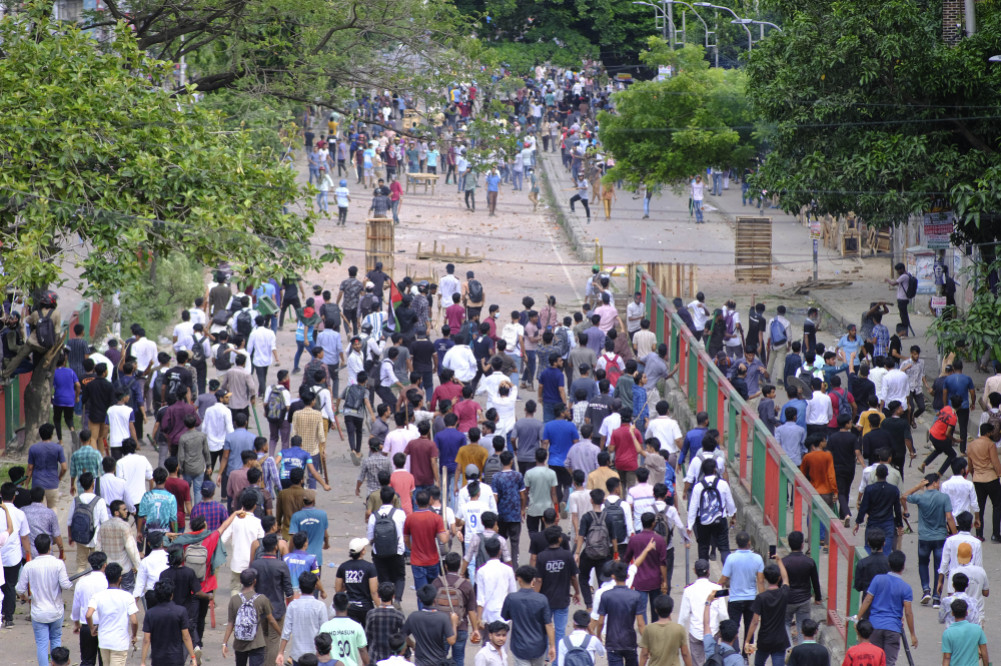
Curfew across the country, at least 100 dead, internet and telephone services disrupted
We use Google Cloud Translation Services. Google requires we provide the following disclaimer relating to use of this service:
This service may contain translations powered by Google. Google disclaims all warranties related to the translations, expressed or implied, including any warranties of accuracy, reliability, and any implied warranties of merchantability, fitness for a particular purpose, and noninfringement.
Eight hundred Nepali students have left Bangladesh after a week-long protest against special reservation in government services turned violent. The Ministry of Foreign Affairs has informed through social network X (Twitter) that 800 Nepalis have left Bangladesh by air and land by Saturday.
The Ministry has also mentioned that the Nepali Embassy in Dhaka is facilitating the safe travel of Nepali students through Dhaka Airport and other checkpoints. The ministry said that a help desk has also been set up for the convenience of students studying in Bangladesh.
Similarly, Prime Minister KP Sharma Oli has also informed that arrangements have been made to return 17 Nepalese students studying at Inam Medical College in Sawar area of Bangladesh to Nepal on Sunday. In a message released by Prime Minister Oli on Saturday evening on social media, it is said, 'Due to the protest demanding the abolition of quota system in government service in Bangladesh, Nepali students who are studying medical education there are saying that they are unsafe. Today I met with the family of that student. According to the request of the family, 17 Nepalese students studying at Inam Medical College in Sawar area have been brought back to Kathmandu at 4 am on Sunday. Since then, it has become violent. At least 100 people have lost their lives so far, according to international news media in Bangladesh. Hundreds of people were injured in the demonstrations in different parts of Bangladesh. According to the BBC, the Bangladesh government has imposed a nationwide curfew since Friday night. Similarly, communication services, internet and telephone services have been disconnected. As the movement intensified, the Nepali students who were there have started returning by air and Indian ground.
Earlier, after the movement in Bangladesh turned violent, more than 650 citizens of Nepal, India and Bhutan entered Meghalaya through the Bogura border, according to the Indian media. Among them, 157 Nepalis are mentioned in the news that quoted the Home Department. It is also said that most of those entering Meghalaya are students. Surendra Thapa, Deputy Chief of Mission of the Nepali Embassy in Delhi, told Kantipur that although he had received information that Nepalis were entering India through the Sthal border, the number was not certain.
He said that the embassy in Dhaka has requested to facilitate the Nepalese entering India by land route. In addition, he said that he has requested the Ministry of Foreign Affairs of India to allow entry of Nepalis through any border. In response to that, Thapa said that the Indian side has promised to facilitate the entry of Nepalis. "Earlier entry was given only through one gate, now the Indian government is positive to facilitate entry through other gates as well," he said.
The movement that started in opposition to the reservation given in government jobs to the children of people active in the freedom movement of Bangladesh took a violent form. Bangladesh seceded from Pakistan in 1971 after the freedom struggle of 'Mukti Bahini'. The students of the university had been rallying against the reservation system for a few days at various places. Universities, campuses and schools have been closed indefinitely as the movement has intensified.
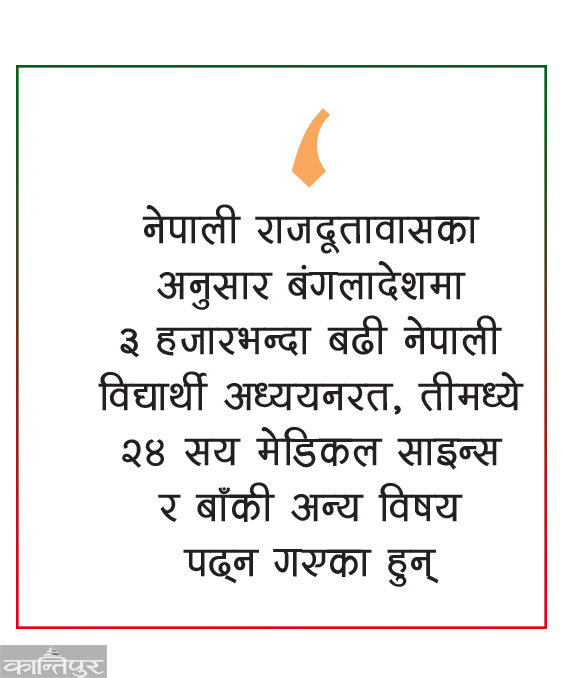
It is said that the government has kicked out the domestic students from the university dormitories and now there are only foreign students. Some college and university administrations have informed that foreign students do not need to worry about security issues. According to the Nepali Embassy in Dhaka, there are more than 3,000 Nepali students studying in Bangladesh. Among them, 2400 students are from medical science and 600 students have gone to study other subjects. In addition to that, around 50 Nepali family members who work in other international organizations including the United Nations live in Bangladesh.
Nepal's Ambassador to Bangladesh Ghanshyam Bhandari said that he is in regular contact with the relevant universities where Nepali students are. He said that the situation of Nepali students is safe so far. Bhandari told Kantipur, "The Nepalis are in regular contact with us, the embassy has been working on their security since the beginning." The embassy issued a statement on Wednesday asking Nepali students in Bangladesh not to leave their homes except for essential work. Two telephone numbers of the embassy have also been provided to be contacted if necessary. The demonstration did not stop even after Prime Minister Hasina's speech. Hasina said that everyone will get justice through the court process. But after his speech, the protests in other cities including the capital Dhaka have intensified. Violent clashes have taken place in various parts of the country between student police and Bangladesh Chhatra League (BCL), a sister organization of the ruling Awami League, protesting against reservation. While the students' league is in favor of the government's plan, other students have protested saying that reservation will only benefit special people. Police fired tear gas and rubber bullets after a clash between anti-reservation students and BCL members. According to the Bangladeshi media, the police initially fired tear gas and rubber bullets after a clash between pro- and anti-reservation students at the university.
In Bangladesh, there is a provision of reservation for women, ethnic minorities and physically challenged people in some government posts. A third of the posts are reserved for children of men classified as 'wartime heroes'. The protesting students have been demanding that government jobs should be filled on the basis of merit, stating that the system is discriminatory.
Hasina's government decided to abolish the system in 2018 after protests over the quota and reservation system. The freedom fighters filed a petition in the High Court against the government's decision. Last June, the High Court overturned the government's decision. That is, the quota and reservation system was revived. In protest, the students started protesting in front of the university. As the students' agitation intensified, the government appealed to the Supreme Court against the order of the High Court. The writ is being heard in the full bench of the Supreme Court on Sunday. Meanwhile, the Attorney General of Bangladesh, Amin Uddin, told the media that he would argue in favor of the students and said that he expected the court to order accordingly.
After the court suspended the quota and reservation system for a month, the students said they will continue their agitation until the system is revoked. The matter is scheduled to be heard in court on August 7. On the other hand, the foreign missions in Dhaka are cooperating with the Bangladeshi government regarding their citizens.
Ministry of Foreign Affairs has established a 'help desk' to help Nepalis who are in trouble due to the latest developments in Bangladesh. The ministry said that a help desk with necessary contact persons has been arranged for the convenience of the Nepalis who are there on Saturday. The Ministry has requested students, parents and relatives who are in trouble to contact the email or phone number determined by the Ministry and fill the online form for the necessary information, support and facilitation. It has been requested to contact Second Secretary Planning Bamjan and Rhea Chhetri at the Nepali Embassy Dhaka and Maheshwaramani Tripathi, Branch Officer for contact at the Ministry at Singhdarbar.
Ministry of Foreign Affairs Designated Contact Persons
Maheshwaramani Tripathi
(9851166987), Branch Officer, Ministry of Foreign Affairs, Kathmandu ([email protected]),
Yojana Bamjan (+8801880691013), Second Secretary, Embassy of Nepal, Dhaka ([email protected], [email protected]), Riya Kshetri (+8801745407958), ([email protected]) .