93 Hourly Babies Raised in Breeding Centers, Existence Threatened by Increasing Pollution and Habitat Destruction.
We use Google Cloud Translation Services. Google requires we provide the following disclaimer relating to use of this service:
This service may contain translations powered by Google. Google disclaims all warranties related to the translations, expressed or implied, including any warranties of accuracy, reliability, and any implied warranties of merchantability, fitness for a particular purpose, and noninfringement.
At the Crocodile Breeding Center in Bardia National Park, the busyness of Ghadiyal children has increased a lot. 93 babies of the world's rare and highly endangered ghidial crocodile, about two months old, have made the pond here attractive.
Some children are playing in the pond in the two cages inside the park. Some are learning to eat fish as a diet. Some children are seen lounging on the pool deck to bask in the sun . Some are mingling with each other and exchanging love and affection.
There are now more children than mothers in the ponds here . "Five nests were laid under the sand in the breeding center this year," senior conservation officer of the park. Ashok Ram said, "Out of 120 more eggs, Ghadial crocodile hatched 150 babies." As many as 15 died. He said that 93 children of five females are now growing in the fertility center. They are enjoying their diet now.
Crocodiles carved 50 babies here in 081 . Of which 32 children survived. Similarly, in 080, out of 85 children drawn, 64 survived. Of the 55 children killed in 2007, 38 survived. "Children die more often within the first one-two months," senior conservation officer Dr. Ram said, "After that, there won't be much problem". Only babies who are cold and unable to eat die soon after birth . Then they grow up happily. However, only about 60 percent of them survive until the time they are released into the river after growing up in the breeding center. However, conservationists say that only one-two percent of the children born in the natural habitat survive. 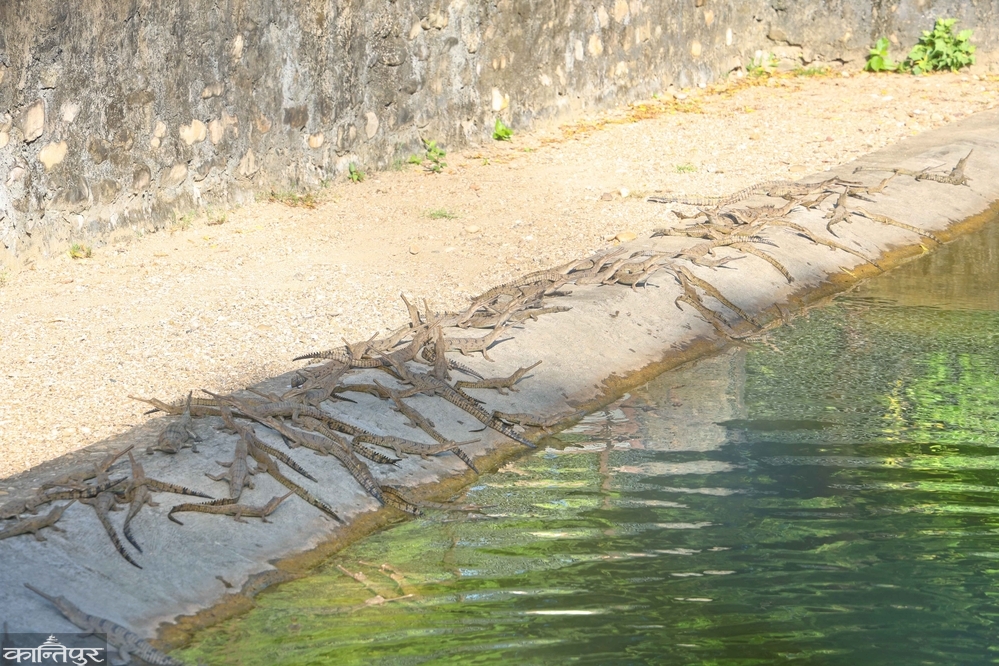 A baby crocodile growing up at the crocodile breeding center in Bardiya National Park. Photo: Manoj Paudel/Kantipur
The information officer of the park, Sarojmani Paudel, said that the baby was born in the first week of June by Ghadiyal at the breeding center. "Now they are about two months old," he said, "When the baby crocodiles grow up, they are taken to the river and released." Visitors to the park are very happy to see the small baby crocodiles, which are often large and scary to look at. Bachera Park has become the main attraction. No one who reaches there now stops to see the child.
The watch crocodile lives in a clean river . Eats fish . This crocodile, like a crocodile, has found a place, it does not go there . It does not attack humans . However, due to recent increasing river pollution, destruction of natural habitats and people going to fish in the river breaking eggs, the existence of crocodiles is in danger. After 073 years, the most number of children were born this year, senior conservation officer (warden) of the park. Ram said . For the clock itself, two technicians are assigned to monitor it daily.
Currently, 93 children should be fed one and a half to two kilos of small fish daily. For this, game scout Rangeelalal Tharu reaches the nearby rivers and streams every day to look for fish. "Small children can't eat big fish," he said, "for 5/6 months, they have to go daily to find small fish." 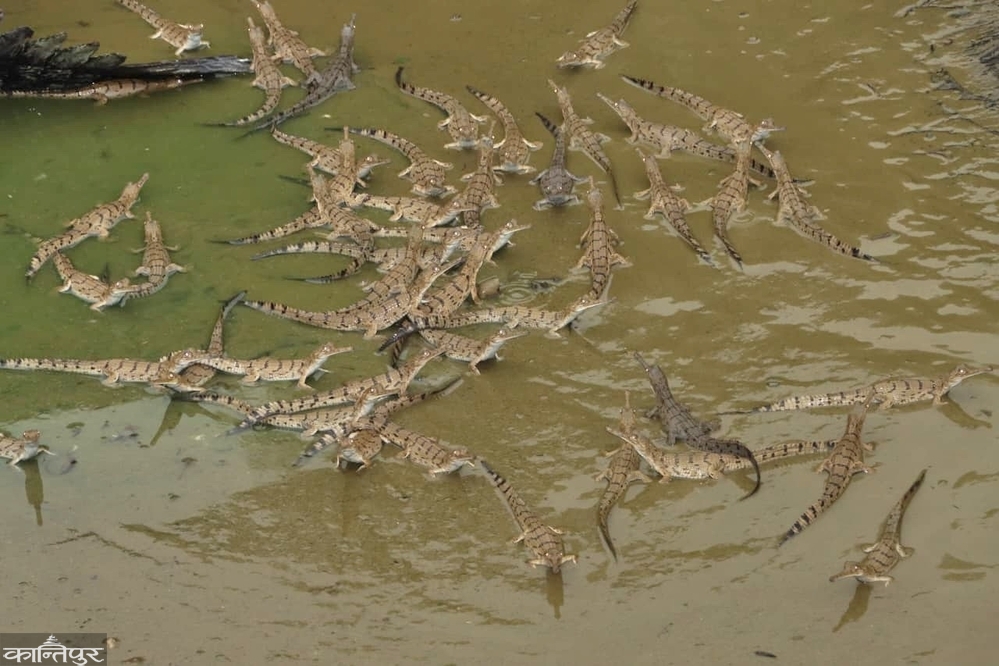 Baby crocodiles growing up at the Crocodile Breeding Center in Bardia National Park. 93 children are growing up here this year. Photo: Manoj Paudel/Kantipur
The crocodiles raised in the breeding center are released into the river when they are 4 to 5 years old. Now there are 15 to 20 crocodiles that can be released in the river at the Bardia Breeding Center . Last year did not leave . This year must be left . Otherwise, there is not enough space. Dr. planning to release crocodiles in Karnali and Babai. Ram said . As of last year, there are 152 small crocodiles. A baby hatches from an egg. A female can lay 31 to 62 eggs . There are two males and 8 females for breeding . 3/4 days after hatching, mother and child are separated .
Clock expert Nurendra Aryal said that the watch is taken as a sign of a clean river system. "When the water is clean, other environments are also clean, which is also important for humans," he said. He said that while the tiger is in the endangered list, it is in the critically endangered list. The structure of the body of the watch is different. There is a special kind of crest on the head of the rooster. He said that people like to see more because it is found in less places in Nepal.
There are two species of crocodiles in Nepal, Magar and Ghadial. Ghadiyal has a nature of not going too far leaving the relatively calm rivers and banks. On the contrary, Magar crocodiles are aggressive in nature and live anywhere in rivers, ponds, hills, and travel long distances.
It is very difficult to preserve the watch in its natural habitat. Successful reproduction of crocodiles has become a challenge even in artificial habitats due to lack of roosters and technical issues. In the breeding center of Bardia, they did not lay eggs for three years in 075, 076 and 077. Every year, at least 2-500 babies come out of natural nests throughout the country. However, crocodile experts say that only two/three percent of these survive.
Ajit Tumbahamfe, head of the National Nature Conservation Fund, Bardia, said that the children who were left out of the mother's care became food for others. "Watching the clock is also a sign that the environment is good," he said.
Since 1978, conservation and breeding program of crocodile species has been conducted in Nepal. Since there are less than 80 ghidals in the country, the Ghidyal Crocodile Conservation and Breeding Center was established in 035 near Kasara of Chitwan National Park.
In the natural habitat of Chitwan, eggs laid by crocodiles are collected and brought to the center to raise babies. In Bardia, eggs are laid in the breeding center and the baby is raised. In 2040, crocodiles were kept in Bardiya National Park as a rescue center. In the same year, 25 crocodile eggs were taken from the Babai river. In 2010, after 10 Ghadials were taken from Chitwan and left, it has now been developed as a crocodile breeding center .

