We use Google Cloud Translation Services. Google requires we provide the following disclaimer relating to use of this service:
This service may contain translations powered by Google. Google disclaims all warranties related to the translations, expressed or implied, including any warranties of accuracy, reliability, and any implied warranties of merchantability, fitness for a particular purpose, and noninfringement.
An important festival of Buddhists, the three-month long rainy season has begun. Monks from different countries, including Thailand, have come to stay in Buddhist places.
In this tradition that has been going on since the time of Buddha, the tradition of monks staying in one place or vihara temple for meditation and meditation is known as Varshavasa.
Lumbini, Tilaurakot in Kapilvastu, Nigrodharam and Ramgram in West Nawalparasi, 43 monks from Nepali, Thai, Myanmar and Sri Lanka are residing in various viharas.
Bhikshu Maitri Mahasthaveer, the former president of the Bhikshus Federation, performed prayers and worshiped at Nava Maitri Mahavihara in Lumbini, and two disciples Koliya Vishuddhi and Mahanama took shelter. The backbone of Buddhism is Vinaya Karma, which is the backbone of Buddhism, and the monks and nuns live in the rain forest because they can be forgiven for their unknowing mistakes and weaknesses without incurring sin.
Meditation and Paritran recitation are done in the evening and morning during the rainy season. At that time, worship is performed by preaching Guna and Dharma along with Buddhism. In the morning they eat one meal. As much as possible, they ask for alms from the local residents and eat. In the evening they only eat light things. 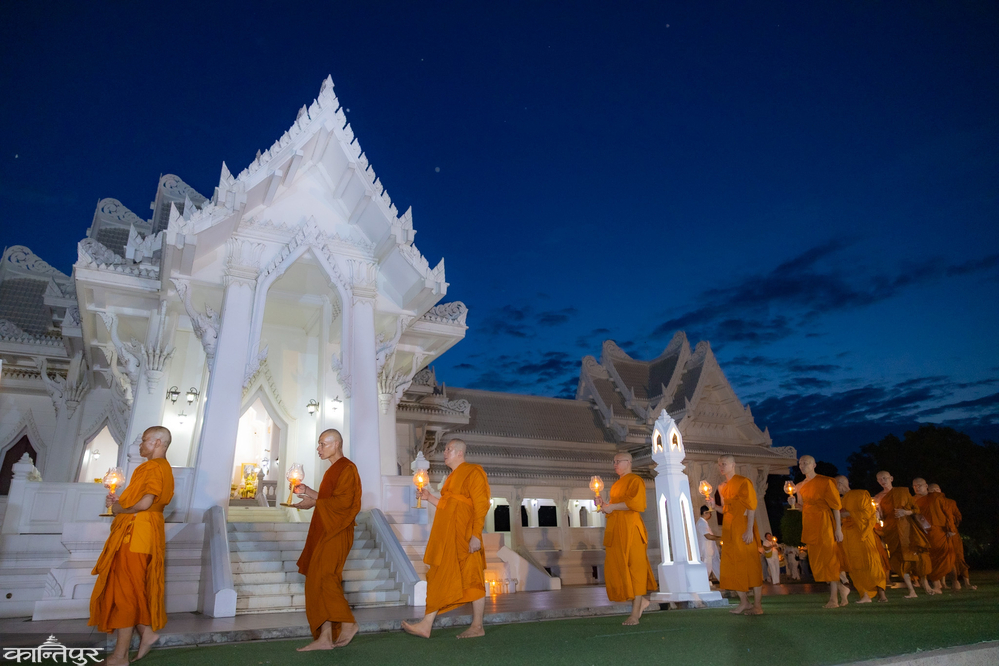 Sajh Dwipa being lit at the Royal Thai Vihar in Lumbini during the three months of rain.
"The rainy season is a rule made in special circumstances," said Sagar Dhamma, the head monk of the Nepal Temple in Lumbini, "that's why it is considered special." Bhikshu Sagar Dhamma said that the three-month rainy season rule was made after it came out that there were many disciples and followers of Lord Buddha who walked for 12 months during the rains, the road, insects and grasshoppers that came out in the fields, and the crops were damaged. He said that the monks living in the rain forest share knowledge with the local people, teach meditation and the importance of charity. He said that individuals and society will be disciplined, morals and morals will change for the better and will be inspired by harmony and compassion.
Now there are 9 monks living in Lumbini Thai Vihar, 6 in Shakyamuni Vihar, 3 in Navamaitri, 2 in IBS, 2 in Maitri Vihar, 2 in Nepal Temple, 2 in Mahabodhi, 2 in Myanmar Temple and one in Sri Lanka Mahavihar . Similarly, there are 5 Thai monks living in Nigrodharam in Kapilvastu, 4 in Tilaurakot and 5 in Ramgram in West Navalparasi. There are 26 Thai monks living in four places and 21 of them came here from Thailand to live in the rain. Similarly, 2 Myanmar and 3 Sri Lankan monks are also residing in Lumbini.
Even birds stay in their nests for 3 months during the rains . Even walking in the rain is difficult . Monks and nuns say that Gautama Buddha started living in the rain because there are suggestions from many places that it is better not to walk as there are more ants and grasshoppers coming out during the rains and when you walk you become a participant in the killing of animals . 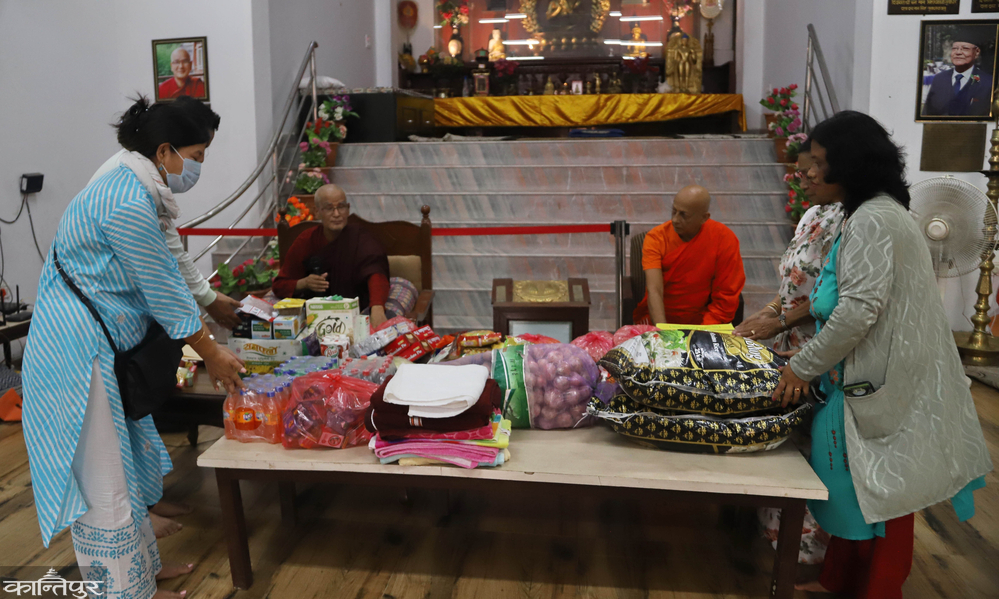 Worshipers helping monks who have been living in the rain for three months at Navamaitri Vihar in Lumbini.
Now, the monk and nun are invited by their devotees to live in the rain house . Accepting their invitation, the monks have started raining. Chartupratya upasaka for 3 months is given to the monk by the worshiper. Chartu Pratya means that the worshiper bears all the expenses of clothes (yellow clothes), food, clothing and medicine needed during the rainy season.
"Thai monks do their best to come to Lumbini to live in the rain," said Phra Bodhi Foreigner Sudhi, the head monk of the Thai Monastery in Lumbini, "because in Lumbini they get the opportunity to accumulate the most important virtues of life". That's why they rush to come here even after leaving any work to stay here.'
There is a popular belief that a monk who lives in a rain forest accumulates virtue. Hard chivar is donated within one month of the rain. It is called a hardship. A yellow robe (chivar) given by the monks' union is given to the monks who live in the rain house and stay disciplined and follow the rules . After that the shower is complete . Only the Theravada sect of Buddhism lives in Barshavas.
"I felt it was the best moment of my life to stay in the rain bath in Lumbini, the birthplace of Buddha," said Phra Sant Chitto, a monk from Udonthani, Thailand, "I am getting good attention here." Myanmar monk Syado said that he had the opportunity to accumulate important merit by making his life more positive. "I will collect harmony, compassion and brotherhood from here and take it to Myanmar and distribute it," he said. 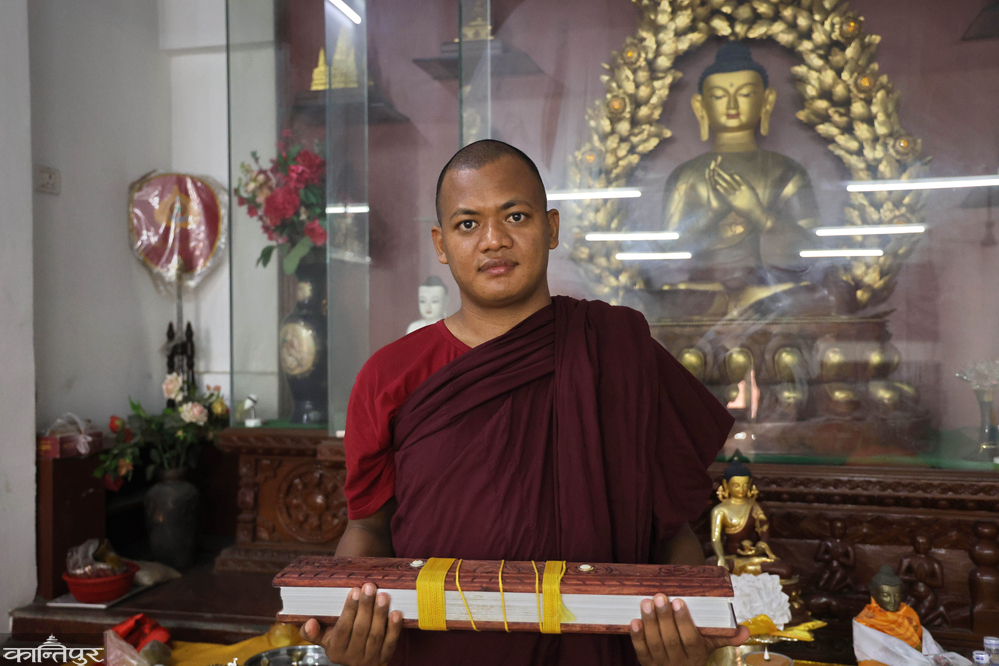 A monk who has been living in the rain for three months is going to recite the Tripitaka at Navamaitri Vihar in Lumbini. Photos: Manoj Paudel/Kantipur
There is rain for 3 months from June full moon to October full moon. Asar Purnima is a very important day in Buddhism. On that day, Prince Siddhartha entered the womb and left the palace at the age of 29 on that day to seek enlightenment. From that day, Manglotsav of planting paddy was held around the palace. On Asar Purnima, Buddha performed his first pilgrimage at Deshana Sarnath and it is believed that Prince Siddhartha's son Rahul was born on the same day.

