We use Google Cloud Translation Services. Google requires we provide the following disclaimer relating to use of this service:
This service may contain translations powered by Google. Google disclaims all warranties related to the translations, expressed or implied, including any warranties of accuracy, reliability, and any implied warranties of merchantability, fitness for a particular purpose, and noninfringement.
The government allocates billions of rupees every year to buy chemical fertilizers. The government allocates a significant amount of agricultural budget for fertilizers, but the farmers do not get fertilizers on time. Agricultural scientists have been emphasizing on the production of organic fertilizers rather than chemical fertilizers.
Meanwhile, in Arghakhanchi, the production of organic fertilizers has been started from the waste leaves in the forest. After reaching the forest of Shitganga Municipality-14 Power Community Forest on Wednesday, Forest and Environment Minister of Lumbini State Government, Devkaran Prasad Kalwar, started the work of composting from Patpatingar.
Consumers of Power, Buddha, Charpokhari, Deurali and Wanganga community forests here had collected leaves during the winter. Minister Kalwar said that this new exercise has been started. He said that when there is a shortage of urea fertilizer, the fertilizer made by composting the collected leaves will increase the agricultural production threefold. He said that the community forest consumer committee based on the
promotion system will make a province-wide program for the production of organic fertilizers from leaves that are wasted along with the development of the village with the income generated by the wood production. "This fertilizer is suitable for producing organic farming," Minister Kalwar said, "It helps to control fires, clean the forest, and grow plants quickly." Locals have collected 33,000 kilos of leaves from five community forests.
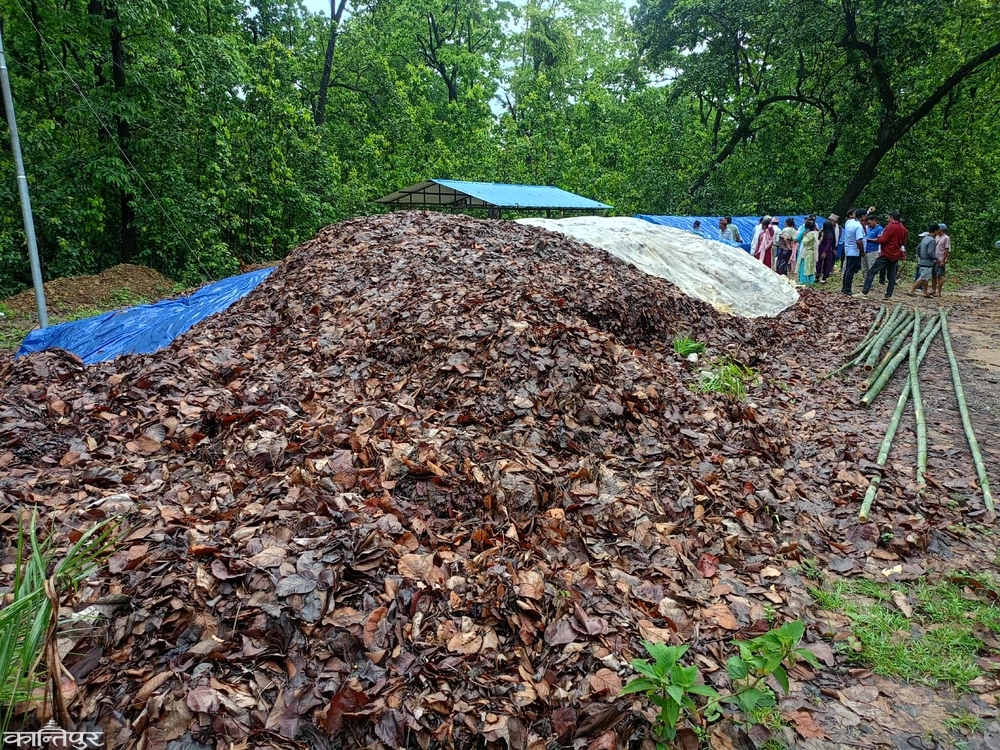 Patapatingar plant has been established inside the forest of Power Forest. With the help of the Division Forest Office, two machines have been installed to shred the leaves. Two ponds have been constructed to digest the shredded leaves. Mohan Prasad Shrestha, Head of the Division Forest Office, said that after putting the leaves in a machine to make powder and rotting in a pond for 15 days, the fertilizer is separated from the grading machine.
He said that if this fertilizer is kept in the fields, the production of vegetables and grain crops will be multiplied, so it will be fruitful for income generation. Consumers are getting income by selling trees while producing wood in forest management based on the promotion system. In the past years, consumers had built fire lines to protect the forest from fire. This year, consumers brought all the leaves from the forest to the plant by cutting them and carrying them in sacks and bags.
"Every year during the rains, leaves were washed away by water, now everything is collected," Shrestha said, "leaves make fertilizer, the forest is clean, the environment is clean, and the forest is protected from fire." Organic fertilizer prepared from leaves will increase production and create employment opportunities for consumers. Bir Bahadur Khamchaki, president of
Power One, said that fertilizer prepared from leaves will be distributed to consumers in the first phase. "This year it will not be possible to package and sell outside," he said, "This fertilizer will increase agricultural production." The goal of selling agricultural produce is to connect it to the local agricultural enterprises of the village and create self-employment.
'We have practiced making organic fertilizers from Patpatingar,' Keshar Khadka, information officer of the forest office, said, 'Next year, we will run a campaign throughout the district. If the produced fertilizer is sold to the farmers and kept in the fields, the production of food crops, vegetables, plants, and carrots will be better.''
Arghakhanchi has an area of 73 thousand 207 hectares of forest. Out of which 34 thousand 342 hectares have community forest. Among the 6 local levels, the largest forest area of 47 thousand 364 hectares is in Shittaganga Municipality. In terms of area, Shitganga is also the largest municipality in the country. There are more forests than settlements here. Malarani rural municipality has the least 2 thousand 870.31 hectares of forest. There are 466 forest groups across the district.
'This time we have achieved considerable success in reducing the risk of forest and human settlement fires,' said Mohan Shrestha, the head of the Division Forest Office, 'We joined the campaign with public representatives, employees, security personnel, locals and forest users at the same time.'

