We use Google Cloud Translation Services. Google requires we provide the following disclaimer relating to use of this service:
This service may contain translations powered by Google. Google disclaims all warranties related to the translations, expressed or implied, including any warranties of accuracy, reliability, and any implied warranties of merchantability, fitness for a particular purpose, and noninfringement.
Some keep on singing, some keep on crying, some get restless, some don't realize that they have passed urine. It is not so easy for anyone to handle this vagrant environment, which seems very different and difficult from normal people.
Abandoned by the family, thrown out of the house or mentally ill due to various other problems, such people are found on the streets and have no one to call their own. Who will take care to bring home such stranded people who are used to living on the street? Some social workers who work hard in such difficult work have established a service house in Ghorahi sub-metropolitan city-10 Narayanpur .
There are 54 people living in the service home including 21 men, 26 women, 3 boys and 4 girls. 45 of them are mental patients who take regular medication . From 4 months old children to 90 years old people are in the same house . People with lice from head to toe, matted beard-hair, long nails, wounds all over the body and abnormal mental condition are taken from the streets and brought to the service home.
After the earthquake of 2072, Sumitra Choulagai, who came to Kathmandu from Hetaunda in search of various opportunities, started the human service work by feeding food to those affected by the earthquake. She gathered some close friends and founded the Human Welfare Society under her own leadership. The organization has started caring for people stranded on the streets since 2075.
There are 6 such service houses across the country. Apart from Dang, there are service houses in Pashupati area of Kathmandu, Jhoukhel in Bhaktapur, Dhulikhel in Kavre, Panauti and Nijgarh in Bara. In which 5 hundred and 5 stranded people are taking shelter. Of which 51 are children . 38 of them go to school . A separate children's wing has been established in Kavre's Panauti with 39 children. Choulagai, who started humanitarian service with her 5-year-old son, is now growing up with other children in the kindergarten.
This service house has no foreign investment and support. Chaulagai, president of Manav Kalyan Samaj, said that only Nepalese fist donation is being conducted and there is a plan to do it in the same way. This is an opportunity for Nepalis to serve Nepalis. She said, "This is a house run by service". It is an open house to develop humanity. So far, it has been going on with the help of Mankari.'
Choulagai said that people who come to the streets for various reasons and are living on the streets are rescued and placed in service homes. How many children have come to the street with their mothers. How many were born and grew up on the streets, how many came mentally ill, she said, how many family members passed away and came to the streets. There is a lot of trouble in getting people who are used to living on the streets to get used to living at home.
How many women have been raped and pregnant while living on the streets. Some of them have given birth on the street and some have given birth in a nursing home. Nothing is known about their other background . Chaulagai is the mother of such children who has done birth registration, pasni, birth registration and naming. At the same time, she changed her name to Sumi Manav. Everyone now knows him as Sumi Manav . Changing the name also has a separate story . 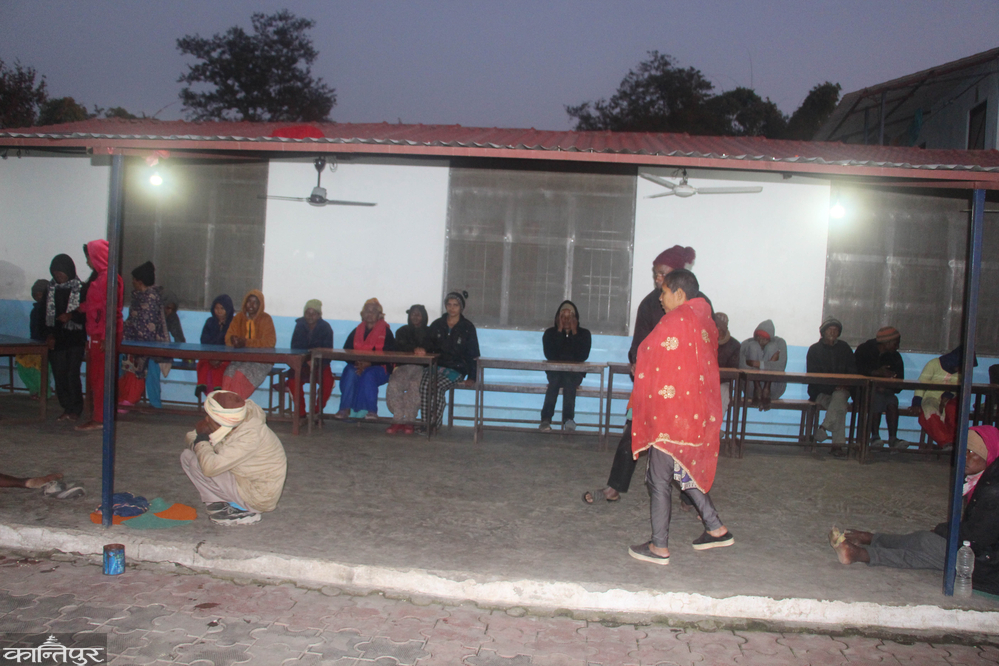 Dangko Ghorahi-10 The dependents at the Sewaghar in Narayanpur. Photos: Durgalal KC/Kantipur
'There was a problem of naming and birth registration of children who were found stranded. I couldn't even keep what I got,' she said, 'After that I started to keep everyone's last name human from the point of view of humanity . I also made my name Sumi Manav.' Because the children are more difficult than Sumitra, she made them call Sumi Mamu for short. After that his name became Sumi Manav .
Not only herself, but also her husband Roshan Dhakal, who has been working in Qatar for seven and a half years, has been called to Nepal three years ago and engaged in human service . No matter how much I tried to take him abroad, he didn't agree. She started saying that she would serve the poor in the country,'' said Dhakal, 'after that I also came back and started living here . Now I am also engaged in human services. Sumi did not let anyone know about her work for 6 months because her family would stop her. Later, after knowing that she has started collecting crazy people from the streets and raising them, everyone started calling her crazy.
What would happen in the society if 50/60 people with mental problems were not able to be taken care of?'' is . Sometimes there are financial problems . Sumi said that a service home costs 4 lakhs per month including medicine, food, and cleaning.
Houses have been built with help from various government lands. There are no housekeeping staff. Among those who came from the street and stayed in the service house, only those who have improved are working inside the house. "Here one sufferer is helping another sufferer," she said, "There is no cost to keep a separate employee." We will work together on our own.'
Out of those rescued from the streets, 1,500 people have been reunited with their families so far. "We have sent them back to their homes even though they have done the work to see that some of them have died. We have found some dead bodies in various houses while searching to see if they belong to my people,' Sumi said. How many have come back here again.'
Sumi said that she started doing Maha Yajna in Ghorahi from 17th to 24th of January due to financial shortage. "I am narrating the story because I don't have the opportunity to find other storytellers," she said, "I think it will be easier to run the service house if there is a donation in the Mahayagya."

