Due to the spread of 'looper' disease in the tea plantations of Jhapa, the plantation itself has been destroyed.
We use Google Cloud Translation Services. Google requires we provide the following disclaimer relating to use of this service:
This service may contain translations powered by Google. Google disclaims all warranties related to the translations, expressed or implied, including any warranties of accuracy, reliability, and any implied warranties of merchantability, fitness for a particular purpose, and noninfringement.
The tea plantations, which are green during the main season of income, are drying up. Moths have appeared on the tea plants, but the garden looks shabby.
The tea leaves have been eaten by insects and have become porous. Some of the plants look like creepers. Not able to pick tea . Gopal Giri, a tea farmer of Haldibari complains, 'It is not enough to look at the tea plant.
Tea plants are dying in his garden, which has planted tea as an alternative to paddy cultivation due to insufficient irrigation . Income does not matter. Even the existing garden is about to end . Reason- Outbreak of 'looper' spread in tea gardens. This year there was an outbreak of looper in all the gardens, big and small. In other times, the outbreak could be controlled with ordinary medicine,'' he said, 'but this year it could not be controlled. The situation is that the plantation is being destroyed.
Not only Haldibari's tea farmer Giri, but most of the tea plantations in the district are in the same situation now. There is a tea garden. However, the face does not grow . The plants have started dying by eating even the dried leaves of tea. Its outbreak has spread in most parts of Kalika Tea Estate located in Bhadrapur . Because of this, the tea-estate is facing an extreme shortage of green tea leaves, said Shilakant Chaudhary, manager of the industry. Looper is spread in most parts of the garden spread over an area of more than 100 bigha .
"While trying to control it, the looper spread throughout the tea plantation," he says, "we also used many drugs to control the outbreak." But, it was not controlled.' He said that the infection of various insects started in the garden from the beginning of this year's tea season.
According to him, in the beginning, the infection of thips was seen in the tea garden . It was controlled as much as possible. Soon the outbreak of looper began . There has been an outbreak of looper in Bagan for about two and a half months. As per the advice of the technician, we have used all kinds of medicine . The disaster was not controlled, he said.
According to farmers, Looper is especially active at night. It chews leaves at night and hides under the soil during the day. It is known as 'looper caterpillar' or 't looper' . Its mouth is butterfly . The larvae hatch from numerous eggs laid on the leaves and eat the tea leaves .
According to Omprakash Jha, the manager of Vaibhav Tea Estate in the district, this insect used to affect tea plantations even 5/7 years ago. However, that effect was normal. He has the experience of killing insects with common insecticides at that time . However, now even the strong pesticides stopped affecting . He says that due to this the green leaves are dying.
In his garden spread over an area of 135 bighas, after the outbreak of insects, the production has decreased by 50 percent, but his efforts to control it have not stopped . The outbreak of looper is spreading in almost all the municipalities of the district . Especially the tea farmers and industrialists of Mechinagar, Haldibari, Bhadrapur and other areas are very much affected by this .
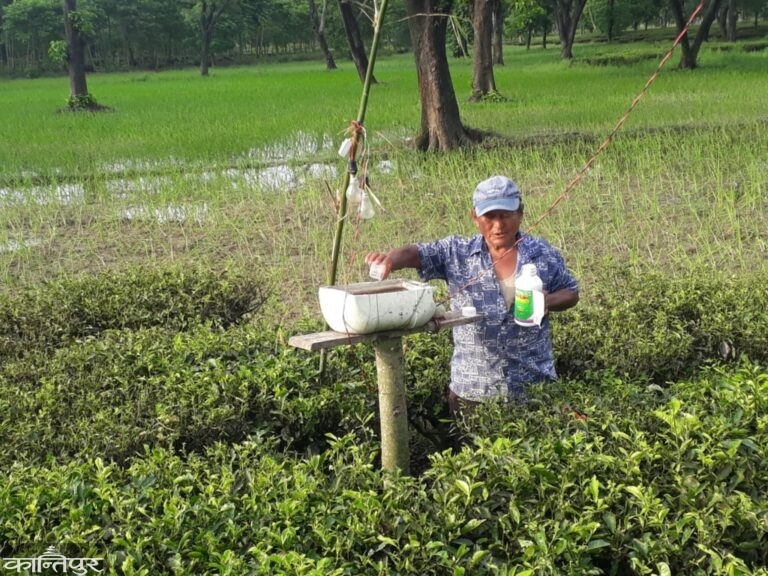
The production of green tea is more during rainy season than other times. Because of this, this is also the main time of income for farmers and industrialists. However, this year, the infection of various insects started from the beginning. Because of this, the production of tea also continued to decline .
Tea cultivation has been expanded to 10,500 hectares in Jhapa. According to the National Tea and Coffee Development Board Regional Office, Jhapa, there is an outbreak of looper caterpillars in large and small tea gardens in the district. Anant Dhungana, a tea expert at the regional office of the National Tea and Coffee Development Board, said that new medicines are being sought to control this pest.
Tea producer farmers and industrialists use chemical fertilizers and pesticides more than necessary to get more produce, he says that disease control is becoming a challenge recently. Insects have digested almost all pesticides. Now use pesticides and chemical fertilizers only according to the advice of experts," he said.
Information officer of Krishi Gyan Kendra Jhapa, Chetraj Bhandari, said that when the weather worsens, the number of this insect increases and it looks like an epidemic. However, he says that the knowledge center is making full efforts to coordinate and control.

