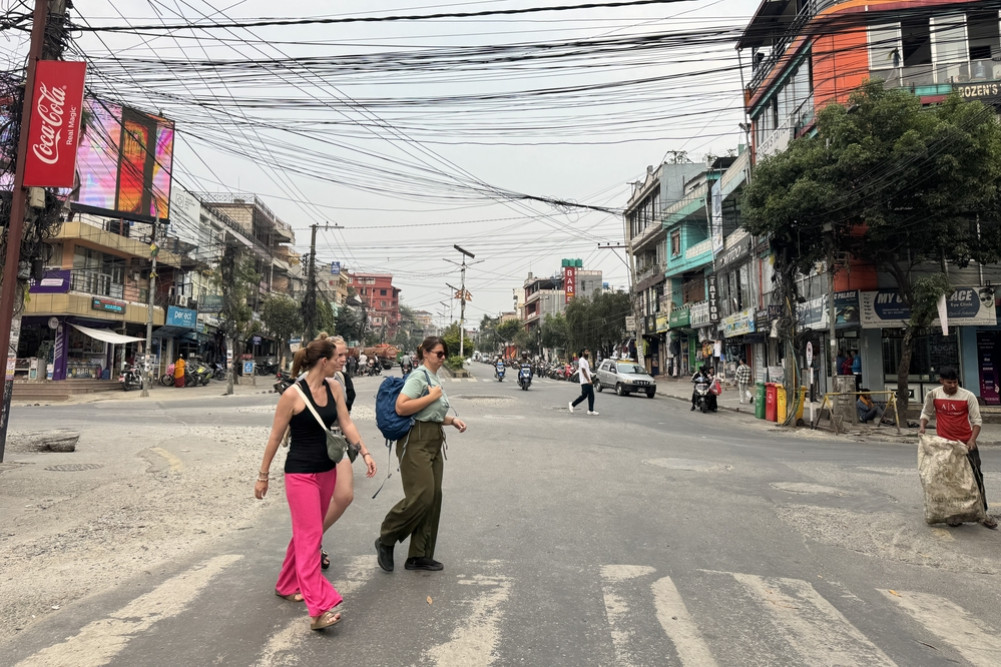
In the middle of Lakeside is Hallan Chowk. Today, this chowk is not just a road intersection - it is a living symbol of Pokhara's economy, memory, and culture.
We use Google Cloud Translation Services. Google requires we provide the following disclaimer relating to use of this service:
This service may contain translations powered by Google. Google disclaims all warranties related to the translations, expressed or implied, including any warranties of accuracy, reliability, and any implied warranties of merchantability, fitness for a particular purpose, and noninfringement.
There is a square in the heart of Lakeside, whose name may seem to many to be a corruption of a foreign word. However, the name ‘Hallan Chowk’, located on the banks of Fewa Lake, was not coined by any geographer or urban planner, nor was it named after a foreign tourist. It is a name born from the slums of a Dalit community, the struggles of a family, and the reckless lifestyle of a character who is ‘shaken’ by the influence of alcohol.
As soon as the name ‘Hallan Chowk’ is heard in Lakeside, Pokhara, a picture of activity comes to mind – a crowd of tourists, the smell of food coming out of restaurants, colorful paragliding flying over Fewa Lake, and colorful lights swimming in the waters of Fewa after dusk.
Where foreign love and Nepali hospitality meet. In the middle of that lakeside is – Hallan Chowk. Today, this chowk is not just a road intersection, but a living symbol of Pokhara's economy, memory and culture. However, a story is buried within the foundation of this chowk, which the skyscraper hotels and modern cafes here do not easily tell.
One of the people who can tell the story of this chowk is Kali Bahadur Pariyar. Kali Bahadur, 67, is a long-time hotelier from Lakeside. The original witness of Hallan Chowk, the heir to this land and a living page in the history of this name. His family is the original inhabitant of this land and the name of this chowk also originated from his family.
The road opened, the chowk was born
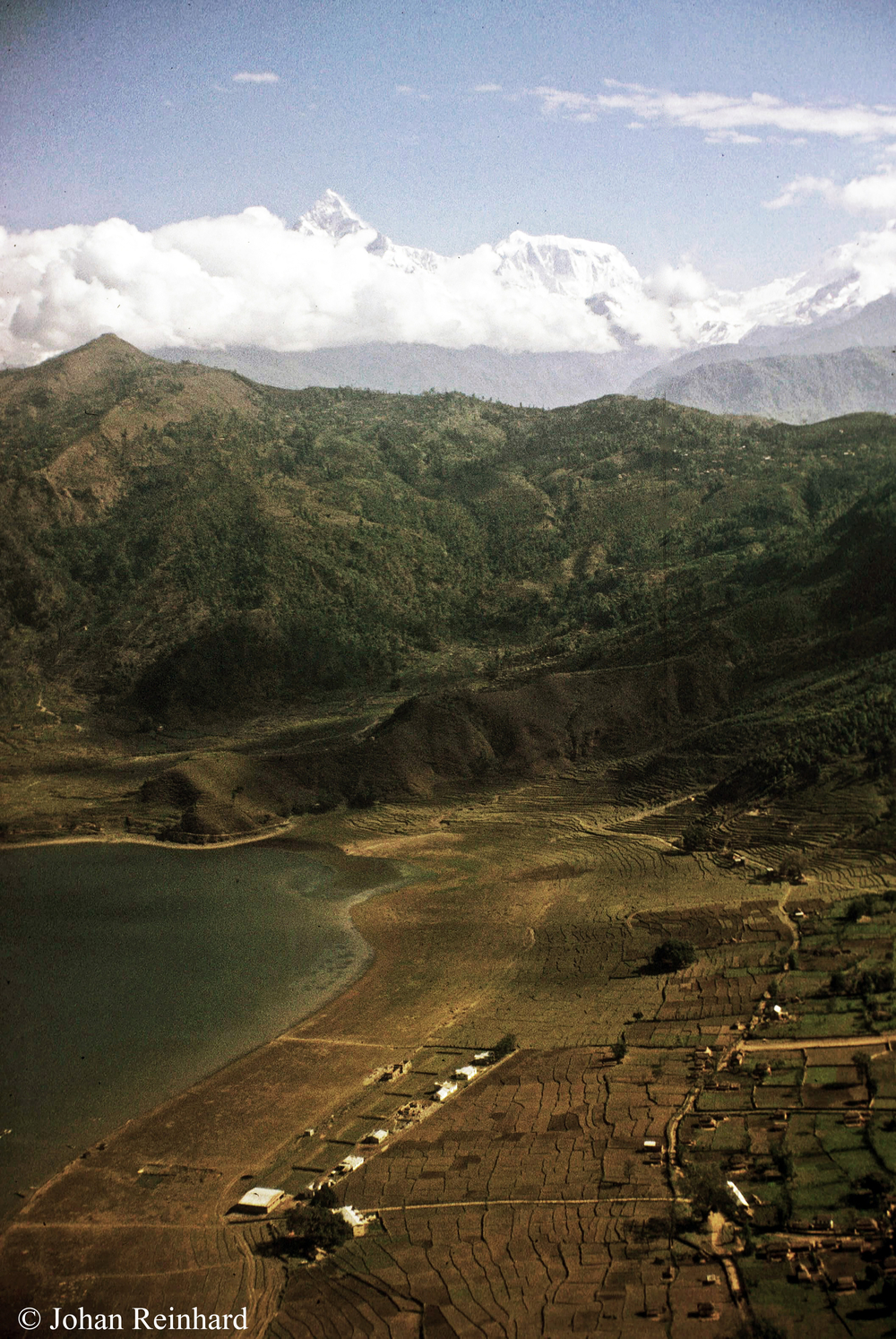
Before 2034/35, where Hallan Chowk is today, there was no road. There was only a paddy field, a buffalo shed and a square. Kali Bahadur's father, Patiram Pariyar, had bought 12 ropanis of land from a man named 'Dharani'. The locals called that place 'Dharani's field'.
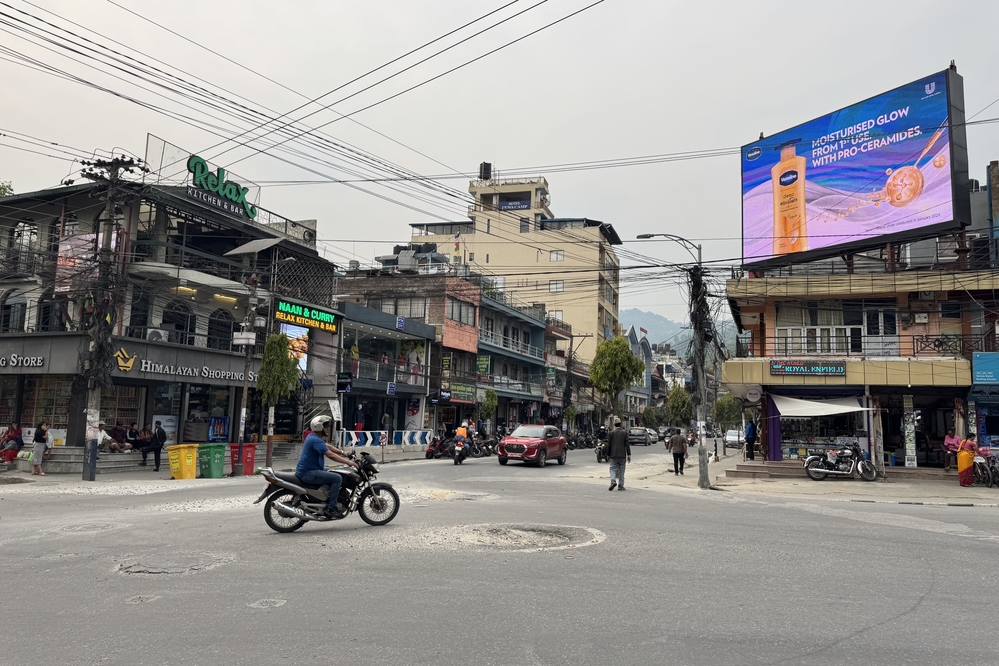
The lakeside at that time was not as luxurious as it is now. There was an old square in the field - 'Thapiniko Chautaro'. There, an old woman from the Thapa clan used to fill water in a jug so that passersby could quench their thirst. Today, those squares and jugs have disappeared in the wake of modernity, but today's tourist center stands on their foundation.
In 2018, the government purchased the local farm on the banks of Fewa Lake and opened the Lake Development Center (currently the Fisheries Research Center). The center taught the fishing community how to cast Tihari nets, how to raise fish, and how to sell fish caught from the lake. There was only a narrow path leading to the center.
Along with Pariyar, there was a farm of some Pahari and Poudel families in Dharne. 74-year-old Krishnaraj Pahari is another old resident of Lakeside. According to him, Damside tourism was moving westwards via Barahichowk. The bullock cart road from Baidam was reaching Dharne's field. After the Pokhara city plan was made in 2030, the unpaved motor road also moved towards the lake from the Patan side of Dinhi. In this way, the road from both sides was connected and the current chowk was formed.
There are many misconceptions and legends about how Hallan Chowk got its name. Some argue that it became Hallan Chowk after the name of a foreign tourist, 'Helen'. However, the locals reject this argument outright. Kali Bahadur Pariyar firmly says, ‘The name Hallan Chowk came to be because of my elder brother Tilak Bahadur.’
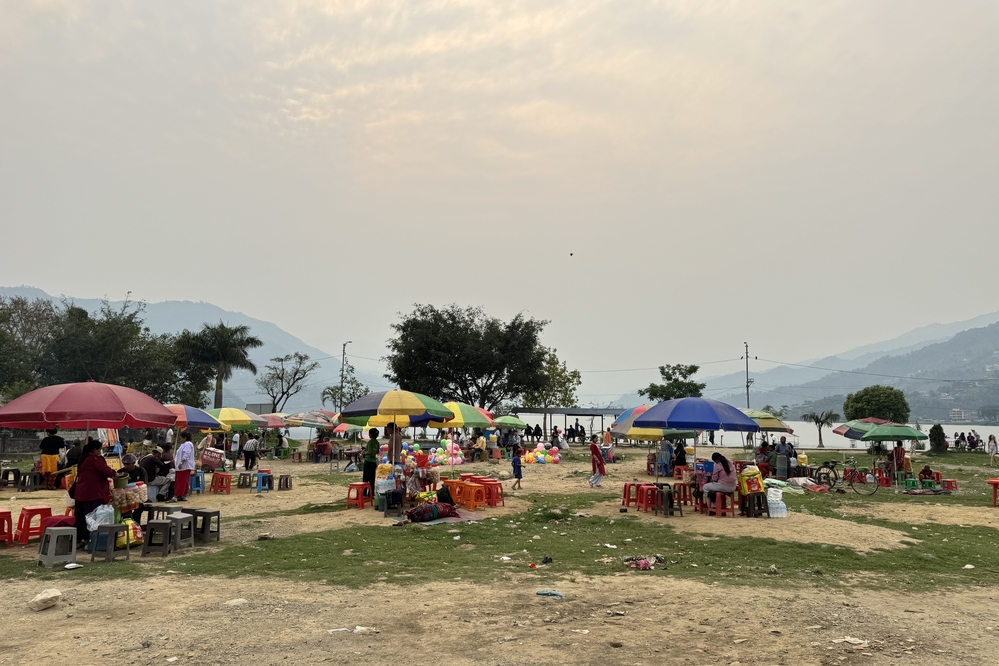
His elder brother Tilak Bahadur Pariyar was a bit of a colorful person. He was a bit fond of drinking alcohol – dancing, singing and always having fun. He often used to sit in that same square (where Hallan Chowk is now) and sway in the throes of alcohol. People would jokingly ask, ‘Tilak, are you always here?’ He would reply, ‘Yes, I always sway here.’ When someone asked him where his house was, he would say ‘Hallane Chowk’.
Gradually, the locals started calling that place ‘Hallane Chowk’. Krishna Raj Pahari also confirms this. He says, ‘Seeing Tilak’s brothers, we jokingly started calling it Hallane Chowk.’ Later, that name became famous. In this way, the lifestyle of a character became the identity of a geography.
Another name is ‘Camping Chowk’
Around 2037 BS, a part of Hallan Chowk started being called ‘Camping Chowk’. There is a long story behind it – the complex relationship between the government, land, tourism and the Pariyar family.
In the 1960s, European tourists used to come to Pokhara by bus via West Asia. Tourists from countries like Britain, Germany, Italy, France and others used to drive for three to four weeks through Iran, Afghanistan, and Pakistan. Those tourists used to park their cars in Barahichowr, which is a land of the Nepal Trust, and camp there. Since it was in front of the Ratna Temple and it was not possible to park the car when the king was in the vehicle, a field near Hallan Chowk was searched for.
The Ministry of Tourism acquired the land under the Tourism Office Kaski. The government took ten ropanis of Kali Bahadur's family's twelve ropanis of land at a rate of forty to fifty thousand rupees. A camping field was built on more than 18 ropanis of land. After the field was built, a dirt road was opened to reach the lake from Hallan Chowk. 'I had protested that a dozer could not be used on our land, the District Administration Office took me away for a whole day, and when I returned, the road was opened,' Kali Bahadur recalled.
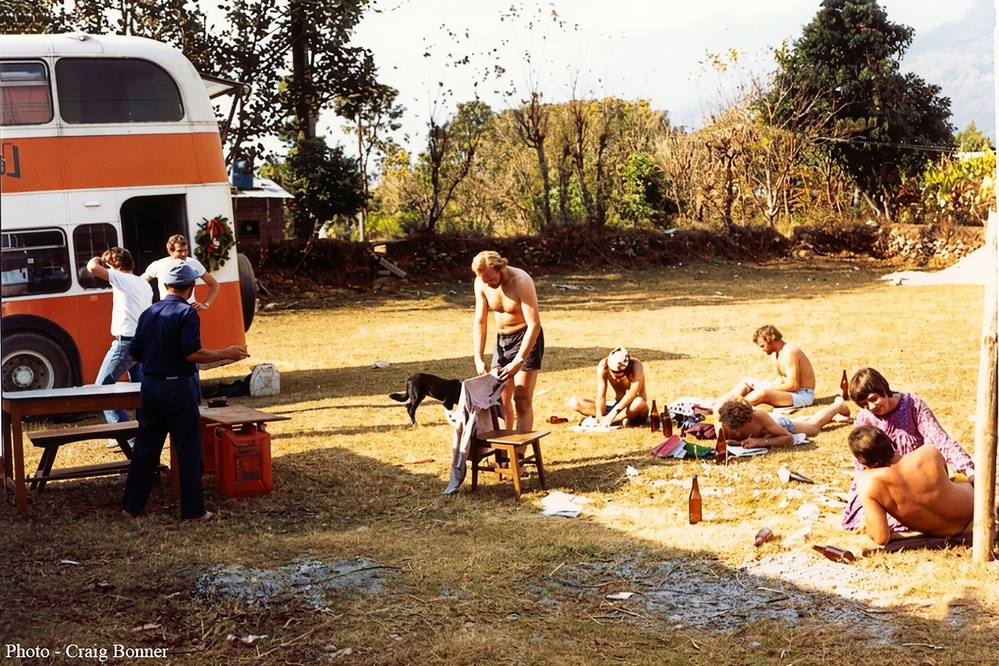
Bathrooms and toilets were also built in the camping field. A public place with facilities for camping was built for foreigners. The name 'Camping Chowk' came from there. However, this name did not become very popular. The name 'Hallan Chowk' settled easily on people's tongues and this name was established on the world map of tourism.
But now? Kali Bahadur says sadly, 'That land is abandoned.' Neither the parking lot was built properly, nor was the camping site operational . The tourism office did not look into it, nor did the municipality look into it . It has not been put to good use due to being entangled in lawsuits and disputes .’
Although the Ministry of Tourism leased the land a decade and a half ago, the Pokhara High Court ordered not to lease it after a complaint was filed with the CIAA. The tourism office, which came under the provincial government after the establishment of federalism, has now been merged with the Integrated Services Office . The land under the provincial government is currently lying idle .
Pariyar settlement and social revolution
Another important aspect of Hallanchowk is the Pariyar settlement here . This area, which is located in ward number 6 of Pokhara, has been densely populated by the Dalit community for generations . According to Kali Bahadur, the children of Bikram Pariyar, Buddhi Bahadur, Tarka Bahadur, Rajdal, Jobane, and Hurkauli Pariyar lived here .
Kali Bahadur’s grandfather’s name was Jaskarn Pariyar . When Babu Patiram narrated, he used to say – Our ancestors came from Paudur. But even in the land revenue office, the old document of that land is not found. A history of migration for generations but no proof on paper. This story is a common story of many Dalit families in Nepal.
What is interesting is that at one time, Brahmins and Chhetris were afraid to live in today's precious lakeside. 'Many say they were afraid of malaria, but in my understanding, the main reason was untouchability,' says Kali Bahadur, 'Since it was a settlement of many Pariyars, some Bishwakarmas and Mijars, the so-called upper caste people lived a little further away.'
However, when the doors of tourism opened in Pokhara, Hallan Chowk led a silent social revolution. For foreign tourists, who was Dalit and who was Brahmin, had no meaning. 'The biggest change came with the end of untouchability. After the arrival of tourists, traders could not provide services based on caste. Those who continued to believe in untouchability did not have a business,' says Kali Bahadur Anubhav, 'After seeing white foreigners eating food from Dalits' hands and respecting them, the thinking of the Brahmins and Chhetris gradually changed.'
On the lower part of the road leading from Hallan Chowk to Barahighat was the Pariyar toll. There were also some houses of the Vishwakarma and Nepali castes there, but the majority were Pariyars. After the camping ground was built in Hallan Chowk, the youth of the Pariyar community became guides, started working in restaurants and started communicating directly with foreigners. This not only instilled self-respect in them, but also destroyed the ancient structure of society. And, this tourism brought about a historic change. After the arrival of tourists, the logic of business became stronger than social discrimination. The price of land increased, hotels opened, and the standard of living rose. Later, Gurungs, Magars, Lahures, Bahuns and Chhetris all started buying land here.
The fascination with land and the pain of displacement
Not everyone was able to take advantage of this change. As the lakeside developed, the indigenous Pariyar families here gradually became a minority. After the price of land increased, many sold their ancestral lands to avoid financial hardship or to dream of farming in the Terai. Buddhi Pariyar, the creator of the song ‘Resham Phiri’, is from Hallanchowk. He later migrated to Kathmandu.
Kali Bahadur says sadly, ‘Many brothers did not understand the importance of land. In the fascination with money, they sold their land and went to Chitwan, Banke and Bardiya. Some became addicted to alcohol. Today, their children are returning to Pokhara again. But they don't have their own land.'
Krishnaraj Pahari also says the same thing, 'Many local residents were displaced, they sold their land and went somewhere else.' However, Kali Bahadur himself stood against this trend. Starting his business by selling goods to tourists who came to camping since the age of thirteen, he understood the importance of land. When others were selling, he was adding. He has been operating Hotel Munal in Hallan Chowk since 1981 (2038 B.S.). His hotel was in the middle of the expensive after Fistel. Today, he has 8 ropanis of land in Lakeside.
There is also a symbolic incident in his life story of the social openness brought by tourism. A woman from Germany came to his shop to buy shoes. From there, a relationship was formed, and they got married. 'That time was a product of the social openness brought by tourism,' he says.
The chowk is still there
Today, Hallan Chowk has changed. Like a snake that has shed its cocoon. Only a few of the old generation of Pariyar community are left. Tilak Bahadur's son Buddhi Bahadur Pariyar is now sick. It is difficult to even speak. His house is in Hallan Chowk. After the construction of Hallan Chowk, it became a place for drinking tea, chatting, and political discussions. People from Khahare, Barahighat, Baidam areas used to gather there. Locals from areas like Sarangkot, Kaskikot, Chapakot, Bhadaure, Panchase used to come to Hallan Chowk. Rallies and processions were held from there. They used to go towards Prithvi Chowk and Shahid Chowk. In the people's movement of 2046 BS, Hallan Chowk also became the center of that area.
Sadananda Shrestha also remembers the social role of this chowk. ‘At that time, there were tea shops and bakeries in every chowk. That was the place where people gathered and chatted,’ he recalled. Sadananda came to Pokhara from Chitwan in 2049 BS. After coming to Pokhara with his family, he first ran a tea shop in Hallan Chowk, and later ran a boat on Fewa Lake. According to him, it was only after 2055 BS that the development of the lakeside really took off.
Today, Hallan Chowk has changed. Like a snake shedding its scales. Only a few of the old generation of Pariyar community remain. Tilak Bahadur’s son Buddhi Bahadur Pariyar is now sick. It is difficult to even speak. His house is in Hallan Chowk.
The land of Camping Chowk is still unoccupied. The tourism office is not paying attention. The municipality has built only one public toilet. ‘That land that was taken with tourists in mind should actually be used for tourism,’ says Kali Bahadur.
Hallan Chowk is not just a tourist destination – it is a witness to the transformation of Nepali society. The story of how a Dalit settlement was transformed into a tourist center and how it broke down the wall of caste discrimination is the real identity of Hallan Chowk. This name, which Tilak Bahadur Pariyar ‘shakes’ under the influence of alcohol, has not only supported the livelihood of thousands today, but has also kept a unique history of Pokhara alive.
As soon as you hear the name ‘Hallan Chowk’ on the lakeside of Pokhara, an image of hustle and bustle comes to mind. Crowds of tourists, the aroma of dishes coming from restaurants, melodious music. However, the story of this chowk is not just a story of tourism, it is the story of a settlement, the story of the struggle of a community. And, it is the story of a silent revolution against untouchability.
The next time you stand at Hallan Chowk, remember – somewhere under this square, the ‘Dharneko Phant’ is still breathing and the scent of the struggle of those indigenous Pariyars still lingers in the air here.