Nepali runners have made marathon participation a rarity in international championships, from South Asian to Asian, including the Olympic Games.
We use Google Cloud Translation Services. Google requires we provide the following disclaimer relating to use of this service:
This service may contain translations powered by Google. Google disclaims all warranties related to the translations, expressed or implied, including any warranties of accuracy, reliability, and any implied warranties of merchantability, fitness for a particular purpose, and noninfringement.
Marathon running has a rich history in Nepali sports. Nepal has many international medals in marathons. From South Asian to Asian and Olympic Games, Nepali runners have made their marathon participation glorious.
Nepal has a strong hold in the South Asian Games (then SAFF, currently SAG), which is considered the 'Olympics' of South Asian countries. The record is in the name of Nepali athletes. Which has not been broken yet. The record of 2 hours 15 minutes 3 seconds set by Vaikuntha Manandhar in the third edition held in Kolkata, India in 1987, has not been broken by any runner from South Asia until the end of the 13th edition.
Manandhar, who has established himself as a legendary runner in Nepali marathons, won his third consecutive gold medal in SAFF when he achieved that time. He had the first Kathmandu SAFF and the second Dhaka SAFF gold. Manandhar made his SAFF participation glorious and golden by winning the bronze medal in the 1989 Islamabad SAFF. Which is still established today. Up to the 13th edition of SAFF, Nepal has won 6 gold, 4 silver and 6 bronze medals in the marathon. Following Nepal, Sri Lanka won 6 gold medals, while India won the marathon gold medal in the 2016 SAG held in its own land, Guwahati.
Following Manandhar's path, Tika Bahadur Bogati has a history of winning gold in the 1995 Madras SAFF (seventh edition). He clocked a best time of 2 hours 19 minutes 39 seconds. Before that, Tika had made SAFF's medal history glorious by winning bronze in Colombo 1991 and Dhaka 1993. Rajendra Bhandari in the 11th edition held in Dhaka in 2010 and Kiran Singh Bogati in the 13th edition held in Kathmandu in 2019 have brought gold to Nepal in the marathon. Nepal has not won any medal in the marathon in the South Asian Games, except in Guwahati (2016).
Arjun Kumar Basnet, who challenged Sri Lankan runner Ajit Bandara in the 2006 Colombo SAF, won silver by covering the distance in 2 hours 28 minutes 10 seconds. Bandara, who won the gold, clocked 2 hours 25 minutes 40 seconds. Rajendra Bhandari overtook Ajit to win the gold in Dhaka. Due to the weakness of the host Bangladesh, the marathon distance (42.195 km) was not completed, so it was recognized as a road race. When Kiran won the gold on home soil, he clocked 2 hours 21 minutes 17 seconds. He had to face a tough challenge from Indian runners Raspal Singh and Shri Singh. Raspal covered the distance only 40 seconds behind.
Indian runner Nitendra Singh Rawat came close to Manandhar's record in 2016. He missed out on equaling the record by 15 seconds. Nitendra won the race in 2 hours 15 minutes 18 seconds, giving India its first gold medal in the marathon at the South Asian Games. Other runners who have won silver in the marathon at the South Asian Games include Arjun Pandit (1st SAFF), Bishan Singh Raut (5th, 1991), Ganesh Bahadur Rai (7th, 1995), and Arjun Kumar Basnet (10th, 2006). Similarly, apart from Vaikuntha and Tika, who came third and won bronze, the other runners are Krishna Bahadur Basnet (2nd SAFF, 1985), Ganesh Bahadur Rai (8th, 1999), and Arjun Kumar Basnet (9th, 2004).
There is only one history of Nepali athletes achieving success in the women's marathon at the South Asian Games (SAG). In 2019, Pushpa Bhandari won the silver medal on her own soil. She achieved this success with a national record. She completed the distance in 2 hours 50 minutes 11 seconds. Before that, Kanchhi Maya Koju had a national record of 2 hours 55 minutes 57 seconds. Kanchhi Maya had set that record at the Kathmandu Marathon in 2016. While Pushpa won the silver, Sri Lankan runner Hiruna Wijayaratne won the gold in 2 hours 41 minutes 27 seconds. Bimala Rana Magar and Indra Malla had completed the marathon distance in the 1995 Madras SAFF. Bimala has a history of completing the distance in 3 hours 10 minutes 34 seconds and Indra in 3 hours 21 minutes 22 seconds. Bimala also participated in the eighth SAFF but could not complete the race due to a right knee injury.
Nepal at the Asian Games
The Asian Games (Asiad) began in New Delhi, India, in 1951. There is a history of a Nepali runner finishing fifth in the Asian Games marathon.
A total of 11 Asian countries participated in the first edition of the Asian Games. Nepal is one of them. Nepal participated in athletics in the Asian Games, which only featured nine events. In the marathon (the distance at that time was 26 miles or 385 yards), Nepal's Gajraj Joshi ran 21 miles and gave up halfway. Indian runner Chhota Singh won the marathon in 2 hours 42 minutes 58.6 seconds. Nepal did not participate in the second edition of the 1954 Manila Asian Games.
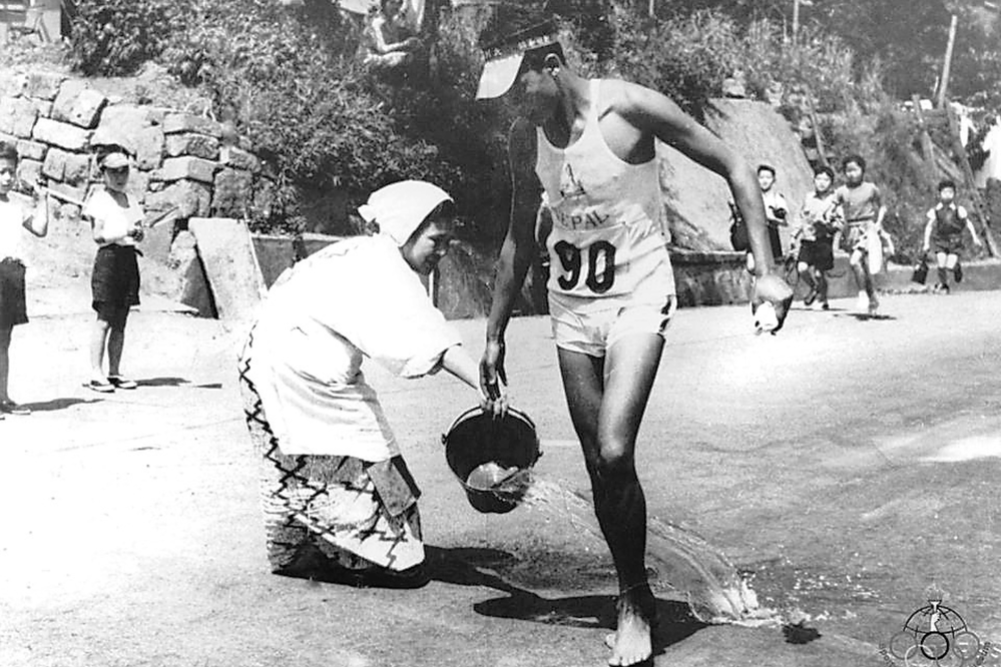
Nepal had two athletes participate in the marathon in the third edition of 1958 held in Tokyo, Japan. When Nar Bahadur Gurung could not complete the distance, Bhupendra Bahadur Silwal finished the race in seventh place. His timing was 3 hours 55 minutes 31 seconds. He ran barefoot. The photo of a Japanese woman pouring water from a bucket while he ran barefoot got the most attention. In this edition, Lee Chen-hun of Korea won the gold in 2 hours 32 minutes 55 seconds. Only runners from Korea, Japan and Burma were ahead of Nepal.
Similarly, in the 1970 Bangkok Asian Games, two Nepalese runners, Jit Bahadur KC and Ganga Bahadur Thapa, successfully completed the marathon distance. Jit Bahadur finished seventh and eighth respectively with a time of 2 hours 48 minutes 53 seconds and Ganga Bahadur finished eighth with a time of 2 hours 56 minutes 52 seconds. Runners from Thailand and Vietnam were behind Nepal when 10 runners completed the distance. Japan's Kenji Kimiharu won the gold with a record timing of 2 hours 21 minutes 01 seconds. The 1974 Asian Games held in Tehran, Iran did not include the marathon event. Due to this, marathon runner Jit Bahadur participated in the 5,000 meter race. He passed the heat stage and made it to the final. He completed the distance in 15 minutes 52.82 seconds, while Indian runner Shivnath Singh won the 5,000 meter race in 14 minutes 20.50 seconds.
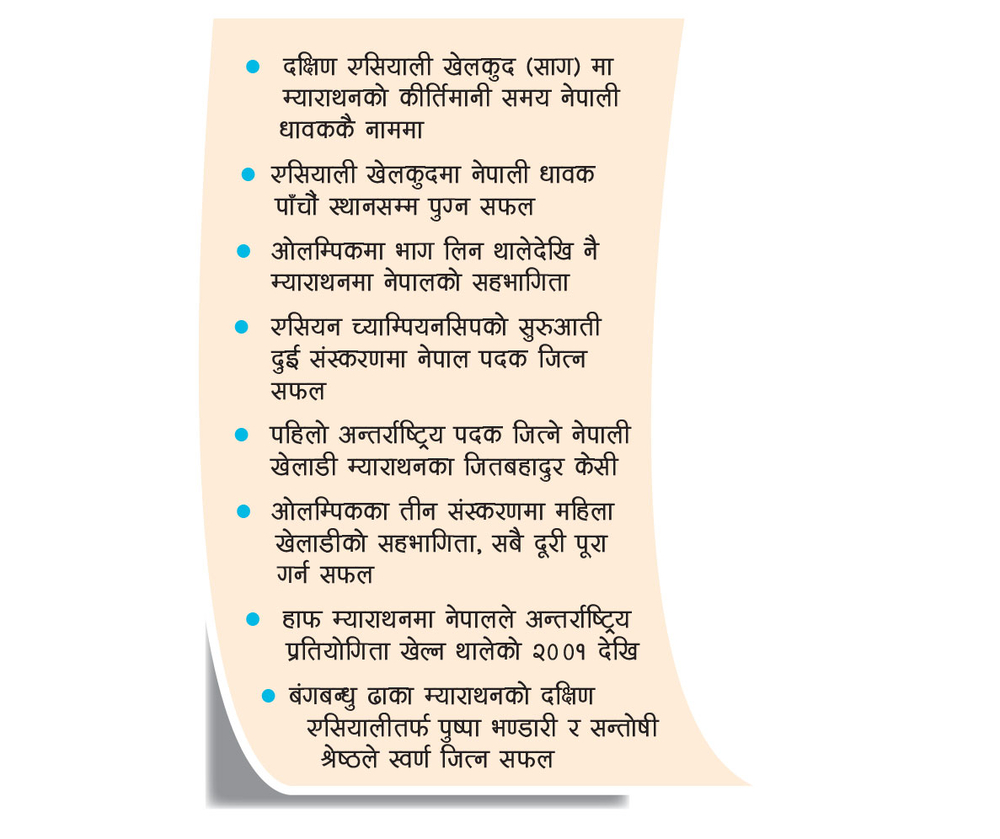 The same Jit Bahadur and Vaikuntha participated in the marathon in the 8th Asian Games in 1978 in Bangkok. Vaikuntha was in seventh place when 18 runners from Asia completed the marathon distance. His time was 2 hours 21 minutes 11 seconds. In the same timing, Japanese Kenji won gold in the 1970 Asian Games. Jit Bahadur was in 12th place. He completed the distance in 2 hours 34 minutes 36 seconds. Mukundahari Shrestha participated in the marathon of the 9th Asian Games in 1982 in New Delhi. But he could not complete the distance. Vaikuntha competed in the 10,000 meters. He completed the race in 30 minutes 59.20 seconds and was close to a medal. The timing of China's Zhang Guoyi, who won the gold, was 29 minutes 37.56 seconds.
Vaikuntha played in the 1986 Seoul Asian Games for the third consecutive Asian Games. In the Asian Games held in South Korea, Vaikuntha and Arjun participated in the marathon. Out of 9 runners, Vaikuntha was fifth and Arjun was sixth. Vaikuntha's time was 2 hours 26 minutes 7 seconds and Arjun's was 2 hours 34 minutes 28 seconds. Japanese runner Takeyuki Nakayama won the gold with a record of 2 hours 8 minutes 21 seconds. Nepal's Dilip Kumar Karki and Durga Prasad participated in the marathon at the 1990 Beijing Asian Games. Durga could not finish the distance. Dilip finished in 12th place and took 2 hours 33 minutes 35 seconds to finish the distance. Out of 14 runners, Kim Won-Tek of South Korea won the gold in 2 hours 12 minutes 56 seconds.
In the 1994 Hiroshima Asian Games in Japan, Tika Bahadur Bogati and Bishan Singh Rawat participated in the marathon. Out of 14 runners, Tika finished eighth and Bishan finished tenth. Tika clocked 2 hours 27 minutes 40 seconds and Bishan clocked 2 hours 39 minutes 19 seconds. Nepal participated in both the men's and women's marathons at the 13th Asian Games in Bangkok in 1998. Runner Radha Shrestha competed in the women's marathon for the first time in the Asian Games. She completed the distance in 3 hours 35 minutes 13 seconds. She was in 10th place. Only 10 runners completed the distance. In the men's category, only 10 runners were able to complete the distance. In that, Lee Bong-ju of Korea managed to win the gold medal in 2 hours 12 minutes 32 seconds. Nepal's Laxman Adhikari and Ram Bahadur Basnet failed to complete the distance.
Nepali marathon runners Arjun Kumar Basnet and Yam Bahadur Pudasaini participated in the 2002 Busan Asian Games. Arjun finished seventh. He clocked 2 hours 28 minutes 23 seconds while Yam Bahadur completed the distance in 2 hours 36 minutes 21 seconds. Only 14 runners completed the distance, and Yam Bahadur was in 12th place.
In the Asian Games marathon, which was dominated by Japanese and Korean runners, in 2006, Qatari runner Hassan Sami Mubarak won the gold medal. On his own soil, he won the gold medal in 2 hours, 12 minutes, 44 seconds. Arjun Kumar participated in the second consecutive Asian Games from Nepal. He finished 11th and finished the distance with a timing of 2 hours, 23 minutes, 55 seconds. This was Nepal's best timing in the Asian Games since Vaikuntha in Bangkok in 1978. Only 19 runners completed the race in Doha. In 2010, Rajendra participated in the marathon from Nepal in the Guangzhou Asian Games in China. But he could not complete the distance. Out of 18 runners, Ji Yong-Jun of South Korea won the gold medal in 2 hours, 11 minutes, 11 seconds. Hassan Sami, who won the gold medal in Doha, came third.
In the Incheon Asian Games in South Korea in 2014, marathoners from both men and women participated. Runner Swaroopa Khadka, who lives in the US, participated in the women's marathon. Swaroopa, who ran the Chicago Marathon, completed the marathon in Incheon in 3 hours and 41 seconds. She was at the bottom when she completed the distance. In the men's category, Nepal's Krishna Bahadur Basnet finished in 2 hours and 27 minutes and 2 seconds, finishing in 11th place. In a fierce competition, Hassan Mahbub of Bahrain won the gold medal in 2 hours and 12 minutes and 38 seconds, beating two Japanese runners by a second.
Krishna Bahadur Basnet and Gopichandra Parki participated in the marathon at the 2018 Jakarta Asian Games, but both were unable to complete the distance. Out of 15 runners, Hiroto of Japan won the gold medal in 2 hours and 18 minutes and 22 seconds. Pushpa Bhandari participated in the women's race and Rajan Rokaya in the men's race at the 2022 Hangzhou Asian Games. Pushpa, who had won silver in the 12th SAG and gold in the Bangabandhu Marathon, completed the distance in 3 hours 2 minutes 37 seconds. She was last among 16 runners. Rajan finished 14th in 2 hours 23 minutes 17 seconds. 16 runners completed the distance. The 19th edition of the Asian Games, which was supposed to be in 2022, was postponed a year due to the Corona pandemic.
Nepal in the Olympics
Nepal has a storied history when it comes to marathon participation in the Olympics. Ever since Nepal started participating in the Olympics, it has participated in the marathon. The 1964 Tokyo Olympics was the first time Nepal participated. Nepal has been participating in the marathon in all the editions it has participated in until the 2000 Sydney Olympics. Since then, Nepal has been promoting its participation in middle-distance and short-distance races rather than long-distance marathons. Vaikuntha Manandhar is the only athlete from Nepal to play in four consecutive Olympics. Tika Bogati represented the marathon in two Olympics. Women runners also participated in the marathon in three editions that Nepal has played. The last time Santoshi Shrestha ran the marathon was in the Paris Olympics 2024.
When Nepal sent a six-member team to Tokyo in 1964, there were two athletes in athletics and four in boxing. Bhupendra Bahadur Silwal and Ganga Bahadur Thapa, who participated in athletics, both ran the marathon. Both ran for 35 km but could not complete the race. Out of 58 runners in the marathon, 10, including Ganga and Bhupendra, abandoned the race midway. Nepal's second Olympic participation was at the Munich Olympics in 1972, when runners Jit Bahadur KC and Bhakta Bahadur Sapkota ran the marathon. This Olympics, held in West Germany, was made more famous by the terrorist incident (Munich Massacre). Bhakta Bahadur's timing was 2 hours 57 minutes 58 seconds while running the marathon distance on the Munich track. Jit Bahadur, on the other hand, had to leave the race midway. He could not run further due to problems with his leg muscles. When he left the race, he had run about 20 km. There were a dozen runners who left the race midway like him.
 Vaikuntha's Olympic journey began in Montreal, Canada in 1976. Vaikuntha completed the distance in 2 hours 30 minutes 7 seconds among 70 marathon competitors. He was in 50th place among 60 runners. Vaikuntha and Mukundahari ran the marathon in the 1980 Moscow Olympics. Vaikuntha completed the race in 2 hours 23 minutes 51 seconds. He ran almost 7 minutes faster than Montreal. Vaikuntha was in 37th place among runners from 53 countries of the world. Mukundahari completed the distance in 2 hours 38 minutes 52 seconds. He finished in 45th place. Mukundahari left eight people behind.
Nepal had fielded three athletes in the marathon in the 1984 Los Angeles Olympics. Vaikuntha, Arjun and Amiri Yadav participated. The seasoned Vaikuntha finished the distance in 2 hours 22 minutes 52 seconds. He improved by one minute from Moscow and managed to finish in 46th place. Arjun finished 63rd with a time of 2 hours 32 minutes 53 seconds and Amiri finished 69th with a time of 2 hours 38 minutes 10 seconds. Out of 108 competitors, 78 people completed the distance. Portugal's Carlos Lopez won the marathon gold by setting an Olympic record of 2 hours 9 minutes 21 seconds. In 1988, Nepal fielded three men and two women in the marathon. Vaikuntha was participating for the fourth time, and Tika Bogati and Krishna Bahadur Basnet were making their Olympic debuts. Vaikuntha finished the marathon in 54th place with a time of 2 hours 25 minutes 57 seconds. Tika finished the race in 2 hours 31 minutes 49 seconds and Krishna Bahadur in 2 hours 47 minutes 57 seconds. Out of 98 runners, Tika finished 66th and Krishna Bahadur finished 85th. Rajkumari Pandey, who became a Nepali marathon runner competing in the Olympics for the first time, finished the distance in 3 hours 10 minutes 31 seconds and Menuka Rawat finished the distance in 3 hours 11 minutes 17 seconds. Overall, they finished 60th and 61st respectively. Only 64 runners completed the marathon.
Hari Bahadur Rokaya ran the marathon for Nepal in the 1992 Olympics held in Barcelona, Spain. Four years ago, Hari Bahadur, who had competed in the middle distance Olympics in Barcelona, finished 70th, finishing the marathon in 2 hours 32 minutes 26 seconds. Out of 87 runners, Korean runner Yong Cho Hwang won the gold medal in 2 hours 13 minutes 23 seconds. Tika ran the marathon at the age of 34 in the 1996 Atlanta Olympics. As an experienced runner, he clocked 2 hours 27 minutes 4 seconds. Tika finished in 74th place out of 111 runners who completed the marathon distance. South Africa's Josiah Thugwane became the first black athlete to win gold at the Olympics with a time of 2 hours 12 minutes 36 seconds.
Nepal participated in the women's marathon at the Olympics for the second time in 1996. Bimala Ranamagar, who competed in it, finished in 62nd place, covering the distance in 3 hours 16 minutes 19 seconds. Out of a total of 65 runners, Ethiopian runner Fatuma Roba won the gold in 2 hours 26 minutes 5 seconds. She became the first African woman athlete to win gold at the Olympics. The marathon made a comeback in 2008 Beijing when the Olympics sent middle and short distance athletes to the Olympics in 2000 Sydney and 2004 Athens. Arjun Kumar improved his personal timing by running the distance in 2 hours 23 minutes 9 seconds in Beijing.
Similarly, Nepal's participation in the 2012 London, 2016 Rio de Janeiro and 2022 Tokyo Olympics was in the short distance event. It was decided to participate in the marathon in the 2022 Tokyo Olympics, which was affected by Corona. For that, the athlete was selected based on the Nepalgunj Marathon. The winner, Gopichandra Parki, was preparing to go to Tokyo. However, he was unable to go at the last minute. Gopi was not able to participate as his name was not registered due to not having the required timing for the marathon.
Santoshi Shrestha participated in the 2024 Paris Olympics held two years ago. She completed the distance in 2 hours 55 minutes 6 seconds. Overall, she finished 79th. Behind Santoshi in the Paris Marathon, which is considered a difficult course, was Bhutan's Kinjong Lhamu (3 hours 52 minutes 59 seconds). Dutch runner Siphon Hasan won the gold medal by covering the distance in 2 hours 22 minutes 55 seconds. Santoshi's second international marathon participation was the Paris Olympics.
Asian and World Championships
The Asian Athletics Championships, organized by the Asian Athletics Association, began in 1973. In the first edition held in Manila, Philippines, Nepal participated in the marathon, and Jit Bahadur KC won the bronze medal. This medal is also the first medal won by Nepal in international sports. While Jit Bahadur won the bronze in 2 hours 35 minutes 38 seconds, two Koreans Cho Ji-hyung won the gold in 2 hours 27 minutes 31 seconds and Park Chang-yu won the silver in 2 hours 33 minutes 45 seconds. The second edition was held in Seoul, South Korea in 1975. Jit Bahadur won the bronze there too. He took 2 hours 39 minutes 6 seconds to cover the distance, beating a Japanese runner. Japan's Suiki Tanaka won the gold in 2 hours 32 minutes 6 seconds and Susumu Sato won the silver in 2 hours 37 minutes 51 seconds. Vaikuntha came fourth.
Then, the marathon event was included in only one edition of the Asian Championship in 1985 and the marathon was separated from the championship. The Asian Athletics Federation had decided that separate marathons would be held in different cities. Meanwhile, Vaikuntha had performed well in the first edition of the World Athletics Championships (Helsinki, Finland) that started in 1983 and finished in 43rd place. He finished the race in 2 hours 21 minutes 43 seconds. Out of 63 runners who completed the race, 18 runners dropped out. The first gold medal of the World Championship was won by Australia's Robert De Castella in 2 hours 10 minutes 3 seconds.
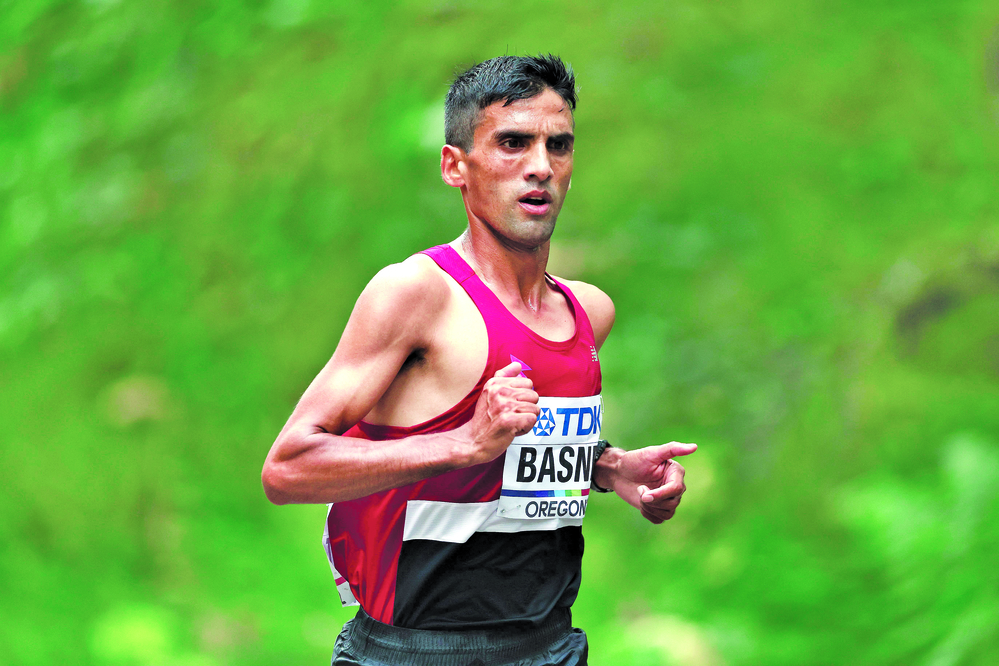
In the second edition (1987 Rome, Italy), Chandra Bahadur Gurung finished in 46th place in 2 hours 43 minutes 54 seconds. Behind him, William Abraham of Guinea completed the distance, leaving 20 people unable to complete the race. Krishna Bahadur (1991 Tokyo, Japan) ran the marathon in the third World Championship. He finished the race in 2 hours 33 minutes 13 seconds and was in 31st place. Nepal participated in the World Championships held every two years, after finishing third, in the 16th edition held in London in 2017. Runner Bhumiraj Rai participated in that. But he could not complete the distance. In 2022, Krishna Bahadur Basnet finished in 54th place in the 18th World Championships in Oregon, USA. He finished in 2 hours 24 minutes 19 seconds.