Surrounded by high mountains and hills on both sides, this valley, which stretches from east to west with a slight southerly tilt, provides peace not only to the eyes but also to the mind.
We use Google Cloud Translation Services. Google requires we provide the following disclaimer relating to use of this service:
This service may contain translations powered by Google. Google disclaims all warranties related to the translations, expressed or implied, including any warranties of accuracy, reliability, and any implied warranties of merchantability, fitness for a particular purpose, and noninfringement.
Many years ago, there was a king named Thichong Deuchen in Tibet. To strengthen Buddhism there, he invited Guru Padmasambhava, who had arrived in Nepal at that time, to Tibet.
While talking to him, one day the king asked Padmasambhava, ‘If there is a difficult situation due to war in the future, where should I go to practice my religion?’
Padmasambhava said, ‘There are five lung (valley) here. There is never a war there. I should go to those lung.’
Such lung, or secret treasure, is also called beyul. These beyul are very suitable for spiritual practice, whether during a war or at other times. Kimyolung is one of the five lung in Nepal. Chum and Kutang around the Serang (Shringi) Himal fall within Kimyolung. Today, let’s set out on a journey to this lung. I will act as the guide for this journey.
Let’s rent a small but sturdy vehicle for convenience. It will take us to Arughat Bazaar in Gorkha. From there, let’s head towards its head via the western bank of the Budhigandaki. The autumn sky is so clear. On top of that, the water brought by nature from the Bay of Bengal has washed it away, making it even cleaner and darker blue. Green vegetation on the ground below! The Budhi Gandaki flowing swiftly on the right, the occasional steep brook, and the white water of the waterfalls cascading down from the mountains on both sides, swaying in the gentle breeze!
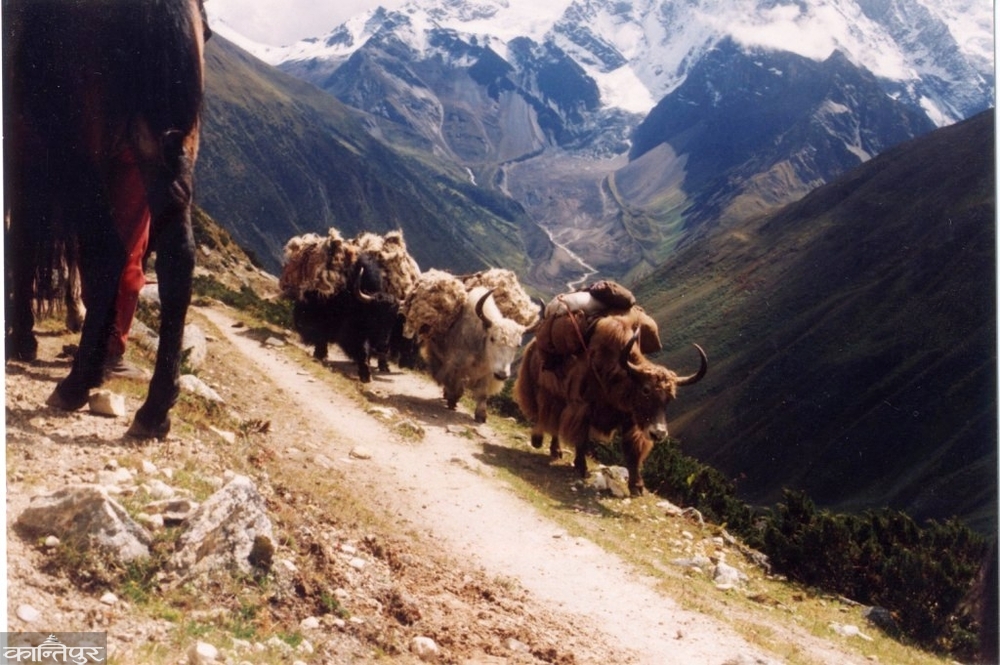
If you go in spring, this place is resounding with the sounds of new leaves and flowers covered forests and the birds singing the spring festival. The waterfalls are hidden. The rivers and steep brooks have dried up. The wounds of landslides are starting to heal a little. Small villages and stone-roofed houses are scattered around. Let's move forward, passing Gurung villages. The world with high mountains on both sides is the gateway to Kymolung. There are no other ways to get there. That is why the government has dug a road here and started collecting taxes (zakat) on items ranging from salt to gold. And the name of the place itself became the world. Further on, passing through Sirdibas village and Chum-Nubri rural municipality on the other side, a school with a beautiful building, and a few government offices, the road to Pangsing ends. From here, we ride the motorbikes that are ready to take us up and across the suspension bridge to Eklebhatti. We ride it until the motorbike stops and then walk to Lokpa village.
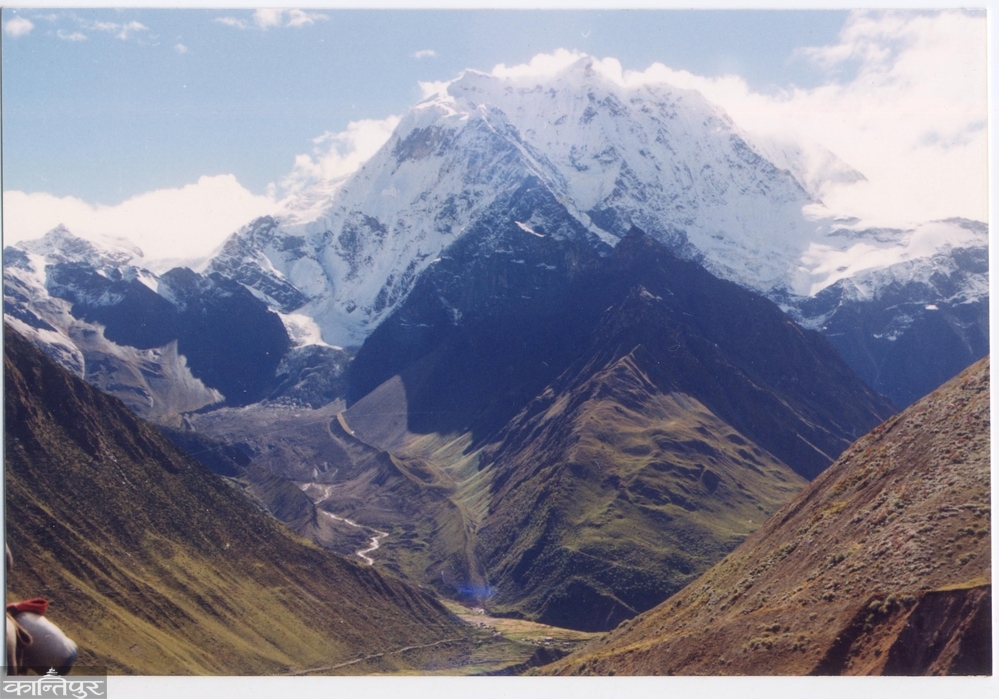
The bed you wake up in the morning on the second day is located northwest of Ganesh and Pabil Himals. That is, today you have to turn south, not north, to see the Himals. The scenery we see is also new. The new fragrance of Lekali incense hits your nose. The sound of the fluttering of flags in the courtyards here enters your ears. The language spoken by the people here (Chum-Nubri) may also be new to you.
Now you can't ride a machine. You can only walk as far as you can on your own feet. If you have been brought down from the pastures of the lake on horseback, you can ride a horse. But let's not imagine that because we have come to walk on our own strength.
Today we will walk from early morning to a place where there is a culture of voting. Let's start the day with tea made with salt, ghee and Chinese tea leaves. For those who have not been to the lake before, I have prepared a new kind of 'breakfast'. That is Champa - or Lekali grain satu. In a bowl, add satu and a little water, knead it like dough, make a ball, and eat it. It will be firm, you will not feel hungry soon. It may not taste good at first, but this is the breakfast for the rest of your stay here. If you cannot eat Champa, they will make you prepare another kind of breakfast.
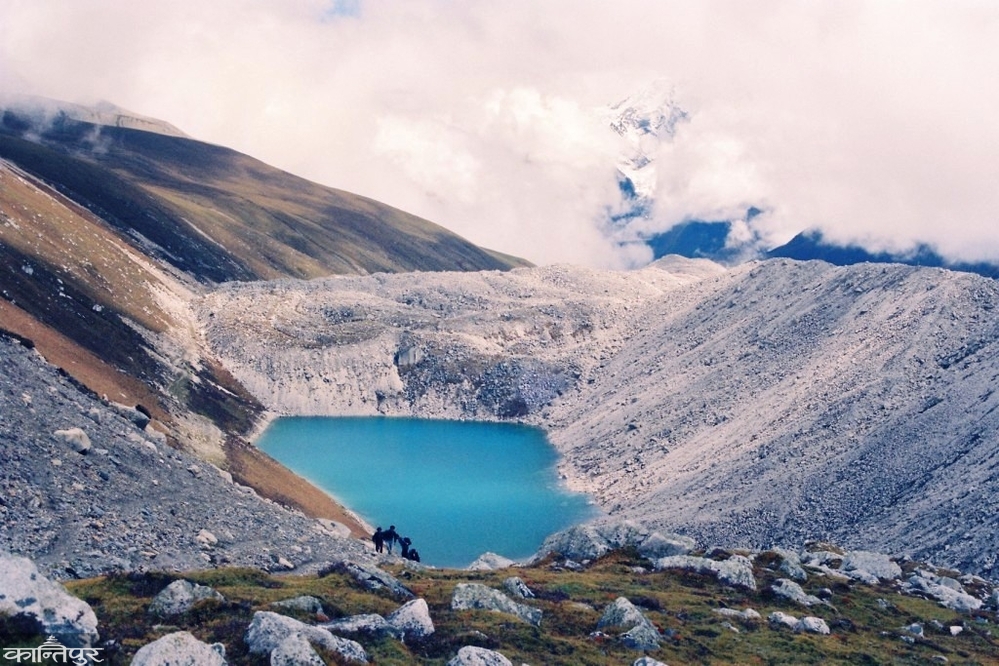
We will take the eastern branch of Budhi Gandaki, i.e. Syaar Khola, and turn right. We will move forward looking at stone walls, houses with wooden roofs and chortens lined up on the road. The settlements here are not dense. Even those that are there are not many houses. The high mountains, the triangular-shaped mountains like the mountains, are visible from the curtain of tall pine trees, and you don't realize that you have reached Chumling. This is a place to have breakfast and rest for a while.
Today is the first day of the trek. So let's not walk much, let's stay in Renjam. If you had come with a tent and food and you could walk uphill for three to four hours, I would have walked south from here and taken you to the base camp of Ganesh Himal. However, that walk is a bit tough. On the third day, I walk uphill a little in the morning. After climbing about 600 meters above Renjam, where we stayed yesterday, we reach the western mouth of a valley. It is a new feeling to enter a wide valley shaped like the English letter 'V' from a gorge. By now, we have already learned that Mane comes before we reach the village. You may have heard someone say, 'Mane comes or village comes.'
If you feel like your legs are hurting, remember one fact. It took the film crew, who were filming the attack on the Chinese army in Tibet by inciting the Khampa rebels, 18 days to reach here from Kathmandu. They were only able to travel by motorbike from Kathmandu to Trishuli Bazaar. From there, they walked for 17 days on a difficult road. You have arrived here on your third morning since leaving Kathmandu and your second since walking. We will visit the main places and pilgrimage sites, from the village of Chekampar on the western side of this valley to the settlements of Chule and Nile on the eastern side and the last one, the Mug Gumba.
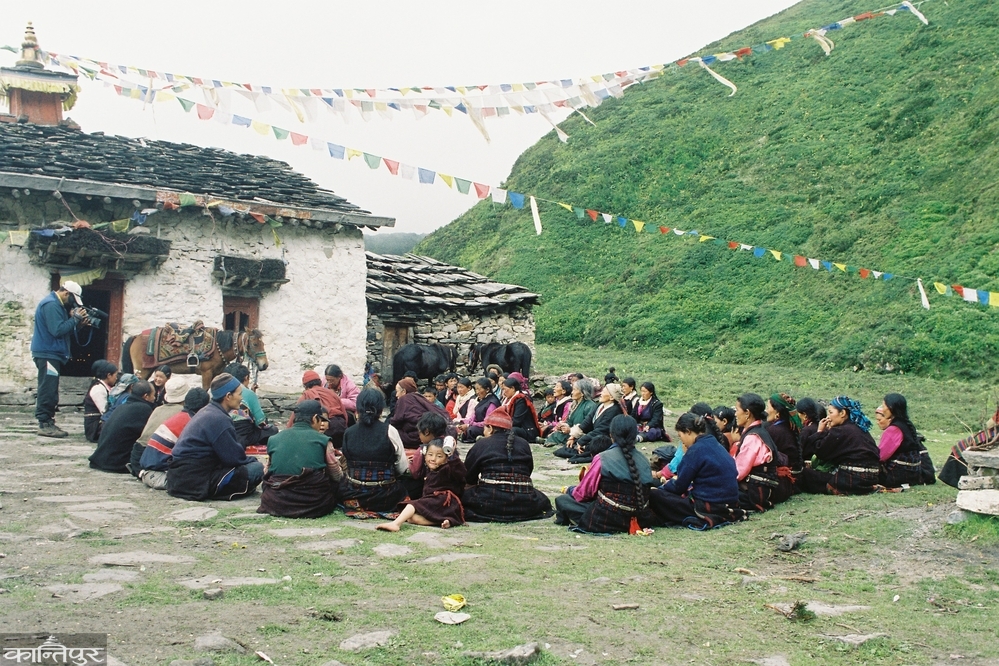
This valley, surrounded by high mountains and hills on both sides, stretching slightly south and east-west, is not only a place of peace for the eyes but also for the mind, because it is part of the sacred Kimyolung, the hidden blissful place, the main part of Beyul, where all other places are peaceful when there is unrest. It is the place where the Buddhist guru Milarepa meditated. The religious leader and the people vowed not to allow violence to take place in this place 105 years ago. Since then, they have repeatedly vowed not to kill any living creature, not to hunt, not to harvest honey, not to light fires, and not to allow animals to be sold for meat to enter. Their vow has been recognized by the Chum-Nubri rural municipality.
After remembering this much at the mouth of this valley and vowing to follow it, let's sit in the courtyard of a hotel, look at the beautiful view, and have a meal. Then, let's walk northeast, looking at the 'Mu' monastery at the head of the valley. Let's stop at the Rachen monastery on the way. Only nuns, or nuns, live in this monastery. It is led by a Lama from Bhutan. If there is a worship service there, let's join it. If you want to see the cave where Milarepa meditated, located on the slope on the right bank of the Syarkhola in front of it, go up there. You don't have to walk very far from Rachen monastery. After climbing about five hundred meters, you reach Nile village. Chule is next to it. Another 200 meters uphill will take us to the ‘Mu’ monastery. We will reach this monastery on a beautiful hill and see the lamas studying and reciting there. If we can, we will reach the ‘Mu’ monastery today and come to the village. If we can’t, we will stay in the village and reach the ‘Mu’ monastery tomorrow morning and return to the village and settle down.
Many Nepalis rush like a fire engine to put out a fire when they travel. They don’t want to do anything when they return home soon, but if they don’t, they do it like the sky is falling. Such travelers get the only benefit they get from sitting at home and watching television. They cannot understand the place, the people there properly and enrich their lives through their association, even if it is short. I would like to say to such travelers, as Laxmi Prasad Devkota said, ‘After all, the world is already ours, you didn’t build a house, you didn’t build a tree, you didn’t add a single star.’
So let’s spend about 48 hours in this valley. Let us try to climb a ladder by contemplating the geographical structure here, the mountains, the hills and the sun, the life of the people of this place called the hanging valley beyond the mountains, and the spiritual height.
Another sacred place of Kimyolung is Serang (Shringi). This small tarn located in the middle of the forest in the lap of Shringi Himal feels truly heavenly. On the wall of that tarn is the Serang Gumba, where lamas sit to achieve spiritual heights. It is believed that there is a treasure hidden by Guru Padmasambhava to the east under the cover of Shringi Himal.
On the fifth day, let us head towards Serang. To get there, we have to return the same way we came yesterday and reach the place where the Syar Khola merges with the Budhi Gandaki. Let us return after seeing the views we missed on the previous trip. If we settle down in the evening, the next morning, we will reach Serang by walking a slightly difficult uphill and a downhill from the banks of Shringi Khola. The path other than the uphill is very beautiful. On the other side, the Shringi Himal and the Serang Monastery and the surrounding forest look very beautiful with clouds.
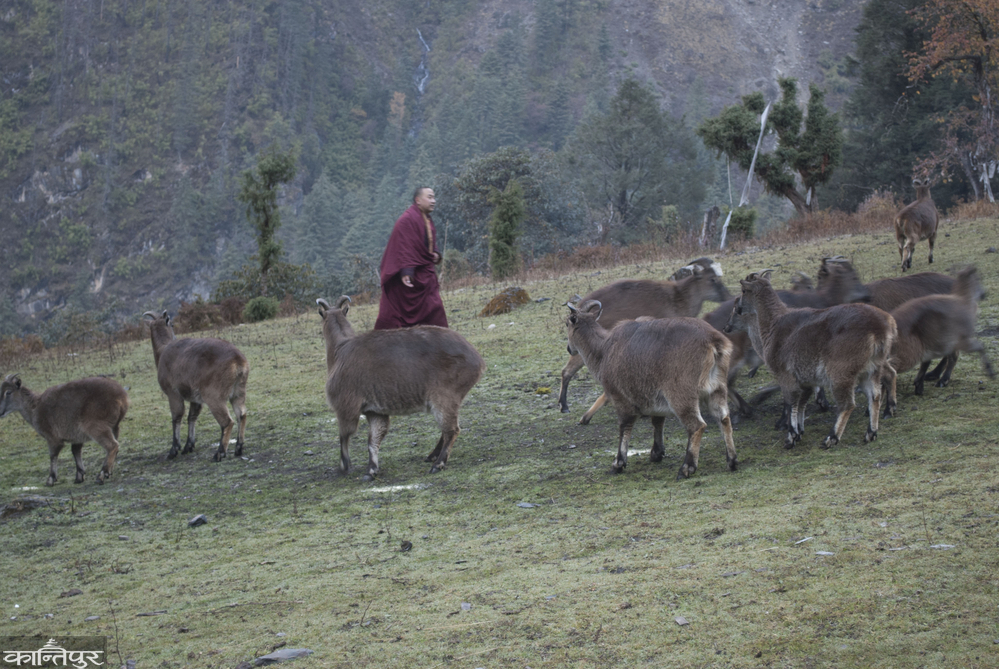
The surrounding part of the Shringi Himal is Kimyomolung. It also includes the Tibetan part. You have to stay in the monastery in the evening. The next morning, you will see a supernatural scene here. The wild animals here are not afraid of humans. They come to the courtyard near the monastery to eat salt from the hands of the lamas of the monastery. It seems that they know the promise made by the people of this monastery under the leadership of the lamas of this monastery to make this area free from violence.
You may be tired and have already returned. Let us tell you one thing here – the place you have reached was considered so sacred and excellent that until Tibet was open, pilgrims used to circumambulate the Shringi Himal for 45 days. On the sixth day, we will see the sunrise adorning the Shringi Himal. Then, we will return the way we came yesterday.
Nubri, located to the northwest of Kutang, is no less sacred and beautiful. It is not fun to go back the way we came from here. Let's go through Nubri and go to admire the Manaslu Himal. Today, let's reach Prok. From there, we could have gone up to visit Kal Lake, but since the main road is long, we did not go there. Instead, let's go through fields planted with corn, karu, barley and potatoes and apple orchards and reach Lho village to stay.
The next day, we have to wake up before the sun! From there, we have to see the unique view of the sun's rays covering the mountains from top to bottom. After that, we can reach Syala village and have breakfast. There were a few temporary huts in Syala Bazaar, which is now so densely populated. Let's reach Sama village early and make arrangements for accommodation. Then let's visit the nearby Birendra Lake. If possible, let's see the cave where Millerpa meditated. The ninth day's route is a bit difficult.
Early in the morning, let's climb about 300 meters and reach Samdo. Samdo means Dobhan. Once there was a big market in Samdo. Nepalese used to come from below with rice and other grains, Tibetans used to come from above with salt. Nepal's trade was good, but now it is not like that. Now let's go up from here. After reaching the top of the hill, let's look back once and see the village of Samdo and then head west and reach Dharamshala and settle down.
On the tenth day, we have to cross the Larke Bhanjyang, which is west of Dharamshala and north of Manaslu. We also have to climb a little. Although this Bhanjyang is only 5,100 meters high, it is difficult because we have to walk a long and tiring path to reach the Bhanjyang. There is also a risk of getting sick at this place. Therefore, we should pay a little attention to food and drink. After crossing the Larke Bhanjyang, the journey to the holy place ends. In the evening, we will stay in Bhimtang and walk a little, then we will take a vehicle and go home via Lamjung.