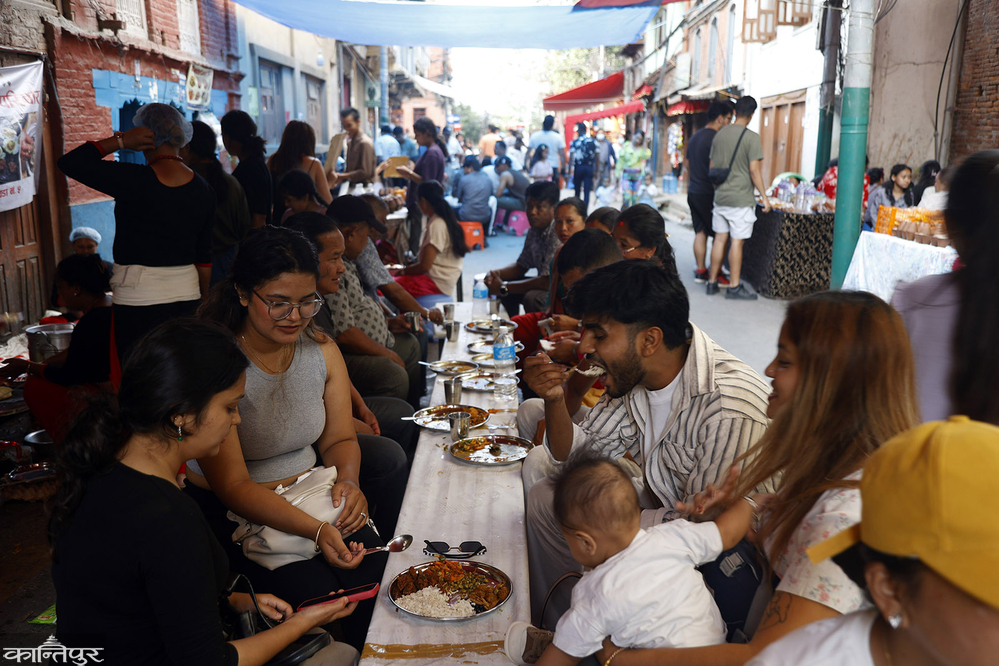
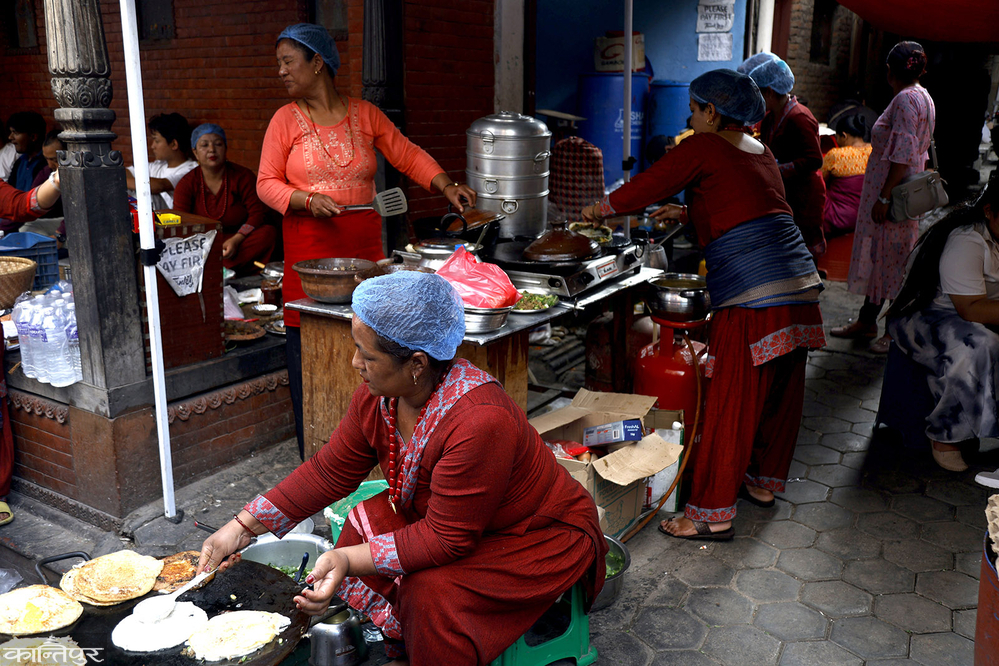
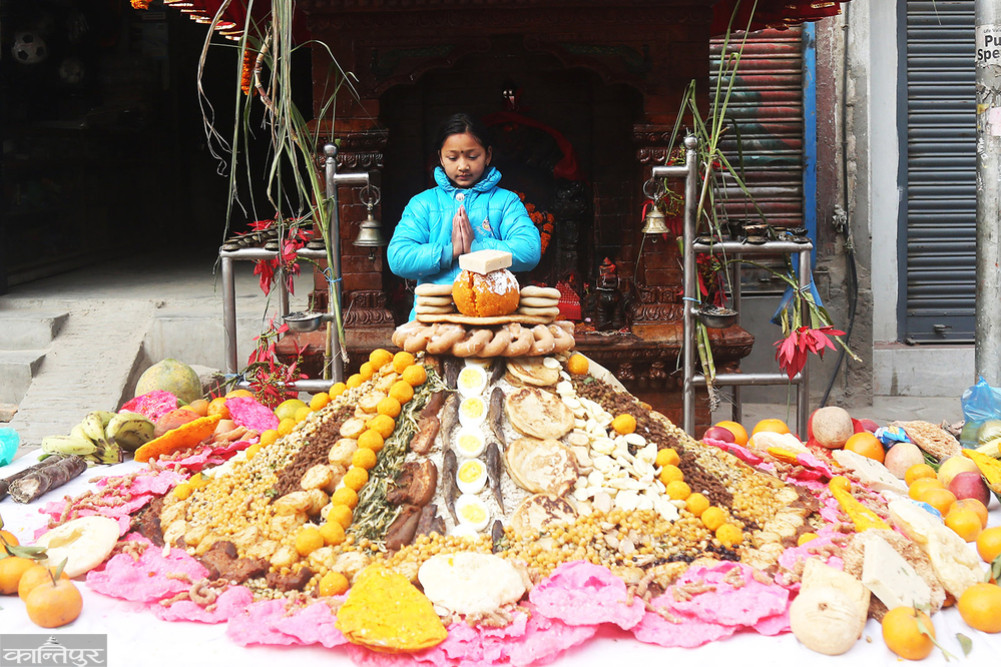
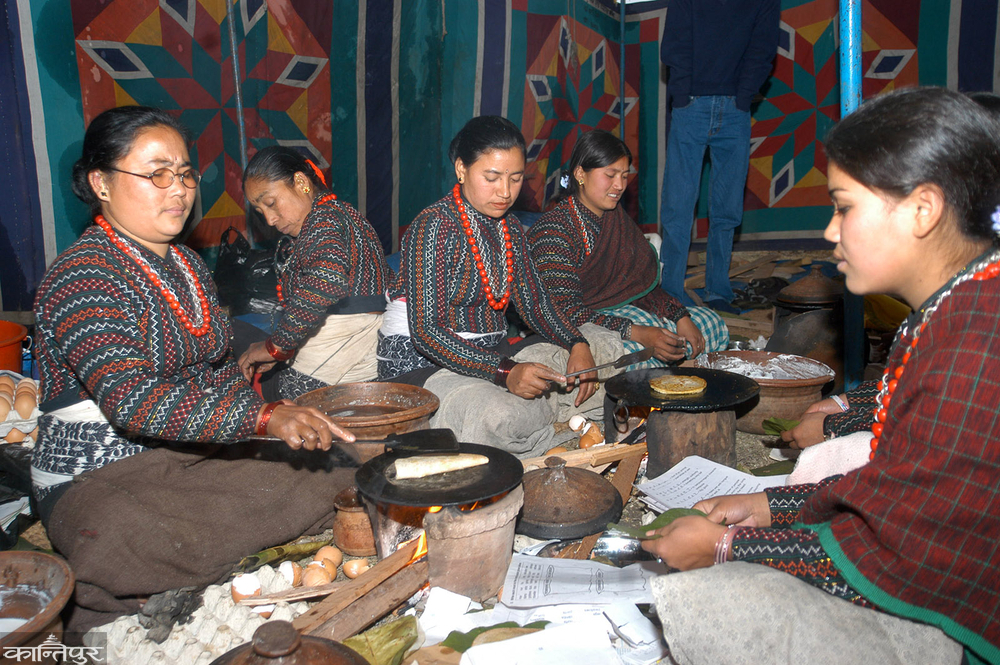
Neva: As culturally important as the grandeur is, the artistic side is equally beautiful. Food is prepared by garnishing various vegetarian and non-vegetarian dishes on top of baji (chiura) and hakumusya (black soybean) around a green lapte i.e. a big tapri covered with leaves, which is called bhay bwa (feast set).
We use Google Cloud Translation Services. Google requires we provide the following disclaimer relating to use of this service:
This service may contain translations powered by Google. Google disclaims all warranties related to the translations, expressed or implied, including any warranties of accuracy, reliability, and any implied warranties of merchantability, fitness for a particular purpose, and noninfringement.
Nepal is rich in food. The Hocho area of Jhapa from Kechna to the top of Mt. Everest, from Kakdbhita to Mahendranagar and from Taplejung to Darchula contains the original taste and specialty of Nepali cuisine. Along with geography, the taste and style of food also changes. The taste of our food is preserved by our agricultural system and lifestyle. Nepali food is a cultural school, where the world of taste meets. In this issue of 'Koseli', we have tried to discuss our food from different geographies. Presented in the food series Neva: The Food Story of Culture:
It has been 30 years since 63-year-old Chiribabu Maharjan of Lalitpur Thechwa played the role of Suvah (head cook) in Nevah Bhyav (feast). Be it the feast organized by the Guthi every year on the occasion of the festival or the various festivals and rituals of the Newar from birth to death - he plays the role of Suwa.
At the young age of 14, he learned to make various dishes according to the feast by going to Lahailhai with his father Nhuchchelal. Nhuchchelal was also sleeping. Nowadays, people often remember Chiribabu when they have to organize a feast in the village. The way of making his tempting dishes is admired by everyone.
He is also in the role of Suva for the Thechva Mataya Jatra, which is celebrated the next day of the Gaijatra. They say, "Suwa is not a chore". Must be very sensitive. You have to be able to live in daily activities.' He said that he is trying to preserve the culture and traditions related to Neva: not to earn income.
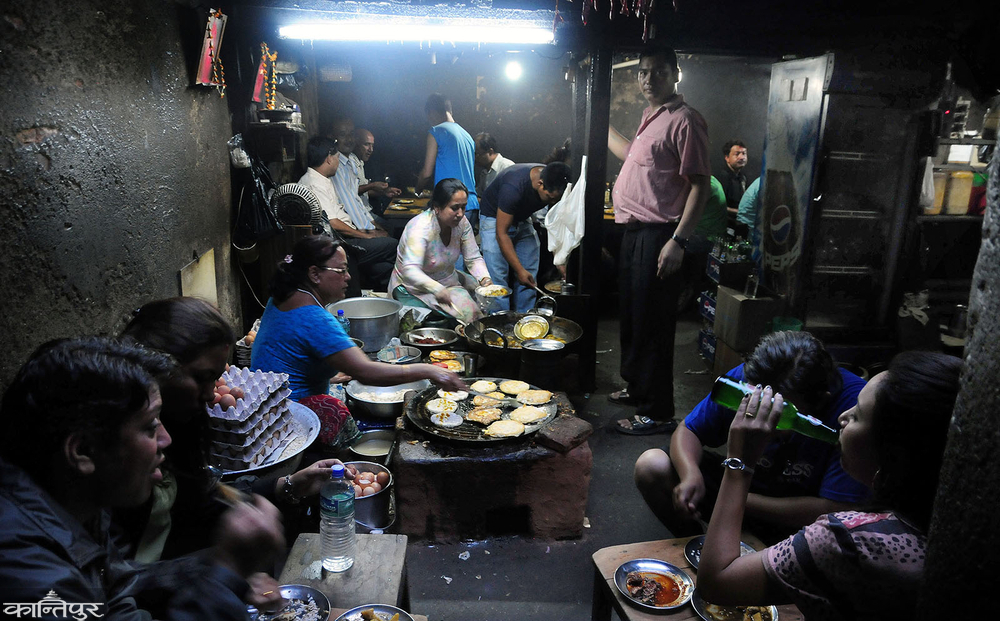
Newar community has 366 festivals in 365 days. Along with the festival, many rituals should be performed throughout the life of the Newars. Feasting is mandatory in all of them. Let's say more, without feasting, no culture and rituals are completed in the community. The Newa community celebrates 28 festivals throughout the year, apart from the fairs celebrated in their respective areas. 25 Harahari Sanskars should be performed from conception to death.
Some feasts are organized according to wishes, economic conditions and traditions. However, there is a strict rule that death rites are not complete without a feast. There is a saying, 'Rana broke with Mozle, Newar broke with Bhoj.'
Newa Bhavay is as important culturally as its artistic side is equally beautiful. In the middle of a green lapte i.e. a big tapri covered with leaves, baji (chiura) is placed on top of hakumusya (black soybeans) and various vegetarian and non-vegetarian dishes are arranged around it.
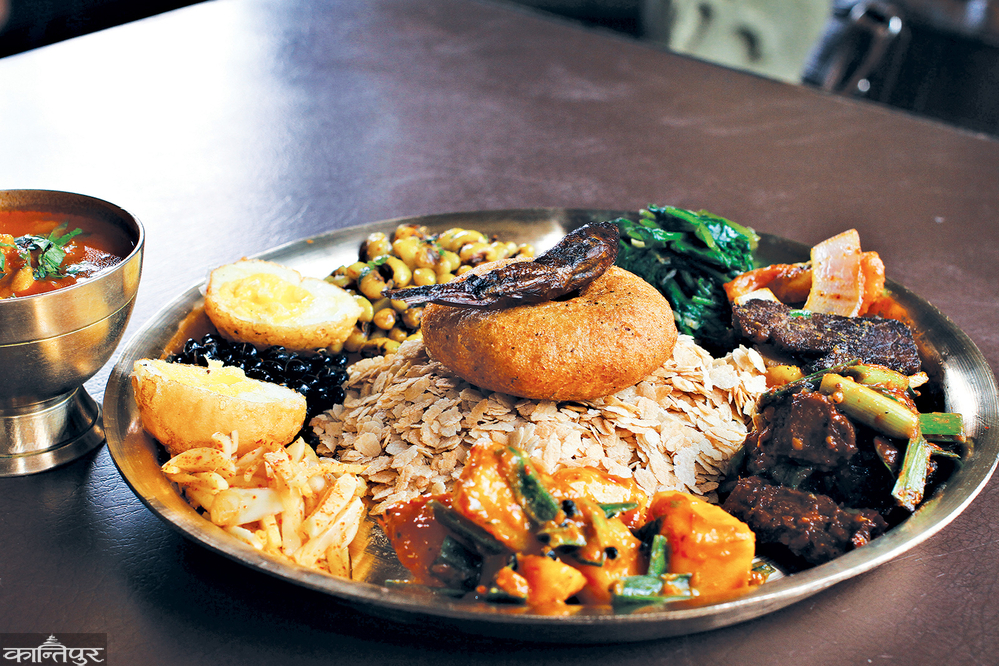
Agiltir sali (earthen bowl) is filled with thawan (white chyang) . And the guests who are sitting to eat the feast and the women who are dressed in hakupatasi adding various dishes saying bapi bapi (eat, eat) are larko . "Bha Thaw" has now disappeared . It is a very soft and hard shell .
The scene of the actors adding thwam, ayla: to the svama (earthen pot of water) and anti (metal liquor vessel) saying vaticha vaticha (little by little) has the power to make everyone go crazy as soon as they say Neva: Bhvay .
Newa: Rajendra Tubanja Shrestha, a student of Vyav, from Madhyapur, Thimika, says, "According to the nature of the feast, a minimum of 4, 8 and 12 types of dishes are needed to prepare Vyav Bv". For 'Saymbaji' feast, 4 types of dishes are enough . There should be at least 12 types of dishes in a Guthigana or family feast and a minimum of 12 dishes in traditional feasts such as Kulchibwa, Sanjbujumbwa, Gubwa, Jantabwa etc.'
According to him, the dishes should be arranged in order while preparing the bhay bwa. "Can't be kept arbitrarily." The method of preparing Bhay Baw is called 'Bwa Tye Guh','' he said .
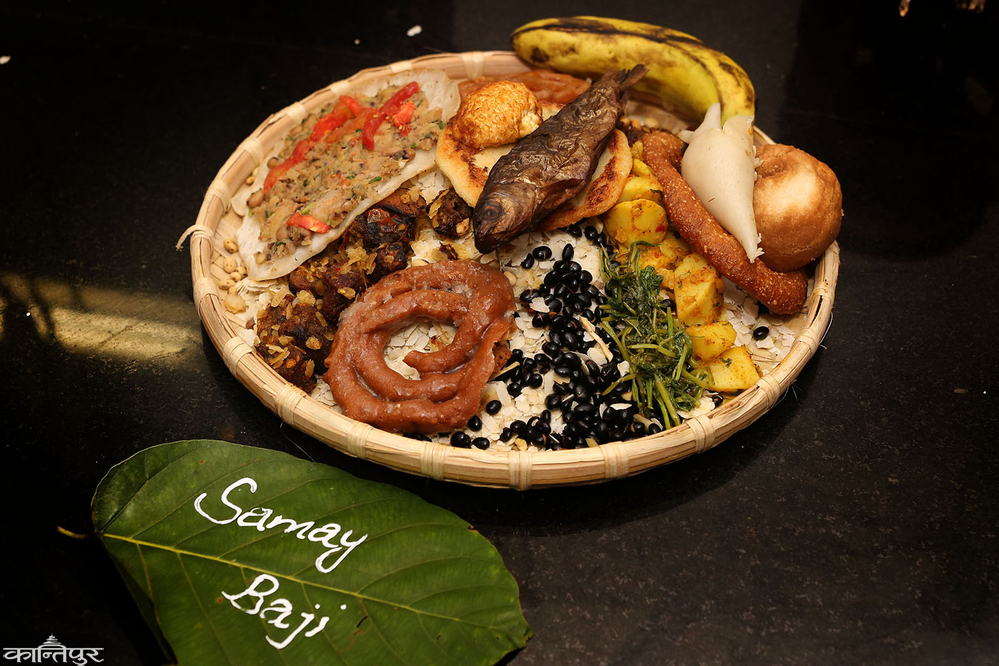
In Neva Vyav, first the chiura, then the prasad used in the puja, and then successively soybeans, garlic seeds and aduwas-small pieces of mushyapalu, bara, choyla, eggs, greens, fish, chicken, fry, khipichpi (a dish made by cutting raw kuvindo into squares), phassi (a dish prepared from kuvindo), bub: (small banana, bhuti and rajma), pickles and potatoes are kept . It is called
- food should have eighty-four dishes. However, it is not possible to prepare eighty-four dishes due to financial reasons as many people are being fed. It is said that Khapichapi is kept as a symbol of eighty-four consonants .
After that: Kha means thalathle, Nyakhuna (Piro thalathle made by keeping raw fish fillets), Dayekula (Ranga kabab), If there is a sacrifice, goat or sheep meat is placed according to the sacrifice .
Anithwan (white wine), Aylaah (liquor), Kathahthwan (black jad) is cooked . Neva-bhayma mishkva (a hot jhol dish made with crushed fenugreek and various spices), pauhkva (a hot jhol dish with sour cream) is a must . These dishes are served in addition to 4, 5 and 6 times . According to Bhoj tradition, Chiura must be cooked before Dayekula and Dhau (yogurt) are cooked. Finally, radishes, cucumbers, carrots, and green bananas ripen in the form of yogurt and salad. Then Ayla: is added as desired.
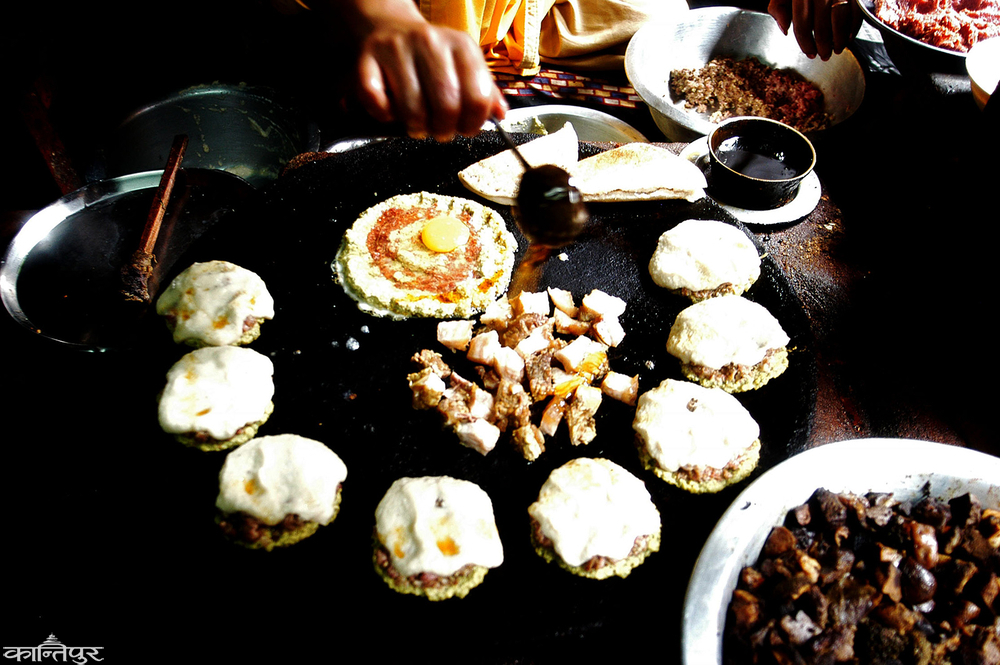
Neva: It usually takes an hour to complete the story . Finally, sukumel, cloves, cardamom, cinnamon, betel nut, coconut, cinchona are provided . Neva: There are few people who cannot stop thinking about Bhay and its dishes . Newa: Bhai is not only delicious but also a nutritionally balanced diet. For health, it is necessary to balance vatha, pitta, and kapha of the body . For this, the food should contain Shadras i.e. sweet, sour, salty, sour, bitter and sour.
A mixture of sweet, sour and salty juice soothes the bath . A mixture of curd, sweet and bitter juice destroys pitta and a mixture of curd, bitter and bitter juice destroys Kapha . Nutritionist Dr. Aruna Upreti says, 'Food associated with Newari festival is good from the point of view of health . Especially these foods contain carbohydrates, nutrients and micronutrients. According to him, curd is considered as one of the Panchamrits. The beneficial germs in curd help in digestion. Since Newari food is rich in legumes, even vegetarians can get enough protein. Lapte i.e. big tapri is taken as a symbol of Ashtamangal or Ashta Matrika . The dish is considered to be a symbol of various gods and goddesses. Syabji (a type of chickpea), black soybean, ginger, choyla and ayla are taken as panchatattva, in which syababji represents sky element, black soybean represents air element, ginger represents water element, choyla represents earth element and ayla represents energy or fire element .
Sagun with an egg is offered to the goddess in the worship of Samyabji i.e. Bhvayma consists of Syabji, Mayvah (meat stick), Usine egg, Kunya (dried fish) and Aylah . In this, the vegetable is considered as the earth element, the egg as the sky element, the mayva as the air element, the kunya as the water element and the ayla as the Tej or fire element.
In general, non-vegetarian and non-vegetarian dishes prepared in Neva are dedicated to Bhairav and Narayan, according to which the right part is dedicated to Narayan and the left side is dedicated to Bhairav and the non-vegetarian dish is decorated.
Neva Bhayma Bhairav, Kali, Barahi, Kumari, Ganesha, Brahmayani, Mahalakshmi, Vishnudevi, Byaghini, Singhini respectively are known as meat, Chiura, Syabji, Kwan Gacha (a dish made of minced bones), Kheyen, Duli, Go, Saag, Jand (black, white) and Ginger, Soybean. Kheyen, Duli and Go Ranga are meat dishes .
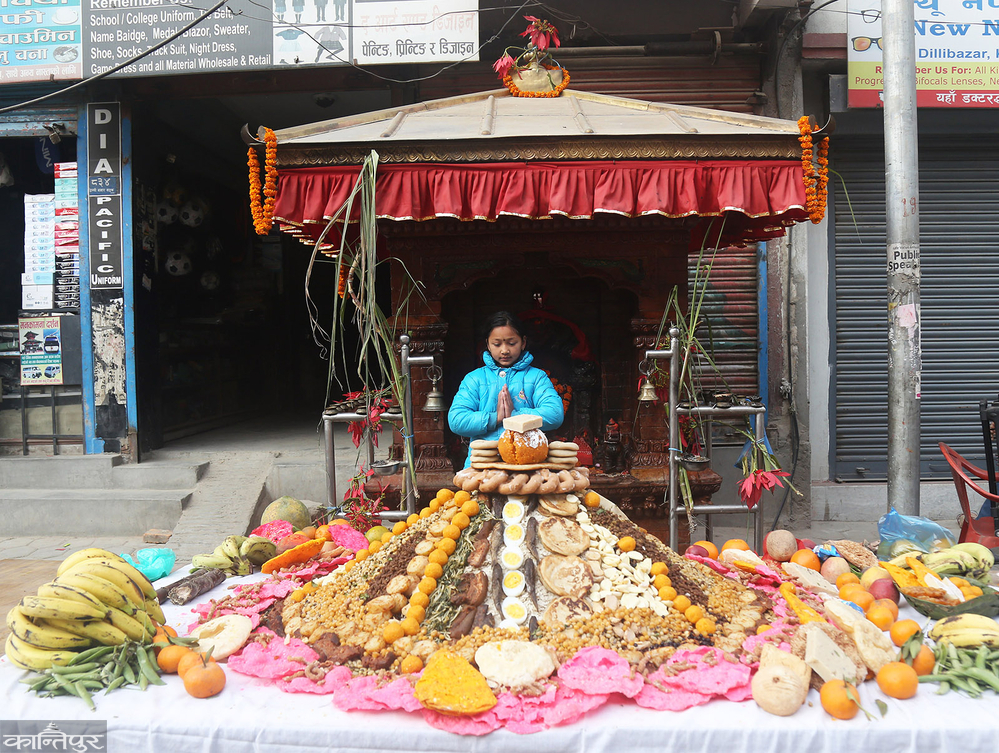
Shrestha, a researcher of Neva: Bhyva, adds, "Neva: Bhvay, which connects with gods and goddesses and ancestors through food and food, is an excellent example of cultural, social and religious tolerance". In Neva Bhavayam, first of all, Dya Bha (Bhaya Set) is kept at the top and below it Agambha (Bhaya Set) is placed under it. "However, there is a different reason for not keeping fire in the worship called Kulacchi and fire," he said.
There is no sure record of when and who started the practice of Bhojbhater, which has so much importance . Writer and actor Malla K. Sunder says, 'As it is found in various records that Rishi Muni had a feast while making a throne, this custom can be considered to have started from the Lichchavi period.' According to him, in the records of the Lichchavi period, it is mentioned that Newar members of the Newar caste sat and had a special feast in the country rescue puja in Luv, Patan, Bhaktapur, Pashupati areas. "Mahasnan of Pashupatinath, Red Matsyendranath's Jatra is found in the Lichchavikal inscriptions about Panejus feasting," he said, "it seems to be developing gradually during the Malla period." Newa, which is organized during festivals and rituals, has now become the main attraction in fairs and exhibitions.
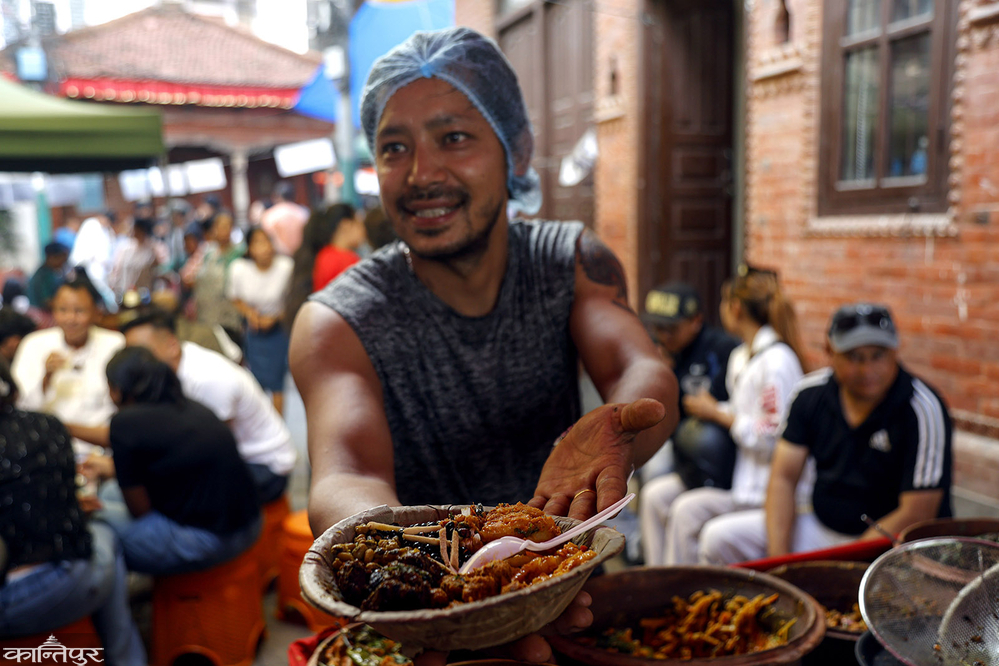
Food festival is held every Saturday in Handigaon, Kathmandu Metropolitan City-5, which is known as ``Journey to Handigaon, which is nowhere''. Handigaon, which has a unique culture, has now become a city of Newari cuisine. Domestic and foreign tourists roam the streets of Hadigaon to taste Newari food.
Some are enjoying the taste of choyla, while others are found sipping the local liquor Ayala . There is an increase in the number of people who avoid the busyness of the city and go a little further to eat Raithane dishes in restaurants. Harisidhi Neva: Suli of Lalitpur Metropolitan City-29, Neva: Lahna and Sasatva: restaurants of Kirtipur are famous, where Newari food connoisseurs are always crowded . Honacha and Newa Ghasa of Patan are also very famous for Newari food. Lately, Neva: Bhay has been organized abroad as well.
Neva: Another profound aspect of Bhay is Suva:, Valin and Sulin . The storage and cooking of food materials such as chiura, meat, curd etc. is done by Valin . Sulin is responsible for storing the intoxicants. The main responsibility of the management is given to the organizer's son-in-law and maternal uncle, while the responsibility of the sulin is given to the woman called Sulin Nike. In this way, the responsible person should properly perform pooja by keeping a banquet set called Bhalim Bhava and Sulim Bhava. It is customary for the head cook to ritually worship the oven before cooking .
In some places, the originality of Neva: Bhay is disappearing . Shrestha, a researcher of Newa-Bhavya says how to prepare feasts eaten on different occasions- such as: Kulacchi Bhavya, Siu Bhavya, Samy Bhavya, Gvaysa: Bhavya etc. Although some dishes are in vogue, they are not being used properly. It is our responsibility to pass down the cultural significance of the Vaya, its types, the method of making and the ancient form, created by the wisdom and hard work of the ancestors. Only if it is preserved in time, the future generations will be able to experience the Newa: Bhav culture.'
He said, 'It is necessary to document the originality of the method of preparing the Newa: Bhvay Bwa, ie banquet set. Due to the lack of documentation, some cultures and rituals have started to be corrupted and disappear.' Neva: Bhvaybina Neva: None of the culture and rituals of the society have been envisioned . However, with the passage of time, luxury has started entering into the funeral feast.
Eighty-four dishes include chiura, fish, farsi, ghee, mula pickle, small/big banana, pindalu, fenugreek, mula, sabji, cooked bara with meat, beans, inkcha/tunk (greens), suwari, black soybean, egg, potato, chatamari, cauliflower, cucumber, orange, garlic, egg bara, bhuti, yogurt, carrot, sukumel, etc. are . Meat dishes include Hinla, Janla, Chunla, Kachila, Daygula, Nikola, Kwenla, Hayla, Mye, Se, Takha, Nyakhuna, Choyla, Dugula, Chhwahighasa, Nugah, Swan, Pukala and Thakula.