At first Bisca: Nakizu was only Ajima's and lasted only two days. In the middle of the Malla period, the practice of performing Jatra to Kashi Vishwanath and Bhadrakali was added, later the tradition of performing Jatra worship to other gods and goddesses was also established, the Jatra period has also been extended.
We use Google Cloud Translation Services. Google requires we provide the following disclaimer relating to use of this service:
This service may contain translations powered by Google. Google disclaims all warranties related to the translations, expressed or implied, including any warranties of accuracy, reliability, and any implied warranties of merchantability, fitness for a particular purpose, and noninfringement.
Bhaktapur is a city rich in culture and heritage. Bhaktapur is full of traditional dances and fairs. Many tangible and intangible assets are scattered here. The importance of the famous Biska Jatra celebrated in Bhaktapur for 8 nights and 9 days has increased in recent times.
Bisca: According to Vikram Samvat, the Jatra starts 4 days before the start of the new year of the solar month. From the second week of Chait in Mari (Taumadhi) toll in the center of the city, artisan communities are active in making Bhairavnath's chariot (Bhail Khah) and Bhadrakali's chariot (Nakiju Khacha). The pagoda-style three-storied Bhil Khah and Nakiju Khachcha, made of wood, are painted and sealed after completion. In the beginning Bhadrakali's chariot is drawn. Then the first day's journey is started by pulling the chariot of Bhairavnath.
Before pulling the chariot, it is customary for the Bhairav Naikes to have a feast after performing the ritual sacrifice at the Bhairavanath temple. The Vetal deity is then seated at the front of the Bhail Khah. After placing the original deity Bhairavnath in Bhail Khah, Khadga and Taleju Bhavani's offerings brought from Hanumandhoka are made to sit at the front of the Prasad Rath.
The first day of the Jatra is said to be Dya Khwah Vijayaigu meaning riding down the deity. In Bhail Khah, 15 people pull the chariot, consisting of 1 jusiju, 6 bhail nikes, 4 carpenters and 4 chaguthi. There are 6 ropes at the front and 4 ropes at the back of the chariot while pulling the chariot. On the first day, thousands of devotees participate to pull and watch the Bhail Kha. Saying Hoste, Hanse...with the same rhythm and voice, the youth pulls the chariot from both sides. Chariot pulling starts from Mari toll. Young people from the lower tol and the upper tol pull the chariot trying to take it towards them.
Rath is taken in the lower tol ie from Mari to Gahhiti, Nasmana, Vansagopal to Tekhapukhu tol. It is taken to Dattatray through Sakotha, Sukuldhoka, Golmarhi of upper tol. Whoever can take the chariot to his village is considered victorious. Then to conclude the first day's journey, Bhail Khah is taken to Gahhiti tol. In the evening all the deities are made to sit down from their seats in the temple. In the local language it is known as Dyahkwan Bijakegu.
On the second day, the Bhadrakali Rath is taken to Azima Dyochen (Bhadrakali Deoghar) at Khalatol in Gahhiti. On the third day at Gahhiti, sacrifices are made to Bhairavnath by the Guthi Sansthan. The meat of the sacrificial puja is distributed as prasad to the people of Lakulache. It is called Syahko Tyahko in the local language.
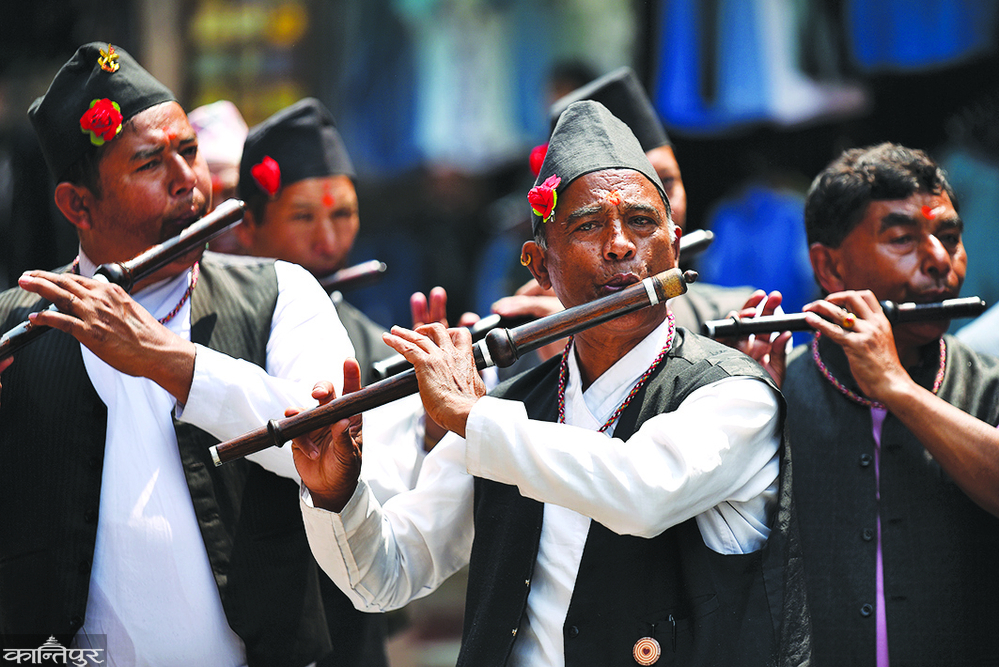
Bisca: On the fourth day of Jatra, i.e. the last day of the year, in the morning, a handless yosin dya (lhamru mha) is erected in the potter village of Talaq, and in the evening in Yosikhel village, the locals prepare to erect a 55 cubit long yosindyo. After duly worshiping the chariot at Gahhiti, the chariot is taken to Yosinkhel. It is customary for the Bhairava Nikes to sacrifice a sheep before raising the lingo ie yosin dya. Yosin Dya is duly worshiped before being erected.
With the help of 8 ropes which are symbols of Astamatrika, devotees raise 55 cubits long Yosin Dyah. The upper part and arms of the yosin dyah, which is considered to be the symbol of Bhairavnath, are wrapped in new cloth. The two flags hanging in Yosin Dya's Kokha are also known as Virdhvaja, Vishwadhvaja, Akash Bhairava's flag. It is believed that Navadurga Devgan will be present here during the construction of Yosin Dya.
Yosin Dya: After the end of the Jatra, there is a special Jatra and Puja of Dumaju in Taleju. Bisca: It is also known as Shatruhanta Jatra as there is a religious belief that seeing the Jatra destroys enemies. On this day, the chariots of Bhairavnath and Bhadrakali are also taken to this place. Yosin Dya: Thimpwa Jatra of Barahi Devi is celebrated in Vansagopal tol.
Bisca: On the fifth day of Jatra, Lingo ie Yosin Dya is thrown on New Year i.e. 1 Baisakh. After that, there is a tradition of fighting the chariots of Bhairavnath and Bhadrakali in Khala Tol. It is called Dyah Lwakigu in the local language. Dumaju Devi Jatra is also performed in the evening. Yosin Dya: The festival of raising and lowering is the main festival of Bisca. Historians and cultural experts say that the Malla kings started the tradition of celebrating the Jatra for eight nights and nine days, including the Rath Jatra of Bhairavnath and Bhadrakali, adding tantric worship methods and laws.
In the middle of the city on the sixth day, there is a procession of Mahakali and Mahalakshmi, on the seventh day there is a procession of Brahmayani and Maheshwari along with the procession. On the eighth day, all the gods and goddesses in Bhaktapur city are worshiped. It is called Dya: Svanga Biigu in the local language.
Bisca: On the last day of the Jatra, 5 Baisakh, the Jatra is concluded by pulling the chariots of Bhairavanath and Bhadrakali. This day in the local language is known as dyah (deity) Thaha Bijayaigu i.e. riding on the deity. On this day, Bhairavnath and Bhadrakali's chariots are pulled like the first day of Biska: Jatra. Yosin Dya, the handless yosin dya, erected in the local Talaq village, is also toppled on the same day in the morning. During the Jatra period, Bhaktapur city is adorned with the Jatra of all the Goddesses of Ashtamatra, Ganesha, Bhairav, Kumari and other Goddesses.
According to Anant Dhaubhadel, a culture lover and a resident of Mari Tol, in the beginning Bisca: Jatra was only a Jatra of Nakiju Azima. According to him, Kashi Vishwanath Bhairava came to Bhaktapur to see the Biska: Jatra, the tantriks cut off his head with a sickle and kept it in Bhaktapur. To make Kashi Vishwanath Bhairav sit here: Bhairav's temple was built in Mari village and Biskah Jatra was celebrated by making Bhail Khah and Nakiju Azima's khat.
According to culture expert and historian Purushottamalochan Shrestha, it has been found that the word bisik is mentioned as a synonym for Vishwa Ketu in Tamsukpatra of Nepal Samvat 500. In the inscription of Nepal Samvat 561 of Yaksha Mall located in Bhaktapur (Tah Mari) Toumadhi, it is mentioned as Vishwa Jatra for the first time while addressing the Jatra. Similarly, the word Viskyat is mentioned in the records written in the royal court of Bhaktapur during the reign of kings Jitamitra and Bhupatindra Malla of Nepal Samvat 808 and 818.
According to Shrestha, the biska running in Taleju is referred to as Vishwajatra Mahaparva in the Sankalp Puja of the Jatra. Based on these evidence Vishwa Ketu is a Sanskrit word. In the last period, according to the Newari nomenclature, Visik, Biskah became Biskah. It has become a biscuit due to corruption. He says that it is still called Biska: Jatra in Nepali language.
Biska: Mentioning that the Jatra is only associated with Bhairavnath and Bhadrakali, Shrestha says that the legend of snake slaying and Naganagini is just an illusion. According to him, this Jatra is not only of Vishwanath Bhairav but also of his own Shakti Bhadrakali. A pair of halipats (flags) hoisted at Yosin Dya as symbols of Vishwa Bhairavnath are actually those of Bhairava and Bhadrakali. Shrestha's argument is that there is a widespread misconception that Bisk, Biskah, Bisket is running in the sense that "B" means "snake" and "Syat" means killed.
In ancient times, this festival was celebrated only for two days. The practice of performing Jatras of Kashi Vishwanath and Bhadrakali in a Jatra lasting only two days began in the middle of the Malla period. Bhaktapur's Vishwa Malla, Gangarani, Jagjyoti Malla, Jagatprakash Malla, Jitamitra Malla, Bhupatindra Malla have contributed to the tradition of worshiping other deities as well. The main Jatra of Biskah is to lift a Yosin Dya (Lingo) with Vishwaketu on the day of Chaitra Shukla Masanta and hoist a pair of flags on it and throw the Yosin on the day of Baisakh Sankranti.
Bisca: Culture expert and historian Purushottamalochan Shrestha says that Jatra is not only a unique cultural identity of Bhaktapur but also a symbol of prosperity and civilization for the whole human being. According to him, since there was a lot of forest around Bhaktapur city at that time, a large and tall wooden lingo was raised so that the Jatra could be seen from all sides and later a pair of flags were added.
Bisca: Guthi Sansthan Bhaktapur branch manages the budget for the Jatra. Guthi Sansthan is also responsible for arranging animals and worship materials for sacrifices at various monasteries and shrines during the Jatra period. Even after the Jatra is over, the Guthi Sansthan also carries out the necessary inspection, puja, demolition of the chariot and safe storage of the material. According to Khima Wali, head of the institute's Bhaktapur branch, 4 lakh rupees are allocated annually to run the Biska Jatra in Bhaktapur. But this year, 28 lakh 64 thousand 265 rupees were spent on the pilgrimage. Bisca: According to Wali, the head of the institute, the Jatra is being conducted under Amanat Guthi.
Sunil Prajapati Biska, head of Bhaktapur municipality, says that Jatra is Bhaktapur's priceless tangible heritage left by ancestors. He says that the municipality is playing a coordinating role to protect this tangible heritage. "To celebrate the Jatra in a peaceful and safe manner, we have organized a harmony rally, raised public awareness about the Jatra, and called a meeting with the relevant agencies," he says.
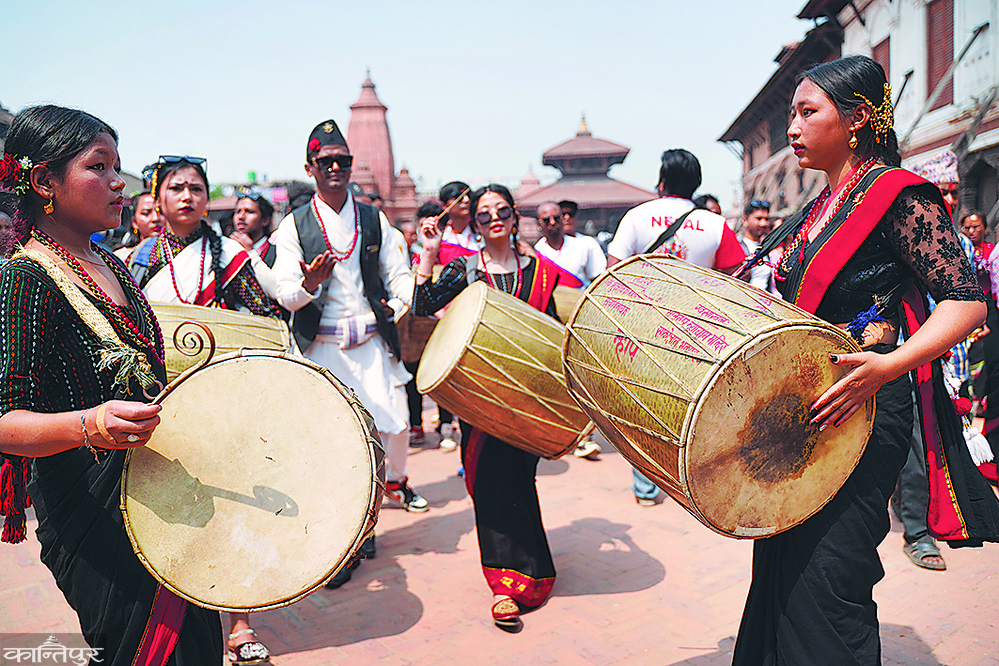
Bisca: Toumadhi Youth Club, Kumari Yuva Club and Bhairavanath Jatra Management Committee have been deployed to make the Jatra organized and dignified. Shivram Bhuju, President of Toumadhi Youth Club, says that the youth's interest in Jatra is decreasing recently. "Even though the number of people coming to watch the Jatra is increasing, the number of young people who pull the chariots and stand the yosi dya is decreasing," he says.
Jatra of Madhyapur Thimi
Bisca: Jatra is also celebrated in Madhyapur Thimi with great fanfare. The Jatra, which starts on the morning of 2 Baisakh from the Balkumari Mandir premises in Madhyapur Thimiko, is called Swinikh (Thirty-two Khatko) Jatra. Now this Jatra is also known as Sindur Jatra called
. Thimiko Bisca: The main attraction of the Jatra is this Jatra. It is also known as Suthsiya i.e. Morning Jatra. On this day, local devotees celebrate Jatra by throwing vermilion on each other. Cultural experts say that it is called the Jatra of thirty-two khats because at one time 32 khats participated. But now 19 Khats participate in this Jatra.
To start this journey, all the deities have to come to the local Balkumari temple complex. After the arrival of Nagesh's Siddiganesh, there is a tradition of starting the Jatra by exchanging omens, but due to an incident that happened a few years ago, Nagesh's Siddiganesh Thimi has stopped coming. After the Jatra starts from Balkumari, the khats are taken towards Chapacho. Then the deities of Siddhikali Gana are made to circumambulate the Chapacho region. The deities of Balakumari and Vishnuveer Gana return from Digutol and after circumambulating Nigupukhu, Inaylachi, Dathutol, Marutol, the Jatra ends with a khat at Laiku. Dakshin Barahi Jatra, Siddhikali Gana Jatra, Bishnuveer Gana Jatra and Siddiganesh Jatra are celebrated on 1st and 2nd Vaishakh in Nagesh.
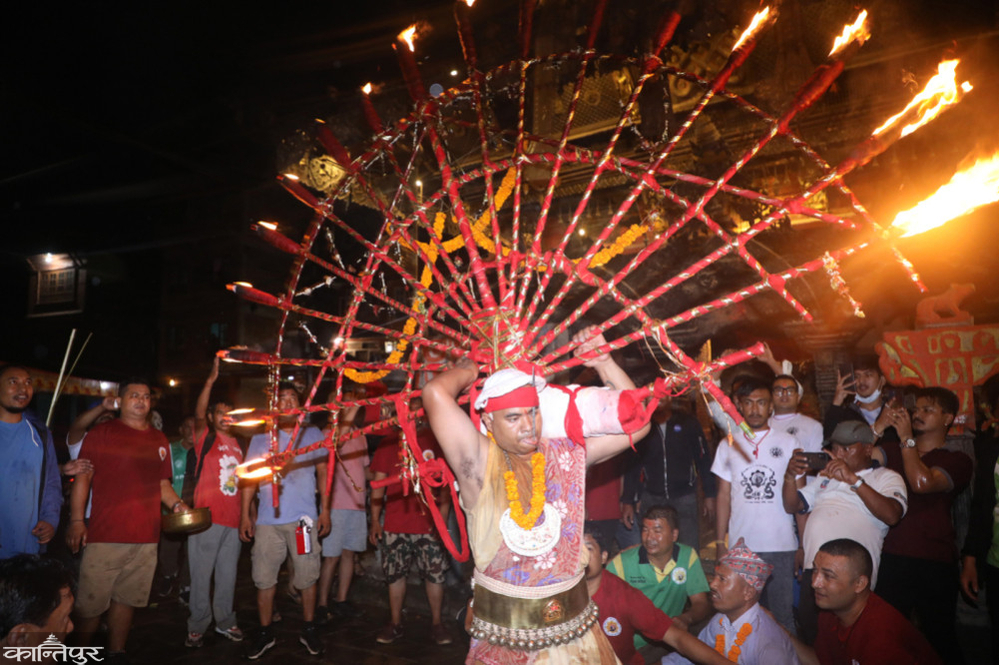
The tongue piercing festival is celebrated on 2 Baisakh in Thimi Bode of Madhyapur. This festival is celebrated by piercing the tongue of a local youth of Shrestha clan. The tongue piercing jatra is started on the platform on the eastern side of the local Pacho Ganesha. It is a tradition that a person who pierces his tongue should not eat anything for three days, and should not touch animals or women. After the piercing of the tongue, the pierced person goes around the city carrying the crescent moon playing the Nayokhin baja. After the circumambulation, locals go to the Mahalakshmi temple, where a worker, Nike, takes out a needle at Pacho Ganesha's Rohwar. Soil from Mahalakshmi temple is placed on the tongue with a hole. The needle is hit in the Ganesha temple. A tongue piercer worships Nateswara and performs Jatra immersion.

