Four years after the opening of girls' school by the government and 33 years after the opening of Trichandra College, Padmakanya, the first women's college in Nepal, was opened.
We use Google Cloud Translation Services. Google requires we provide the following disclaimer relating to use of this service:
This service may contain translations powered by Google. Google disclaims all warranties related to the translations, expressed or implied, including any warranties of accuracy, reliability, and any implied warranties of merchantability, fitness for a particular purpose, and noninfringement.
Bhim Bahadur Pandey has written his book on the Nepal of that time - 'Around the year 2003/04 (during the reign of Padmasamsher), if there was any concrete progress in Nepal, it was women's education.'
The book written by Pandey, who worked for a long time in the Rana administration since the time of Juddhashamsher and held many high positions in the state-administration even after the end of the Rana's rule, is considered by many as a strong 'reference book'. After writing the
, Pandey did not have the facility to deny it, but the doubt that 'was it really like that?' We have been hearing and reading that the common people did not have the facility to read and write during the Rana regime. The literacy rate of Nepal in 2007 (less than 2 percent) also reinforces the same thing.
After Prime Minister Juddha Shamsher resigned in November 2002, Padmashamsher became the new Prime Minister. At that time, there were huge movements for freedom in the neighborhood and the outside world. The winds of change were blowing. Such a window had penetrated even within the Nepali border.
If the window of change was not followed, the century-long banyan tree of Rana rule was destined to break. Padmasamsher seemed to be able to guess this fact. That is why the somewhat liberal Padma, who received the title of 'Runche Maharaj', stood for gradual reforms. Although the other pillars of the Rana regime were not reformed, some relaxation was seen in the society during the time of Prime Minister Padma.
Taking advantage of that openness, schools started to open especially in the cities of Kathmandu Valley and in some outlying districts in the main Gounda. In addition, Padmasamsher said that women should be educated in such a way that "Nepali woman's good manners are not harmed", so the way for girls to go to school was opened to some extent. After Padma's statement, the common people made an inquiry to open a girl's school, and accordingly, in 2004, a girl's school was opened by the government in Kathmandu. First, the school ran in the morning session at Darbar School and later shifted to Dillibazar. Soon after that, one non-governmental school was opened in Kathmandu and one girl's school in Lalitpur.
Three girls' schools were established in a row at a time when there was no school for girls. Other schools are gradually moving towards co-education. In the streets of the city, girls were seen walking to school or returning from school carrying bags. If Bhim Bahadur Pandey saw the never-before-seen scene as a great progress of the immediate time, it should not be taken otherwise. With the opening of girls' schools, girls also started to climb the ladder of education and with it, a small number of SLC exams began to appear and pass. Since 2005, women (2 persons) have taken the SLC exam as private students, and in 2006, they also passed the SLC from New Girls' School. Meanwhile, 2007 changed. The 104-year-old Rana regime, which prevented the Raitis from even getting an education, collapsed. The
began with the change in governance – what many call the 'Renaissance Era'. Those who were transformed from raitis into masses now joined together and engrossed themselves in doing social work of their interest and interest. Many types of organizations were opened all over the country. There was a rush to open libraries and schools for themselves and their descendants. Despite the expected improvement in the political sector, Professor Kamal Prakash Malla called the period 2007-17 the 'decade of extroversion' or the decade of extroversion.
With the change, the expectations and demands of the common people will increase. The women also united among themselves and started making various demands in their own way. Their one such demand was the establishment of women's college. As girls and other school-educated girls gradually moved up the ranks, it was not unusual for college to be in demand. One of those demanding a women's college was Punyaprabhadevi. According to the news published in Gorkhapatra on 27th Chait 2007, while giving a speech at the 12-year celebration of JP School held after the change of year 2007 (in Chait), he made a strong voice for women's college. Punyaprabha was the leader of Akhil Nepal Mahila Sangh, which was opened after the change of 2007, and in that capacity she was invited as a speaker at the festival.
The impact of the changes in 2007 is also evident in Nepal's journalism sector. Along with the announcement of Raja Tribhuvan on 7th February 2007, Jagran weekly and Awaz daily started publishing from private level. Later many other newspapers were also published. In the last page of the 11th issue (13 Baisakh 2008) of this new newspaper Jagran Weekly, a letter titled 'Mahila Intermediate College' has been printed.
A letter published in the name of student Kumari Sheela, who wants to study in a women's college, indicates that efforts are being made to open a women's college in the immediate future - "It is heard that there is an industry from some elite to open an intermediate college for us." She suggested in that letter that a women's college can be run in the morning at Trichandra College, just like when the government opened a girl's school in the morning session at Darbar School.
Although it is said that the letter printed about the college which is supposed to be opened, the concern of those students is a little different, so it seems that the letter was not written by the student but by a teacher teaching the college. She writes - 'The education of Trichandra College and the education of women's college should be kept at the same level (standard) due to the current lack of experienced Nepali professors until the shortage is filled.
An ordinary, just-going-to-college student's interest in what kind of teacher will teach him seems a little out of place. In that letter, it is further written: 'If the professor of the college has to teach a paper that he did not teach in the women's college, the education of the college will be affected. Therefore, every professor should only teach the paper he teaches.'
Anyway, one thing that Kumari Sheela wrote was right - at that time, inquiries were being made regarding the opening of women's colleges by the government. According to the material on 'Nepal-Education-Department's work progress' published in Gorkhapatra dated 15th June 2008, the new government/Education Minister entrusted Shankardev Pant with that task and Pant also gave a report to the Education Minister according to the responsibilities assigned to him. The minister discussed the plan with his ministry staff and other ministers and also requested the cabinet to arrange a budget for the establishment of women's college. In the
news, it was said before - 'If it is passed by the cabinet, this work will be started for the establishment of the college as per the plan. Since the economic situation is understood to be very critical, it can be opened with the help of the government as much as possible since the world's support is more than from the government.'
While it was being said that a women's college was about to be opened, a rumor that such a college would not be opened spread in Kathmandu - the city of rumors, as poet Bhupi said. Two women, Shanta and Sita, accused the then Principal of Trichandra College, Rudraraj Pandey, of obstructing the plan to open a women's college through a letter in Jagran Weekly. And threatened, "If the women's college is not opened, there will be a protest against the education minister and the principal." In the first week of July 2008, Jagran and Gorkhapatra published news about the women's college at the same time. It has been stated in the news that a women's college is going to be opened in Kanya Mandir High School, which was opened in Nhyokha on a non-governmental basis, so that intermediate level classes will be conducted soon. For this, it is said that there is a discussion between the school authorities and the Minister of Education.
After the opening of the first women's college in Kanya Mandir with government assistance, there was further discussion about it. Some say there is no time to establish women's colleges. Someone said that there is no need for a separate women's college, Trichandra itself should be run as a co-educational college. And the other way, if it is going to be run with government support, why should it be run in a community-run Kanya temple, why not set up in a government school? A big 'lobbying' started to establish that college in Padmakanya Vidyashram which was opened by the government.
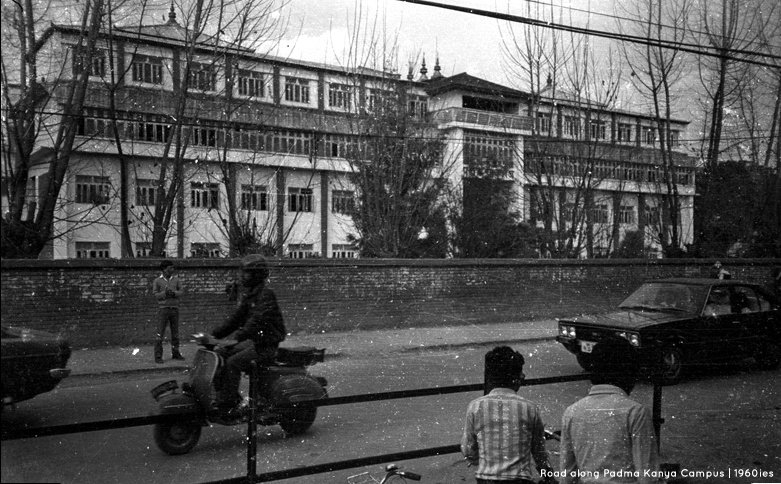
Finally, after much struggle, Nepal's first women's college was established on October 17, 2008 at Padmakanya Vidyashram in Dillibazar. Initially, it was said that the Queen would inaugurate, but later King Tribhuvan inaugurated Nepal's first women's college in a grand ceremony. The inauguration was attended by Ranidwaya, Prince Mahendra, Home Minister BP Koirala, Education Minister Nripjang Rana etc.
When Trichandra College was established in 1975, there were only 3 students. Initially, 9 students were enrolled in Kanya College, who were taught by the teachers of Kanya School and Trichandra. Geography, history, psychology, Nepali, economics and Sanskrit subjects were taught in the college at the IA level. The principal of the college was appointed Bodvikram Adhikari, who was ill. Devi Prasad Rimal replaced him.
In this way, the first women's college 'Padmakanya' was opened in Nepal four years after the opening of girls' school by the government and 33 years after the opening of Trichandra College. In 2007, the Rana regime was overthrown and democracy did not come. Because in 2005, Chandrashamsher's son, Mohanshamsher, who was considered liberal, came to power after ousting Padmashamsher, who was said to be a bit liberal. He was trying to stem the tide of change, following in his father's footsteps. However, the people protested. They ended not only Mohanshamsher, but the entire Rana regime. And, opened the door of educational awakening.

