The house built by Madan Bhandari at Morang Itahara keeps his thought, spirit and fascination for culture alive even today, the house is not just a simple structure but a monument to an idea.
We use Google Cloud Translation Services. Google requires we provide the following disclaimer relating to use of this service:
This service may contain translations powered by Google. Google disclaims all warranties related to the translations, expressed or implied, including any warranties of accuracy, reliability, and any implied warranties of merchantability, fitness for a particular purpose, and noninfringement.
Madan Bhandari, the then General Secretary of UML, was a visionary thinker of Nepali politics, a powerful speaker and an extraordinary leader who was in the hearts of the people. V.No. His short life was not limited to politics only, who died mysteriously at Dasdhunga in Chitwan on 3rd June 2050. The way of life, thinking and culture made that trip more special.
Itahara village is reached after descending 16 km south from Urlabari on the East-West Highway. There is a small and deserted settlement here – Satmedi. This is the work house of public leader Madan Bhandari. From here, Madan Bhandari envisioned today's communist path and contributed significantly to the birth of CPN (Malay).
The political theory of the CPN (UML) "People's multi-party democracy" (Jabaj) was planted by Madan in and around this house. Leader Madan Bhandari's Morang Ithara home is a blend of progressive thought and culture. This house, where Madan planted the seeds of communist philosophy in the thirties, is awaiting preservation today.
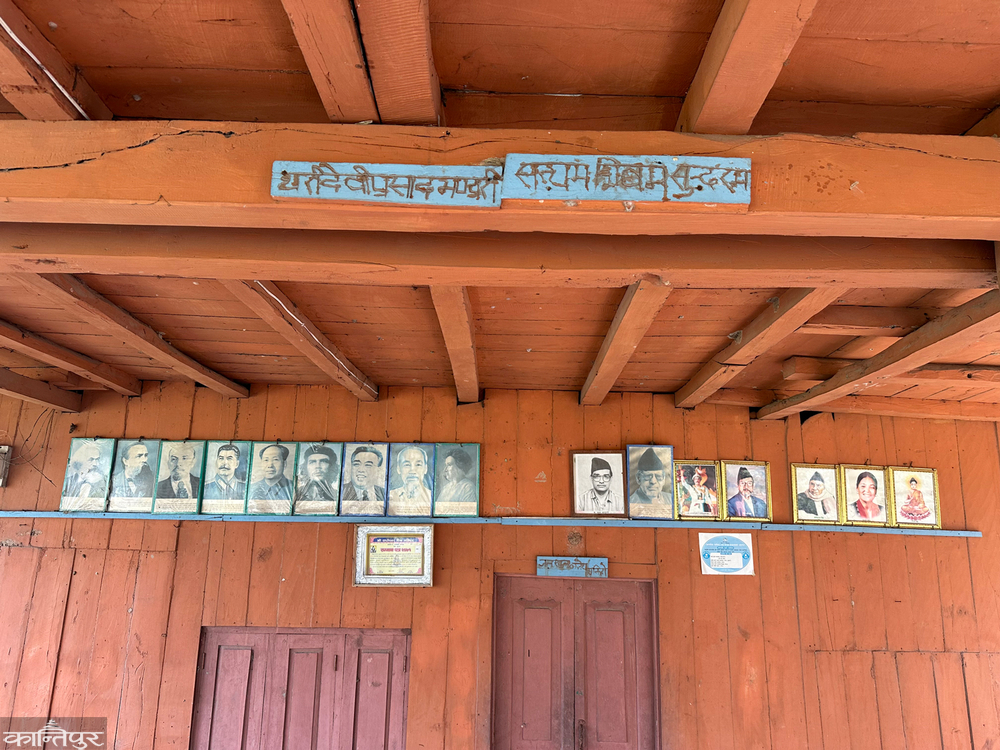
I had the opportunity to see 'Madan's house' on this June 26 with the late Madan's wife and former president Bidya Devi Bhandari. It is this wooden house that keeps Madan's ideas, his soul and his fascination for his culture alive even today. This house is also a monument to an idea. The house is decorated with Sanskrit verses and mantras. Madan did not only build the general structure of the house, but also the plantation of that idea. Sanskrit mantras and Nepali sayings engraved on the wooden dalins kept in the house have made it like a temple of thought. The
mantra is written - 'Satyam, Shivam, Sundaram'. That means truth is Shiva, truth is beautiful. Near the staircase where friends, relatives and guests come, is written in Nepali, 'Namaste, basaun hain.' Madan has written these words in Sanskrit and Nepali by carving letters on the wood. Such eternal mantras and writings reflect the depth of his thoughts. He made this house not just a place to live but a place of pilgrimage for consciousness.
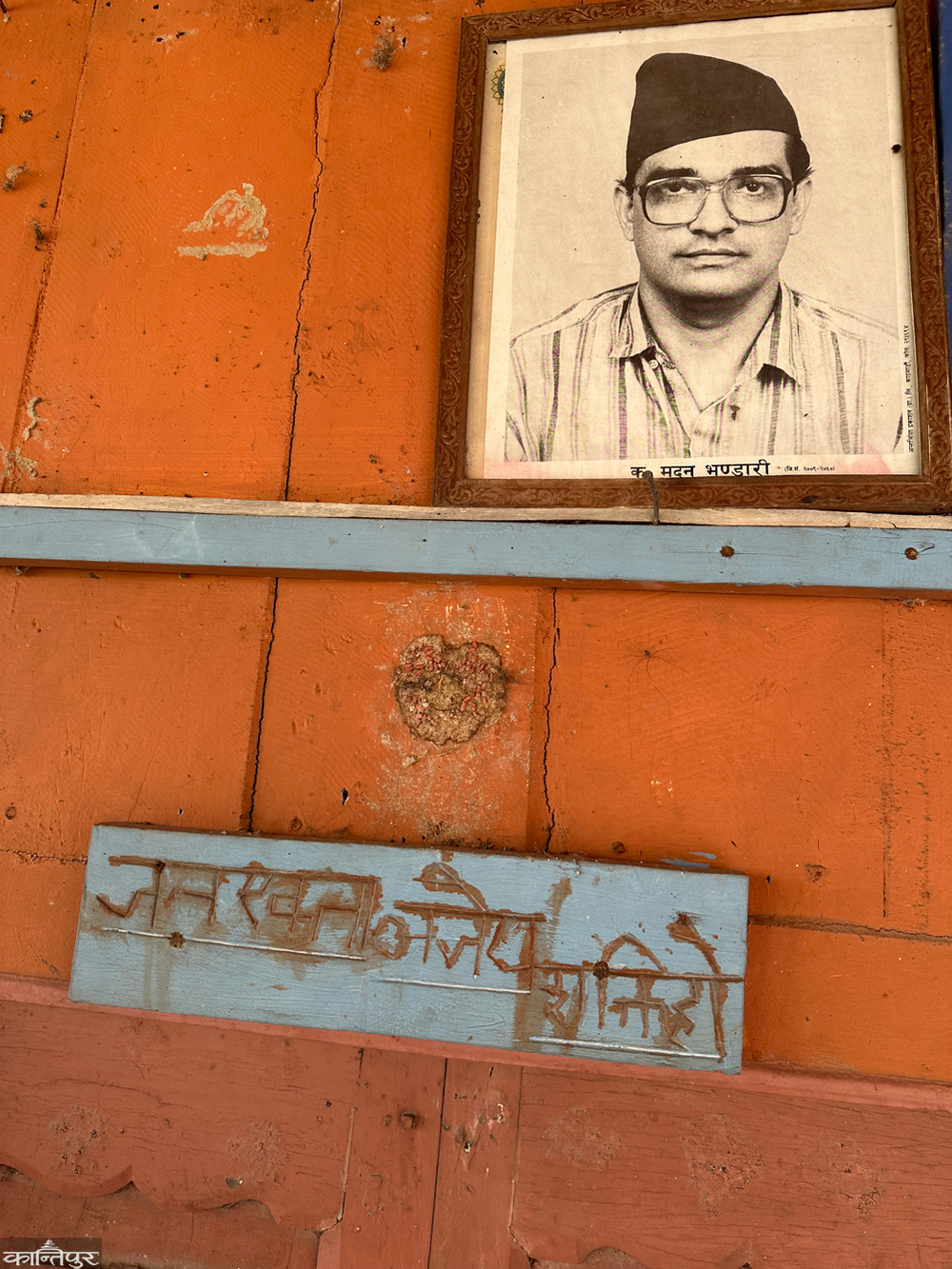
It is written on the wall of the guest room - 'Janaekta is an invincible power.' This sentence that Madan wants to say has a very deep meaning. This means that when people unite, their collective power is so strong that no one can overcome it, stop it or suppress it.
Here, 'people' means common people, masses, or general Nepali people. Madan has considered the people as paramount. 'Ekta' means harmony and cooperation based on common goals, ideas, feelings and struggles. 'Invincible power' means such an invincible (never losing) force which has the power to win against any power, tyranny, injustice or exploitation. Madan understood the unlimited power of the people, in stark contrast to the current leadership. Anyone who reaches Madan's house and reads this sentence may have the same question. Written in the year 2030, these sentences give deep and lasting meaning. It seems that he is also trying to convey the message of national unity through this sentence. Madan's message was that people's unity is the basis of democracy, social justice and equitable society.
In the case of Madan Bhandari, this house was also the starting point of his political journey. Madan returned to Ithara after completing his studies from Banaras when there was a debate whether the communist movement of Nepal was an armed rebellion or a pre-peace people's movement. It seems that after returning from Banaras, he designed this house by learning from Sanskrit texts with the aim that it would be comfortable for his parents and that he could live safely even when he came and went. Family members say that his village friend Bhakta Bahadur helped him for this.
Janshakti is deeply connected with his political philosophy. It can be easily understood that he chose the path of bringing about change by uniting the majority of Nepali people. It is for this reason that Madan envisioned a theory like 'people's multi-party democracy' based on public opinion. In fact the said sentence established the omnipotence of public opinion. It took a long-term shape under Madan's leadership when Nepal's communist movement was fragmenting from the Jhapa Rebellion of 2028. On this basis, it can be said - 'People's unity is an invincible power' is not just a sentence, but a revolutionary philosophy, which calls upon the people to be aware, organized and capable.
Madan's bedroom is upstairs on the east side. Above the room is written in Madan's handwritten letters, 'Do not enter without asking.' The first defense can be taken from this request. Another thing, if someone tries to enter Madan's bedroom, a tunnel has been constructed so that he can secretly hide inside from Madan's bedroom.
From there, you can sneak up to Buingal, not only Buingal, but you can turn around and get out on the other side of the stairs. ``Actually, that art or Kaligarhi should be accepted'', said CPN (UML) vice president Guru Baral, who worked closely with Madan, ``Madan learned that art from the study of Sanskrit.''
Located in a quiet area of Ithara in Morang, eastern Nepal, this house is no ordinary house. When Madan Bhandari built this house, it was not just for living, it was a reflection of his philosophy, culture and thoughts. The ideals, culture and education in his life were embodied in this house.
Sanskrit verses are also engraved on the wall of this house - 'Sarve Bhavantu Sukhinah'. Such mantras not only make the house holy, these verses inspire everyone who steps into the house to follow the path of moderation, social religion, truth and humanity.
Madan Bhandari and love for Sanskrit
Madan Bhandari's love for Sanskrit started from Thotne village of Taplejung Dhungesanghu where he was born on 14 June 2009. His passion for Sanskrit education was transferred to Madan from his father Pandit Devi Prasad Bhandari and brother Swami Mahidharananda (Dr. Manoj Kumar Bhandari). According to Swami Mahidharananda, Madan, who initiated Sanskrit education in the local district, went to Vrindavan in India to study Sanskrit education in 2023. After studying in Dehradun for a short time, Madan took higher education in Sanskrit from Banaras.
Madan joined the communist movement through the Pushpalal group while passing through Banaras. But in a short time, they develop a feeling that there will be no revolution in the country by staying in exile, for that they should return to their country and unite the movement. With this feeling, he entered Nepal and rebelled with his friends who were in the Mukti Morcha at that time. And, they return to Itahara.
At the same time, he starts meeting leaders/activists associated with the Nepali Communist movement, which is divided into various groups, including the Jhapali group. And, they start sowing the seeds of the new idea of unity from Itahara. At the same time, it also becomes the house of Ithara. It is not only a house, but the flow of ideas expands from here. CPN (Malay) is established in Tek Bahadur Rai's house nearby.
Although many communist leaders were opposed to religious or traditional rituals, Madan Bhandari was an exception. He believed that religion and rituals are not just different subjects of faith but are the backbone of our society's civilization and social life. On the wall of the house, it is written on one side, 'Thari Devi Prasad Bhandari.' Thari means the head of the village, Devi Prasad means Madan's father was the root of that house.
sanskrit verses pasted, a proven home of pure and transparent lifestyle was witness to his serious contemplation. Another verse 'Satyam Shivam Sundaram' also reflects the personality of Madan Bhandari - simple, honest and well-mannered nature.
In Eastern civilization, truth is Shiva (welfare) and Shiva is considered beautiful (beautiful). It was this profound meaning that Madan wanted to connect with his life. Also, it seems that Madan tried to apply some of the advanced philosophy of Sanskrit in his practice and also tried to make it relevant to the Eastern philosophy in his political thought, which philosophy he brought to Sri Ganesh from Itahara.
He understood well that 'truth is pure and purity is actually beauty' from the study of Sanskrit. What message did Madan Bhandari try to convey by writing this sentence in his house? He seems to understand well that walking on the true path in life is the path to well-being. He believed that the value of truth and purity should be paramount in politics, social service or personal life.
Therefore, Ithara's house is not only a wooden house, it is also a center of emotion. Not only a leader, but a thoughtful person's soul and simple lifestyle can be seen here. There was a plain bed, a library full of books which have now disappeared from there. An open space for welcoming guests and a balanced environment – all this shows that for him the house is not only a place of rest, but also a laboratory for the development of ideas.
The importance of that house in today's context
Whether it is the house built by Madan in Itahara or the house in Taplejung Dhungesanghu where he was born, it is becoming dilapidated due to lack of protection. Without long-term protection, the weakening of this house does not mean that only the house is weak, it is the weakening of ideas and faith in UML and the loss of confidence.
Former President Bidya Devi Bhandari, who recently came to Ithara to see the house she entered after marrying Madan Bhandari, drew the attention of the government to take immediate protection of these houses of the people's leaders. Bhandari said, "Although she has been raising her voice for the protection of this house for a long time, she has not been heard." And it is the duty of the present government to protect these houses.'
After the village of Itahara was transformed into the current Ratuwamai Municipality, the history of Itahara is also in the process of being erased. Local resident Shiv Prasad Poudel, who understands the historical importance of Madan Bhandari, wants to make this place Madangram by including this house of Madan.
In this regard, the local residents also gave a memorandum during the recent visit of former President Bhandari. Now, as we celebrate Madan's birth anniversary, on June 14, we are not only remembering his contribution, but envisioning his home as a memorial. When we reached that house, we felt his decency, clear thinking and dedication to the people.
It is relevant to convert that house into 'Madan Smriti Museum'. It should now be UML's duty to transfer Madan's ideas to the new generation and preserve his traditions. Because it is not only the house of Madan Bhandari, that house is a heritage that includes Nepali politics, thought and culture.
In the opinion of Yogesh Bhattarai, secretary of CPN-UML, one of the staunch supporters and lecturers of 'people's multi-party democracy', 'the house of Ithara built by Madan Bhandari or the house of Taplejung Dhungesanghu, where Madan was born, are not just ordinary physical structures. "Those houses are the witnesses of an era - where ideas are alive, traditions are speaking", says Bhattarai, "When we celebrate Madan's birth anniversary on June 14, even looking at those houses, let us resolve to put our lives on the path of serving the people with truth and sincerity."
Heartfelt tribute to Madan, a simple and loyal communist leader who passed away forever at the age of 41.