That Mukumlung-Yatra is not just an event, but a struggle-saga written in the background of history
We use Google Cloud Translation Services. Google requires we provide the following disclaimer relating to use of this service:
This service may contain translations powered by Google. Google disclaims all warranties related to the translations, expressed or implied, including any warranties of accuracy, reliability, and any implied warranties of merchantability, fitness for a particular purpose, and noninfringement.
In Mukumlung, the state opened fire on the anti-cable car movement on 081 Magh 12. Three protesters were injured. The wounded were brought to Kathmandu and the next day when I went to visit the University Teaching Hospital, my mind went to those barbaric events of the Madhesh movement.
I remembered that dark time when Madheshis were shot in the name of constitution making. When I saw that the sons of Limbuwan were being oppressed again today, one question arose in my mind - 'Why shoot at Limbu who had to fight to protect his own land?' Why does the state always adopt the path of repression?' I was trying to go to 'ground zero' to find the answer to this question. Meanwhile, the Sangharsh Committee decided to march from February 6 to 8. I resolved to travel.
The desire to travel to Mukumlung was not just political, but spiritual. I felt that Yuma-Mang (the goddess of lemons) was calling me to her sacred land. Also, being a spiritual person myself, I went to Mukumlung to seek the blessings of the Goddess.
This place in the lap of Phaktanglung (Kumbhakarna Himal) is not only geographical but also a symbol of identity, faith and struggle of the Limbus. At Mukumlung, the Yuma-Mang welcomed us through the blowing snow while the state terrorized us and tried to turn us back. However, it has also opened the way to complete the incomplete revolution that could not connect our Madhesh-Pahad. And, the need and justification of the national liberation revolution has been realized.
I am a Madhesi born in Nadhiman, Sarlahi. Being active in Madhesh politics, growing up at 150-250 meters above sea level, it was a challenge for me to travel to Mukumlung at an altitude of about 4000 meters. We started the Mukumlung Yatra with the determination to stand shoulder to shoulder in the struggle against the exploitation of the center of Mundhumi faith in the name of tourism and economic development for a long time.
Mundhumi Trail
I grew up in Madhesi culture and Samthar terrain. It was difficult to reach Phungling headquarters on the first day (February 7) by passing through Dharan from Biratnagar on the dirt road of Tamor Corridor and sometimes on dusty roads. We stayed that day at the Snow Leopard Hotel of Khagendra Fambo, Chairman of Mukumlung Cable Car Cancellation Struggle Committee. The next day, we drove from Fungling to Kaflepati in the morning, where hundreds of youths were ready for the reception. We carried the sticks hand in hand and started - Mundhumi Trail.
Starting from Kafle Pati, the first stop of this journey was the Great Fedi, where hundreds of people took the soil in their hands and took oaths. Ram Maden swore to us, 'We will save Mukumlung, Yuma-Mang is watching.' I also took a handful of mud mixed with snow and swore three times - to save Mukumlung. Showing worship and reverence in Kanchi Than, one of our team went up to Mukumlung Yatra to take the blessings of Yuma-Mang, while the other team went to the cable car substation construction site to warn those who hurt Yuma-Mang and exploit Mukumlung.
I vowed to fast throughout the journey to make the journey purposeful. So I was walking determined to reach the place for darshan without eating. Due to the recent snowfall and the difficulty of walking for the first time at an altitude of 4,000 meters, the journey was moving at a very slow pace. The journey was beautiful with the snow covered stairs, pilgrims going uphill and pilgrims returning after darshan. Although the mountain journey is difficult, maybe it is because of the power of Yuma-Mang, I felt that I will move easily in the arms of the snow chain.
When I reached Yuma-Mang in Mukumlung, all the tiredness of the journey disappeared, my mind was refreshed. There we organized a kamsha pooja for the encroachment on Mukumlung by the exploiters with the Yawa Shamba and Thevas as witnesses. Meanwhile, we were elated by the news that our friends put up a valiant fight with the police and drove back the exploiters. However, we saw on the way back – the cable car side (government side) conspired. The local cable car supporters were stationed for gangsterism by blocking the road. The atmosphere was getting uncomfortable. After that the second chapter of Mundhumi trail started.
We were waiting for a rest at Thapa Hotel in Kaflepati and a comfortable environment to reach Phungling. The night was falling, it was decided to stay there. Vigilantes (state gangsters) and even the administration in that hotel showed fear, threats and terror to the hotel owner. Around the hotel, under the protection of the administration, local gangsters came to beat the door with sticks and cut off food and water. Perhaps if it wasn't for my personal security, we would have been hit directly. A tense situation prevailed throughout the night. This situation was seen till 12 o'clock on the next day, February 9. There was no exit position. After the
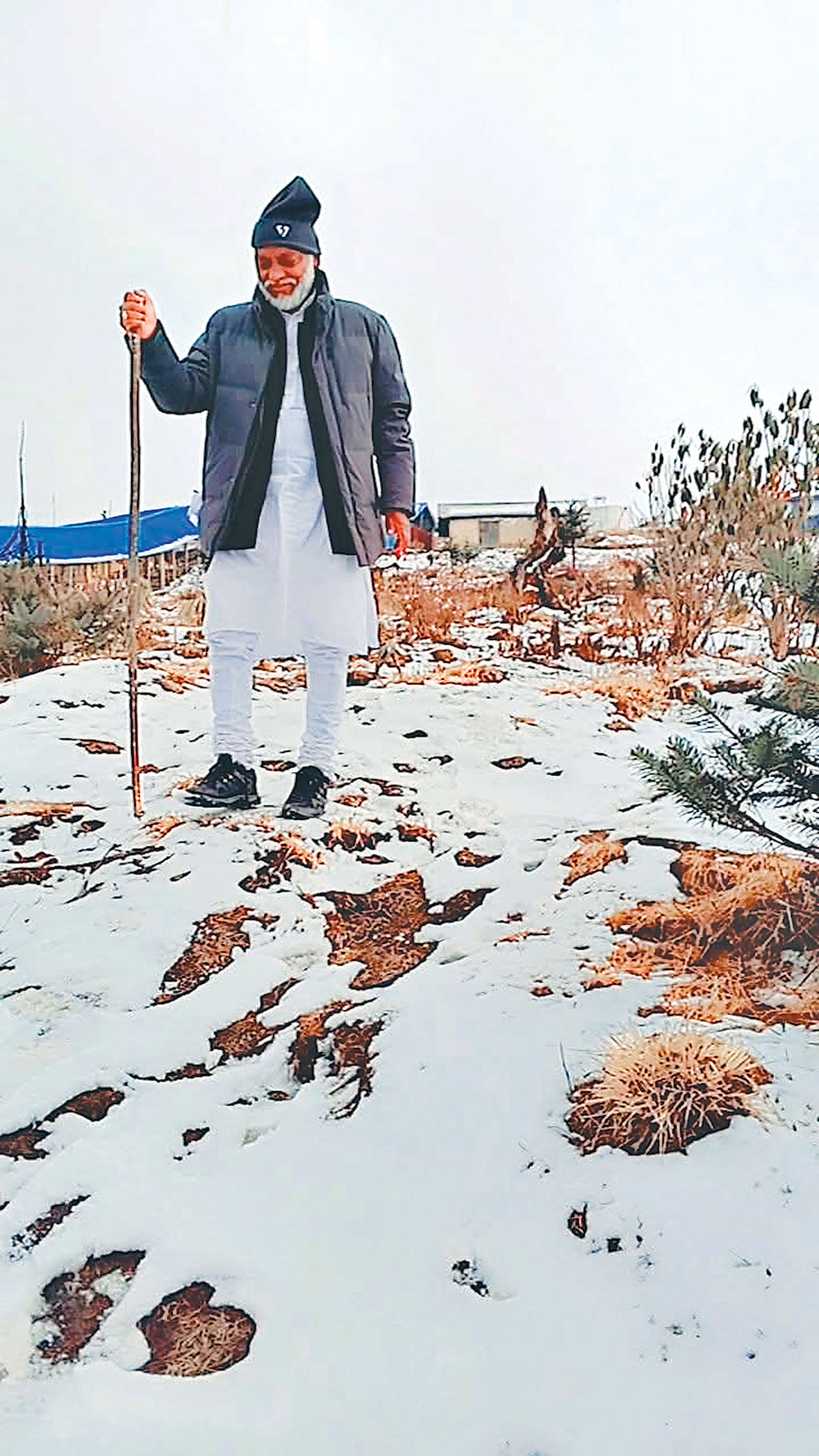
, we made the protestors who had taken shelter on the hill of Big Fedi and Ballu Danda down Kaflepati. When we dared to step out of the hotel, there was a clash situation. It seemed as if the police administration was on the lookout for 'what can be done'. In order not to spoil the mood, we headed towards the Big Phedi Kanchithan. It was very windy and snowing. As sponsored transport was stopped, so were our comrades. The next day morning, playing with snowballs, we went down the Ballu hill and had a meeting between the protest leaders and some decision was made.
On February 10, the journey started at 1 pm according to the decision to go to Fungling in a group walk and leave from there. Hundreds of Mukkumlung conservationists arrived at Fungling around 6pm. 8-10 women were standing on the road with black flags. Perhaps this is the first incident where a black flag has been shown to the protestors. Some 'vigilantes' came with the pretext of meeting me. In no time at the nearby Birendra Chowk, the protestors who were peacefully burning mobile torches and spices were charged with house holders and sticks and injured. The hotel where we stayed was a hospital before Snow Leopard, there was also lathicharge.
There was a terror demonstration by the state party at the hotel - CCTV, lights and glass of the car we used were broken. Various houses were pelted with stones from the midst of plainclothes policemen. The participants of Masal Julus said that the movement was made tense by carrying water in buckets and even stones in it. Dozens of teargas were fired at the house where the protestors were staying, brutally beaten. More than a dozen people were arrested after throwing tear gas from Chandra Maden's house and making them unconscious. The police and vigilantes were fierce. Such an atrocity in Yuma's sacred land?
The police administration was repeatedly telling us to leave Fungling, while there were reports of gangsters being mobilized to attack the road. We left the hotel at 12 o'clock in the night and I don't know how Taplejung crossed the border! From 5 o'clock in the morning, an indefinite ban was issued and until 4 o'clock in the morning, the houses and lodges of the people who were involved in the struggle were attacked in a guerilla style, which turned into a battlefield. Have we brought such democracy?
Limbuwan Rebellion
Gorkhali It can be said that the war with Limbuwan, which started in March 1830, continues even today. After concluding that Gorkhali could not win after fighting for five months, the treaty was concluded in July 1831. At that time, 6 types of Yakthums who refused to give up reached Sukhim and repeatedly rebelled for their role.
Even after that, the Limbus continued to do many rebellions, which can be read in the pages of history. Taplejung and Panchtharmai AD. In 1988, 4 activists fighting for the Limbu language were sentenced to prison. I found that constant rebellion made lemons steel. Those who did not want to understand until now will now understand - lemons are steel, which do not break, do not bend.
The struggle above has proved that Limbu is not a caste that gives up no matter how much the state oppresses. The Mukkumlung struggle has put the overall movement across the country in a situation where it has to fight for new polarization and 21st century relevance. The agitation going on in Mukkumlung is not against any individual, certain businessmen or political party. This year Guaranteed by Gorkhali in 1831, Yakthum is a strike on the sovereignty of the nation and a fight for justice against Gorkhali colonialism.
Mukumlung's snow didn't give me cold, it gave me fire. That fire, which has kept the blood of lemons warm for 200 years. The Mukumlung-struggle is not against the cable cars, but the 200-year struggle of the Limbus against Gorkhali colonialism.
Mukumlung-journey to pick up Chotlung
Gorkhali colonialism is justified in Yakuthum land (Limbuwan) which Gorkhali did not conquer? This is the main question of today. Gorkhali annexed Limbuwan on the border of Nepal through an agreement. He considers that land as his own, but considers the people of Yakthum nation as enemies who provoke harmony? Infamously, the overthrow of the Yakthum nation through state-sponsored riots in Fungling. This is the head of identity of lemons. Yuma-Mang has made her home here. However, today the state is trying to sell it in the name of 'cable car'. The Limboos are saying, 'If we can't save Mukumlung, we can't save our history.'
According to Mundhumi belief, the most sacred shrine of the Yakthums is Phaktanglung, and those who cannot reach there can visit Mukkumlung and remember Phaktanglung. Mukkumlung is the head of Yakthum Laje (Yakthum land). It is to go to Mukumlung to collect Chotlung during Undhauli or Umbhauli collectively after carrying out certain rituals for a certain purpose. Even those who consider this holy land as Pathibhara said that the whole hill looks like Pathi. In that sense, the entire hill is worshiped by Hindus.
Uprooted societies and communities do not have original lives and dreams. Because when the roots of society and community are cut, its essence dies. After the life, dreams and essence of the society and community are lost, its history, civilization, culture and traditions do not become a matter of interest. It brings about a state of over-rule and over-independence. Not only for the lemons, this is a country-destroying project. Therefore, the demand of the Limbus is clear – the attack on culture, civilization and faith will not be tolerated. Today, the state is trying to distort the holy land by pointing guns and creating terror. How can a state be a democratic state that is not ready to act in Mukkumlung while accepting the sovereignty of the Yakthum nation and fully respecting their self-determination?
Mukumlung's autonomy is necessary to raise Chotlung. Chotlung has become an immortal symbol of culture, struggle and freedom. This is only the first page of the history of Chotlung raising. Perhaps it was because of that journey that the state took away my security after returning to Kathmandu. But, I'm not scared at all.
My journey to Mukumlung is not just an event, it is a story of struggle written in the background of history.
(the author is the President of National Liberation Party of Nepal)

