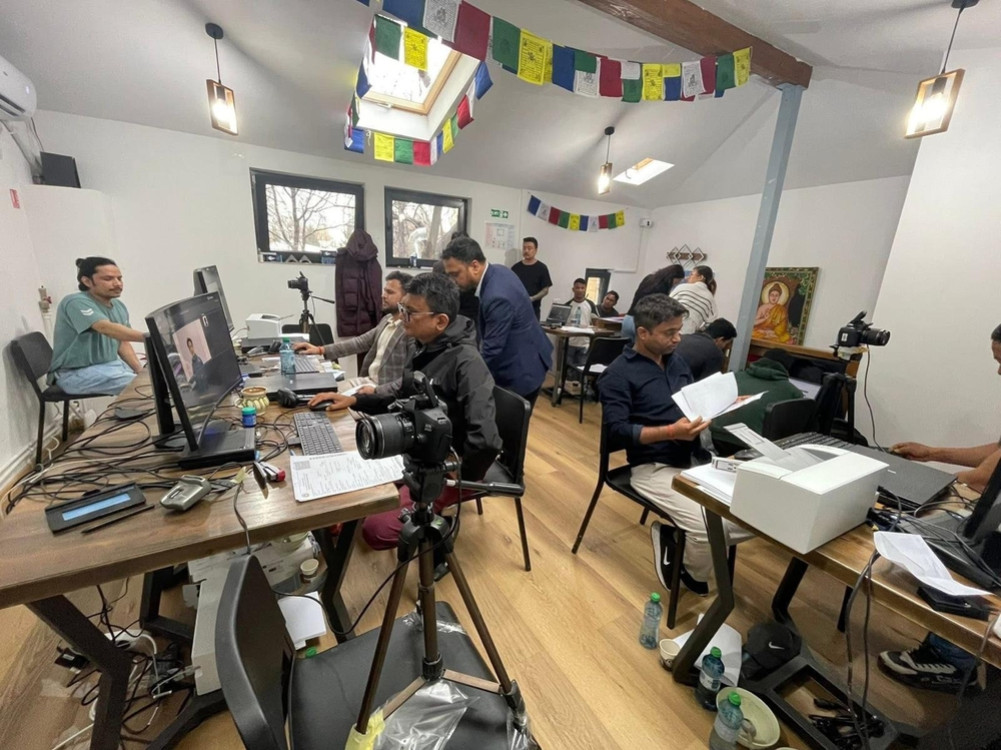
Nepalis are making Europe a labor destination because of the permanent residence permit, the opportunity to bring their families, and the potential for long-term settlement, rather than immediate savings.
We use Google Cloud Translation Services. Google requires we provide the following disclaimer relating to use of this service:
This service may contain translations powered by Google. Google disclaims all warranties related to the translations, expressed or implied, including any warranties of accuracy, reliability, and any implied warranties of merchantability, fitness for a particular purpose, and noninfringement.
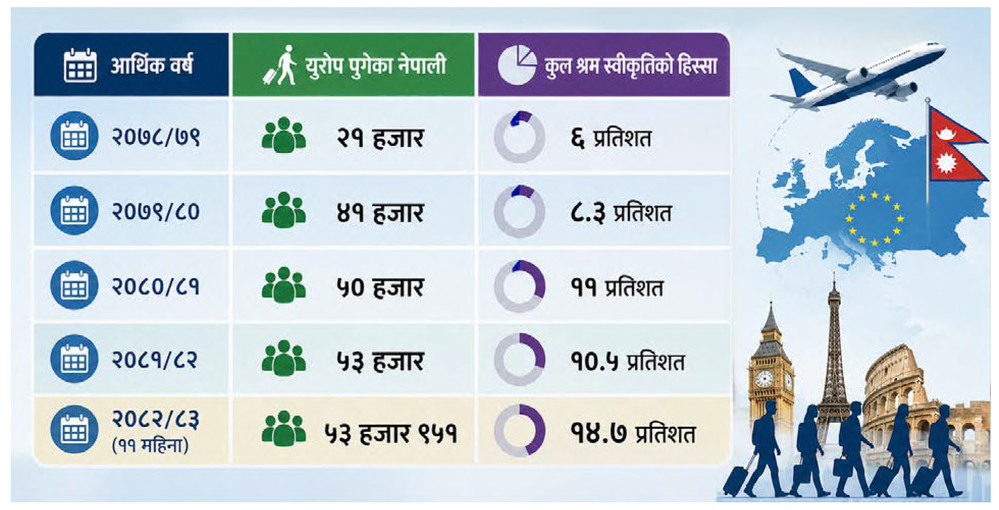
The new destination for Nepali workers is becoming European countries. In the last 11 months alone, 53,951 Nepalis have obtained new work permits for 24 European countries. Europe accounts for 14.7 percent of the total work permits. Earlier, Europe's share in the total work permits was 10.5 percent. Among the women going to Europe, 12,482 are female workers, or 23.91 percent.
Europe has emerged as an alternative when the future of employment is in danger due to tensions in West Asia. Still 55.4 percent of Nepali workers have gone to the Gulf region, which is a traditional labor market. Malaysia's share is 15.9 percent. According to the Department of Foreign Employment, the number of people who have obtained new work permits for 160 countries from July 2082 to Jestha 2083 is 367,000.
Romania accounts for the largest share of Nepalis going to Europe. 24,767 Nepalis have obtained work permits for Romania, of which 3,144 are women. This is about 46 percent of the total Nepalis going to Europe. Acting Ambassador to Germany for Romania Sagar Fuyal, who handles Romanian affairs, said that the attraction of Nepalis has increased after Romania became a member of the European Union. ‘A labor agreement has also been signed between Nepal and Romania. Preparations are underway for its full implementation,’ he said.
According to a public study report by the Economic and Social Council of Romania, 100,000 quotas were allocated for non-European workers in recent years due to labor shortages. More than 51,000 foreign citizens have been registered in the Ilfov district around the capital Bucharest, of which the largest number are Nepalis. The demand for foreign workers is still high, especially in sectors such as construction, hotels and restaurants, manufacturing industries, warehouses and logistics, and care services.
According to the immigration service, the main reason why foreign citizens choose Ilfov is employment and family reunion. Lhakpa Sherpa, president of the Sherpa Community Association, who has been living in the capital Bucharest for 10 years, said that Romania is becoming a ‘transit’ country for Nepalis going to Western Europe. ‘The visa here is the fastest. After obtaining a temporary residence permit (TR) here, you can go to Western countries. After obtaining a TR, many people come with the intention of going to Western Europe,' he said, 'but now the Romanian government has started to tighten up. If the employer does not have permission, they are sent back from the airport.'
According to Romanian Radio, Romanian Labor Minister Florin Mano has also said that some foreign workers are reluctant to work in Romania. According to him, although the government has set a quota of 100,000 non-European workers annually, that number has never been met in practice.
Cyprus has become the second largest destination within Europe, where 7,314 Nepalis have received new work permits in the last 11 months. There are 4,742 women in Cyprus. Most women in Cyprus go as domestic workers. Then 3,245 went to Portugal, 3,056 to Malta, 2,993 to Bulgaria, 2,899 to Serbia, 2,817 to Croatia, 2,254 to Greece and 1,961 to Austria.

Nepalis' entry into the developed economies of Western Europe is still limited. According to the department's data, only 316 people in Germany, 190 in Ireland, 146 in France, 146 in Spain, 62 in the Netherlands, 20 in Belgium and 9 in Sweden have received new work permits.
The final destination of Nepalis who have gone to Eastern Europe with work permits is Western Europe. This is also called the 'Balkan Route'. The 'Balkan Route' is chosen to enter Europe without a visa. The ‘Balkan Route’ is a demand to travel illegally or for asylum procedures through the Balkan countries of Eastern and Southeastern Europe (Turkey or Romania to Greece-Bulgaria, North Macedonia-Serbia, Bosnia and Herzegovina-Croatia-Slovenia) to Western Europe (Italy, France, Germany, Portugal, Poland). There are hundreds of risky land routes to reach here. Agents and ‘dunkers’ (people showing the way) take them across the borders of countries through forests and mountains. From some countries, they are also taken across the border by bus.
Yamkumar Rupakheti from Nawaparasi said that he reached Italy after working in Croatia for 11 months. ‘When I came from Nepal, the visa on my passport was valid for one and a half months. The agent made me a temporary residence card (TRC) for one year. After that, I have to find a job myself. Sometimes I worked as a wirehouse, sometimes as a bike delivery driver, sometimes as a painter,” he said, “It became difficult to save my salary. Again, it was not certain whether my TRC would be renewed or not. Since my card had expired, I came to Italy by buying a bus ticket. I didn’t have to do anything.”
Labor shortage in 2,617 occupations across Europe
According to the European Labor Authority’s ‘Labor Shortage and Surplus Report-2025’, labor shortage in the European labor market is not a temporary problem but is becoming a structural problem. Under the International Classification of Occupations (ISCO), there is a labor shortage in 2,617 occupations across Europe. The labor shortage is not uniform in all countries. The largest number of labor shortages is seen in Italy, with 253 occupations. This is followed by the Netherlands, Bulgaria, Belgium, and Romania, with 195, 193, 184, and 170 occupations. These five countries alone account for 38 percent of the total labor shortages seen across Europe.
The report shows that there are labor shortages in only 4 occupations in Malta, 30 in Croatia and 30 in Ireland. ‘Demographic changes, skills imbalances, challenging working conditions and limited labor mobility are creating obstacles to labor market adjustment. To address these challenges, an integrated strategy is needed to increase labor activation, develop skills, improve the quality of employment and effectively utilize labor mobility and migration within Europe,’ the authority’s report states, ‘Labor shortages are most prevalent in the professional, skilled craftsman and technician, machine operator and assembler groups.’
According to the report, labor shortages are not limited to high-skilled sectors. There are also long-term labor shortages in sectors requiring medium skills such as construction, transport and personal services. 57 percent of the total shortages are classified as moderate or high severity. This indicates that employers are continuing to face difficulties in recruiting the necessary manpower, even though the overall pressure on the labor market has eased somewhat.’
The health and care sector in Europe is facing a growing labour shortage. This sector employs around 25 million workers, accounting for 11% of total employment in the European Union. There is a 36% shortage of specialists, general practitioners, nurses and health assistants. ‘The demand for health and care services is increasing rapidly as the ageing population in Europe increases. The proportion of doctors, nurses and health workers over 50 has reached more than 50%,’ the report states. ‘Long training periods, long periods of study for professions such as doctors and nurses, difficult working environments, high workloads, long and irregular working hours and mental stress are the main reasons for the labour shortage in this sector.’
Europe is gradually becoming more dependent on foreign and migrant workers in the health sector. 92% of home care workers are non-European citizens. Even in highly skilled professions such as doctors and dentists, up to 18% of workers are foreign.
The ability to bring family members is an attractive feature
Kumari Waiva from Sindhupalchowk was working as a cook in a five-star hotel in the United Arab Emirates (UAE). But now she is in Bulgaria. She says that she came to Europe with the dream of being able to live with her family. ‘I have been in Bulgaria for three years. I work in a hotel. My earnings and savings are less than in the UAE. But after getting a permanent residence card here, I can bring my family,’ she said, ‘I have not yet received PR.’
Kumari is earning 1,100 euros (about 200,000 rupees) per month. ‘Not all the money I earn is saved. Rent is expensive. Health insurance, tax deductions, transportation and daily living expenses are high,’ she said, ‘I can hardly send even 700 euros to Nepal.’
According to the European Employment Service, ordinary workers in Europe earn an average of 1,200 euros per month. After deducting housing, taxes, insurance and daily expenses, up to 800 euros are saved. Nepali workers are increasingly attracted to Europe due to permanent residence, family reunification and long-term opportunities. Workers are unable to save more than 500 euros if they do not work ‘overtime’.
According to the report ‘Immigration, Labour Mobility and the European Union Labour Market: Recent Developments’ published by the European Union in February, 1.3 million non-European citizens obtained a first residence permit (first residence permit) for the first time on the basis of employment in 2023. This number is 33.8 percent of the total residence permits issued that year.
The number of first residence permits issued in 2023 has reached more than 3.7 million, which is almost double the number issued in 2014. Despite a slight decrease in 2020 due to the COVID-19 pandemic, migration to Europe has increased sharply again in recent years, the report shows.
According to the European Labour Market Survey, 2023, the main reason why people move to their current country of residence is family reunification. 45 percent of respondents said they migrated for family reasons. 28 percent cited employment, 10 percent cited international protection (asylum), 7 percent cited education and training, and the remaining 10 percent cited other reasons.
People who migrate for economic opportunity generally choose their destination country based on job availability, salary, and standard of living. In 2024, nearly 900,000 non-European citizens applied for international protection (asylum). This number is 13 percent lower than the previous year. The number of people seeking asylum in Europe is still high, according to the study.
According to the report, employment-oriented migration is likely to increase in importance in the coming years due to the growing labor shortage, aging population, and declining working age group in Europe. The demand for foreign workers is continuing to grow, especially in the healthcare, construction, hospitality, agriculture, and technical sectors.
Despite the demand for workers, foreign employment entrepreneurs from Nepal have not been able to send workers to the European labor market on an institutional basis. Nepali workers are going to Europe through personal contacts (agents not recognized by the law), which is costly and also fraught with fraud. Nepalis pay between 700,000 and 200,000 rupees to go to Europe. The cost of going to Western Europe is higher than that of Eastern Europe. According to the Department of Foreign Employment, 4,993 people have filed complaints claiming 240 million rupees.
Bhimsen Thapa, Youth Vice President of the Non-Resident Nepali Association, said that as the number of Nepali workers in Europe increases, the problems and challenges faced by Nepalis are also becoming more complex. “The situation is becoming more complicated when the employer company does not provide work and housing as promised, they have to remain unemployed for months, live in irregular conditions, and face the risk of arrest and deportation,” he said, who is working in Portugal. “It is difficult for undocumented workers to rent a house. They are not allowed to open a bank account. Nepalis are also facing difficulties in the legal process for visa renewal. Due to lack of language and information, they are at greater risk due to lack of information about labor rights, immigration policies, and available services.”
According to Thapa, Nepali workers have faced verbal abuse, physical harassment, non-payment of overtime, low wages, and occupational health and safety issues.
Dik Bahadur (Kumar) Khatri, president of the Nepal Foreign Employment Entrepreneurs Association, said the government has legally banned manpower companies from sending workers to Europe. “We are not authorized to send workers. All those who are going to Europe are through individuals. We cannot take responsibility for this,” he said, “There is an opportunity in Europe. The government here has tied the hands and feet of manpower companies to find that opportunity.”
Jeevan Baniya, research director at the Center for the Study of Labor and Mobility (CSLAM), said that there is a need to focus on protecting the labor and human rights of Nepali workers working in Europe. ‘विगतमा युरोप हेर्ने नेपाली दूतावासहरूले वैदेशिक रोजगारसम्बन्धी मागपत्र जाँचबुझ निर्देशिका–२०७५ अनुसार संस्थागत रूपमा मागपत्र प्रमाणीकरण गर्न पर्याप्त जनशक्ति, स्रोत र साधन नभएको भन्दै प्रमाणीकरण प्रक्रिया रोकेका थिए,’ उनले भने, ‘तर, समस्या स्रोत–साधनमा मात्र सीमित थिएन, परराष्ट्र मन्त्रालय र श्रम मन्त्रालयबीचको असमझदारी पनि त्यसको एक प्रमुख कारण थियो । अहिले भने युरोपमा नेपाली श्रमिकको संख्या बढ्दो छ र थप विस्तार हुने सम्भावना पनि उत्तिकै छ । यस्तो अवस्थामा नेपाली दूतावास तथा नियोगहरूलाई थप सक्षम, सक्रिय र प्रभावकारी बनाएर नेपाली श्रमिकको श्रम तथा मानवअधिकार संरक्षणमा केन्द्रित गर्नुपर्ने आवश्यकता झन् टड्कारो बनेको छ ।’
श्रम, रोजगार तथा सामाजिक सुरक्षा मन्त्रालयले श्रम बजारलाई विविधीकरण गर्न युरोप क्षेत्रलाई प्राथमिकतामा राखिएको जनाएको छ । श्रमले अल्बानिया, अस्ट्रिया, टर्किए, माल्टा, सर्बिया, साइप्रस, लक्जेम्बर्ग, पोल्यान्ड, बोस्निया र हर्जगोभिना, क्रोएसिया र बेल्जियममा श्रम सम्झौताको प्रस्ताव पठाएको छ । ‘श्रमिकको कल्याण, सेवासुविधा र सामाजिक सुरक्षाको हिसाबले युरोपको श्रम बजार नेपालीका लागि महत्त्वपूर्णर् छ । यसका लागि श्रम सम्झौता गर्न युरोपका ११ देशमा सम्झौताको मस्यौदा पठाइएको छ,’ श्रम मन्त्रालयका प्रवक्ता पीताम्बर घिमिरेले कान्तिपुरलाई भने, ‘हामीले अपेक्षा गरेअनुसार संस्थागत रूपमा श्रमिक पठाउन सकिएको छैन । यसका लागि परराष्ट्र मन्त्रालयसँग समन्वय गरिरहेका छौं ।’