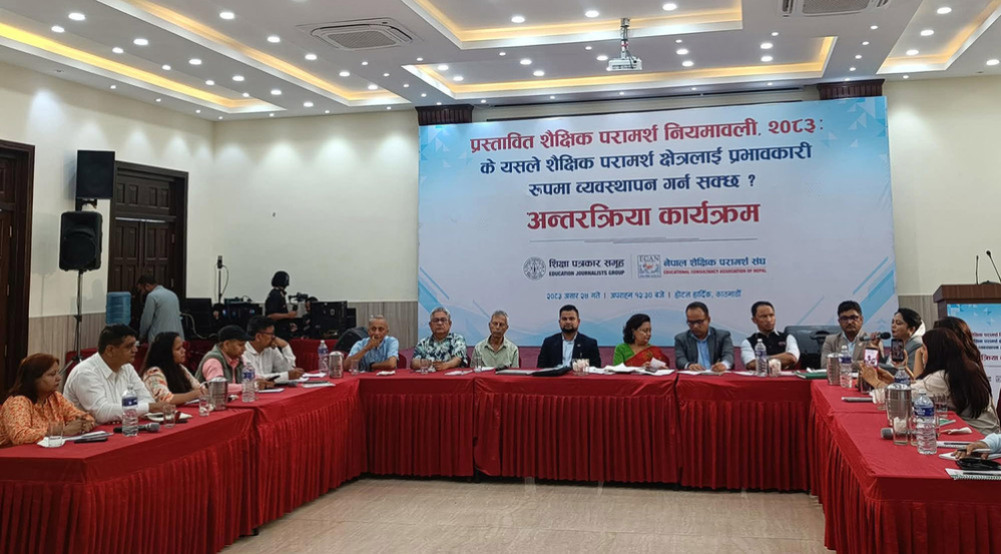
Educational consultancies and foreign-affiliated colleges had been operating under the guidelines issued by the Ministry of Education, but the government has now introduced regulations.
We use Google Cloud Translation Services. Google requires we provide the following disclaimer relating to use of this service:
This service may contain translations powered by Google. Google disclaims all warranties related to the translations, expressed or implied, including any warranties of accuracy, reliability, and any implied warranties of merchantability, fitness for a particular purpose, and noninfringement.
The government has introduced new standards for educational consultancies and colleges operating in Nepal under the affiliation of foreign universities. The Cabinet meeting held on Wednesday passed the Educational Consultancy, Language, and Preparatory Classes (Operation and Management) Regulations, 2083, and the Educational Program (Operation and Regulation) Regulations, 2083, under the affiliation of foreign universities.
Educational consultancies and colleges with foreign affiliations had been operating under guidelines issued by the Ministry of Education. The regulations passed by the Cabinet set standards for mandatory deposits, renewal, submission of student data, annual and financial reports to the ministry, as well as physical infrastructure requirements.
According to the regulations, a deposit of 2.5 million rupees each must now be maintained for establishing a consultancy and for operating a branch. Existing consultancies must also maintain the deposit at the time of renewal. Previously, the guidelines did not include provisions regarding deposits. Similarly, foreign colleges must submit a deposit ranging from 2.5 to 3.5 million rupees. Earlier, the maximum deposit allowed was up to 3 million rupees depending on the course. The regulations approved by the Cabinet state, “A deposit of 2.5 million rupees is required for postgraduate level and 3.5 million rupees for undergraduate level. For additional programs at the same level, an additional amount equal to half (50 percent) of the specified deposit must be submitted.” There are currently 56 colleges operating in Nepal under foreign affiliation.
It has been stipulated that only colleges affiliated with universities ranked within the top 1,000 globally may operate in Nepal. Although this provision was mentioned in the guidelines, it had not been implemented. According to the regulations, the university must have applied for five consecutive years in the Times Higher Education or QS Rankings and must have been ranked at least once. The 49 colleges currently in operation must also meet this standard within three years. The regulations state, “If any educational institution fails to submit proof of global ranking within the specified three-year period, its operating license will be revoked.” A study by the Ministry of Education found that most colleges did not meet the global ranking criteria.
Under the new standards, colleges must have obtained Quality Assurance and Accreditation (QAA) from the University Grants Commission of both the relevant country and Nepal. Existing colleges must obtain QAA within three years, and newly approved colleges within five years, or their approval will be automatically revoked, as stipulated in the regulations.
The number of students admitted per class or section has also been specified. According to the new standards, no more than 30 students may be admitted to a single class, or more than the number specified by the university. Even if the university allows more, no more than 30 students may be taught in a single room. The regulations also stipulate that no more than two admissions may be conducted in a single academic session according to the academic calendar.
The provision in the guidelines requiring at least 10 percent of students to be given free scholarships has been continued in the regulations. If the college has foreign investment, 20 percent, and if domestic investment, 10 percent full scholarships must be provided according to government standards. Although this provision existed in the guidelines, it had not been implemented. Experts had suggested that foreign colleges should be operated under the University Grants Commission, but the regulations have kept them under the ministry.
Laxman KC, president of the International Education Providers Association (IPAN), stated that colleges operating under the guidelines have gained additional legal validity through the regulations, which is positive. The Education Act had been amended by ordinance to allow the issuance of regulations. KC noted that although there were suggestions not to make global ranking a standard for colleges and to set a minimum quota of 48, the regulations were not issued accordingly. “There is no particular disagreement with other provisions of the regulations. The government is seeking to regulate. We are positive,” he said.
According to the new standards, a college may not operate academic programs under the affiliation of more than one university. If programs from more than one university are being operated, only one must be chosen within five years of the issuance of the regulations. Even if foreign curricula are taught, the study of Nepal must be made compulsory. The Ministry of Education claims this provision is to help students understand Nepal’s identity, uniqueness, and culture.
The regulations also require foreign colleges to have their own land and buildings. Accordingly, colleges must construct buildings on their own land within five years of receiving approval, and existing colleges within ten years. Colleges operating in the Kathmandu Valley must have at least 3 ropani of land, those in the hills 6 ropani, and those in the Terai 15 kattha, as stated in the regulations. When students transfer credits to a foreign university, no more than 40 percent of the curriculum may be transferred.
The Nepal Educational Consultancy Association, however, has expressed dissatisfaction that the regulations were issued without consultation. Association president Laxman Paudel stated that the provision of a 2.5 million rupee deposit would cause most consultancies to collapse. He complained that the government is seeking to prohibit rather than regulate consultancy companies. “It is positive to seek regulation through the regulations, but there is an attempt to restrict,” he said.
The regulations also prohibit foreign educational institutions from organizing educational fairs. “Approval will not be granted to organize educational fairs, exhibitions, or seminars targeting Nepali students intending to study abroad,” the regulations state. However, fairs such as ‘Study in Nepal’ aimed at attracting foreign students to Nepal or promoting study at domestic universities may be organized with ministry approval.
Consultancies are required to conduct financial transactions exclusively through digital systems and only via banks, not in cash. Income received from students or educational institutions will be subject to the education equity fee set by the government. The government had stipulated a 3 percent tax on students of private educational institutions through the budget.
The regulations discourage foreign investment in the educational consultancy sector. According to the regulations, consultancies may only be operated with domestic investment. If there is foreign investment, ownership must be converted to domestic investment within one year. The regulations passed by the Cabinet also specify the educational qualifications of consultants. Consultants must have at least a bachelor’s degree or have received training in educational consultancy from a diplomatic mission.
Consultancies will be classified based on the quality of their work. The ministry will grade institutions as A, B, or C based on the success rate of students advised, quality of service, and number of complaints received. The regulations state, “If a student is stranded abroad due to incorrect advice from the institution or if the educational institution is found to be illegal, the concerned institution will be held responsible. In such cases, the institution must provide appropriate compensation based on the mental and financial harm suffered by the student. The institution must enter into a written agreement with the client before providing services. The agreement must clearly specify the consultancy fee, the institution’s authority, admission conditions, scholarships, and refund policies.”
Consultancies must have their own building or at least a three-year lease agreement. Office buildings must have separate toilets for men and women and be accessible to persons with disabilities. The annual renewal fee has been set at 25,000 rupees. Until now, there was no provision for any fee. The regulations also include provisions for revoking permits and confiscating deposits. If the permit is not renewed, if students are financially exploited or defrauded, if misleading or false information is disseminated during service delivery, if tax details are not submitted, or if students are stranded abroad due to incorrect advice, the deposit will be confiscated and the permit revoked.
Similarly, those registered outside Kathmandu may also renew at the central office. Since 2074, consultancies have also been registered at the provincial level. According to the Ministry of Education, about 1,500 consultancies are registered and operating, but only 924 have been renewed at the ministry. After provinces such as Bagmati began registering consultancies, the Ministry of Education had suspended renewals. Renewals resumed in 2081 according to the guidelines. While language teaching and preparatory classes may be registered at the provincial level and regulated by local authorities, consultancies must be mandatorily registered and renewed at the Ministry of Education. Ministry officials claim that due to confusion over registration and renewal, many consultancies are operating without registration.