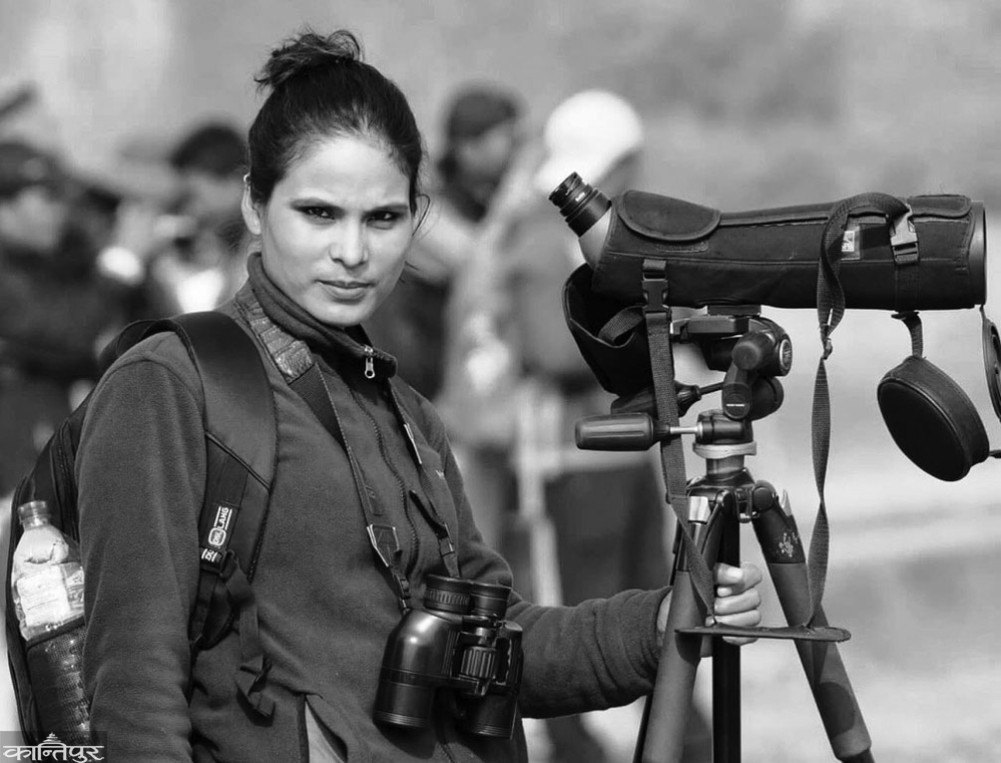
The death of Sitarani Chaudhary, a nature guide with an amazing skill in showing tigers in Bardiya National Park, has dealt a huge blow to local tourism and conservation efforts.
We use Google Cloud Translation Services. Google requires we provide the following disclaimer relating to use of this service:
This service may contain translations powered by Google. Google disclaims all warranties related to the translations, expressed or implied, including any warranties of accuracy, reliability, and any implied warranties of merchantability, fitness for a particular purpose, and noninfringement.
Sitarani Chaudhary was born near Bardiya National Park. Her childhood was spent in the lap of the forest. As she grew up with the chirping of birds, the footsteps of tigers, and the peaceful environment of the forest, nature became her life. Later, that love introduced her to nature guide. She established herself as a guide who was skilled in showing tigers in Bardiya National Park, had deep knowledge about wildlife and birds, and could provide information to tourists in a simple way. Many people have taken up ecotourism after learning from her in Bardiya and Banke National Parks. She is working as a guide.
Sitarani Chaudhary, who was skilled in easily showing tigers in Bardiya National Park, has left her forever, leaving her relatives, friends, and conservationists crying. Her steps towards the forest have stopped. Photos of wildlife and nature have stopped being posted on social media. Her walking stick, binoculars, and camera have lost their beloved friend. Nature lovers, conservationists and tourism entrepreneurs of Bardiya and Banke are feeling the pain of losing an extraordinary nature guide.
The tourist settlement of Thakurdwara is in mourning after the death of 37-year-old Sitarani of Thakurdwara, Thakurbaba Municipality-9, Bardiya two weeks ago. A few weeks ago, she fell while bathing in the Patuwa culvert near the village and suffered a serious spinal injury. Despite undergoing surgery at the Annapurna Neuro Hospital in Kathmandu for treatment, she could not be saved.
Her fascination with nature drew her to the forest from a young age. At the age of 16, she took basic nature guide training in 2062 BS and then gained experience in the forest for seven years. She has been active as a professional nature guide since 2069 BS.
According to senior nature guide Rajan Chaudhary, although Sitarani did not have much formal education, she had the ability to easily and effectively inform foreign tourists about wildlife in English. She was equally proficient in Nepali, Hindi and Tharu languages. 'She was studious. Most tourists wanted to go on safari with her because she could provide factual information about wildlife and birds,' he said.
Conservationists and nature lovers from home and abroad had raised financial support for her treatment. A significant amount of money was collected after wildlife photojournalist Rajesh Dhungana appealed for help through social media. Senior neurosurgeon Dr. Vasant Pant also performed the surgery at a minimal fee. 'The surgery was successful, but she could not be saved,' Dhungana said. According to him, Sitarani's 13-year-old daughter is currently living with relatives and needs help for her education.
Sitarani's greatest specialty as a nature guide was her amazing ability to show tigers. Based on the tiger's movements, habitat, footprints, feces and urine, she used to guess where the tiger might be. That is why foreign tourists used to go on safari especially looking for her.
According to ornithologist Ram Shahi, it is not an easy task to keep tourists safe and observe wildlife in the forest. 'Sometimes encounters with wildlife are very risky. Even in such situations, Sitarani could keep tourists safe and provide an exciting experience,' he said.
Due to her skills, tourists from British World War II veterans to Christopher Usher, Deputy Chairman of Nepal Nature Trust (UK), had made her their guide for years. Usher has paid tribute to her through social media, recalling the unforgettable moments they spent with her.
Sitarani also led the tented camp program operated inside Bardiya National Park. She was not only introducing tourists to the forest, but also took the lead in the campaign to explain the importance of conservation. According to Ajit Tumbahamphe, head of the National Trust for Nature Conservation, Bardiya, Sitarani was one of the guides with excellent knowledge about wildlife, birds and nature. 'She won everyone's hearts with her smiling face, humble demeanor, and clear explanations. These were her greatest assets,' he said.
Along with nature guiding, Sitarani was also excelling in wildlife photography. She has taken attractive photos of tigers, leopards, rhinoceroses, elephants, chitals, deer, and rare birds. Many of her photos were praised on social media and in various exhibitions.
She also worked as an office assistant at the Tharu Museum near the entrance to Bardiya National Park for 15 years. Although that was her means of livelihood, her real identity was in nature conservation.
Her colleagues still remember her saying, 'Forests, wildlife, and the environment are our common property.' Her colleague Anuram Chaudhary says, 'She was more of a conservationist than a nature guide. She believed that only if tigers and forests are protected can the future of tourism be secured.' Now, her colleagues say that the tigers she showed, the birds she identified, the stories of the forest she told, and her dedication to conservation will be remembered for a long time along with the forests of Bardiya.