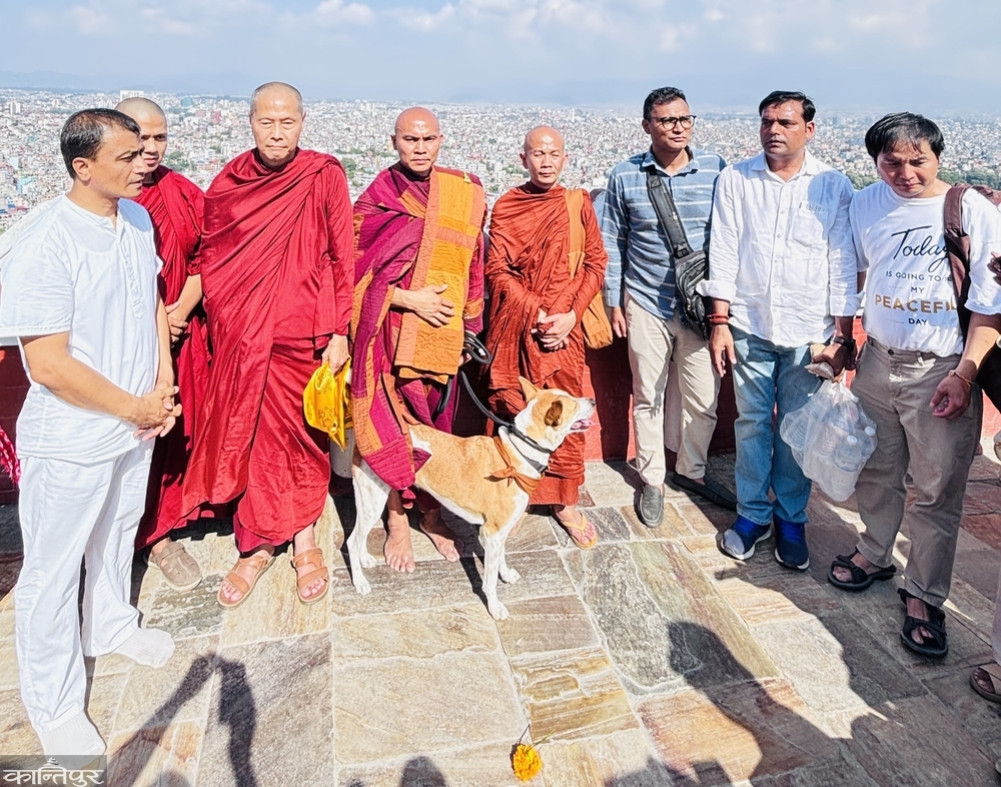
Aloka had participated in the 'Peace Journey' to Lumbini with a team of three monks, including Vietnamese-American monk Bhante Panyakar, from Sunauli border crossing on Sunday alone. And, on Monday morning, he boarded a Buddha Air ATR plane from Bhairahawa to Kathmandu.
We use Google Cloud Translation Services. Google requires we provide the following disclaimer relating to use of this service:
This service may contain translations powered by Google. Google disclaims all warranties related to the translations, expressed or implied, including any warranties of accuracy, reliability, and any implied warranties of merchantability, fitness for a particular purpose, and noninfringement.
A busy street in Kolkata, India. The honking of car horns, speed and noise. Amidst the noise, an ordinary, stray dog struggles to save its life from the rolling wheels.
When the dog followed a group of Vietnamese-American Buddhist monks on a road in eastern India in 2022, no one could have imagined that this was the beginning of a journey that would teach the world a new definition of compassion.
Today, the same dog is known worldwide as the ‘Peace Dog’. This ‘Indian Pariah’ breed of dog is now known to the world as ‘Aloka’.
Not long ago, the monks took Aloka on a 3,700-kilometer-long peace walk across 10 states in the United States, from Texas to Washington, DC. The same international 'celebrity' Aloka is currently on a trip to Nepal, the country of Buddha.
On Sunday alone, Aloka, along with a team of 3 monks including Vietnamese-born American monk Bhante Panyakar, had participated in the 'peace journey' of Lumbini. And, on Monday morning, he boarded a Buddha Air ATR plane from Bhairahawa to Kathmandu.
After visiting Boudhanath, Aloka's afternoon destination was Anandakuti Vihara in Swayambhunath. When Aloka and the group of monks arrived at Anandakuti, considered to be the first Theravada Buddhist monastery in Nepal, the atmosphere was festive.
There was a buzz of traditional music. There was a large crowd of ordinary people and monks and nuns carrying bouquets.
The monks of the monastery welcomed Aloka and his team as messengers of compassion, friendship and hope for reminding us of the Buddha's teachings of love, compassion and non-violence in a world plagued by conflict and division.
A beautiful scene was witnessed there. Before his address, Guru Bhante Panyakar poured water from a common drinking bottle and gave it to Aloka to drink. When the Guru stood on the stage and began to address, Aloka, who had walked thousands of miles, fell asleep peacefully on the stage.
In his address, Guru Panyakar recalled the same hustle and bustle of people that he had seen just a few moments earlier. He conveyed a profound philosophy, 'The search for peace does not begin outside, but within one's own mind.'
As he entered the Anandakuti, people were bustling around excitedly to meet, touch or take pictures of Aloka. Referring to this, he added, ‘The real purpose of the peace journey is not to get personal benefits or blessings, but to spread the consciousness of love and compassion within ourselves. If we ourselves get caught up in haste, competition and greed, we can never feel peace.’
In today’s society, people are constantly living a hurried life. The monk expressed concern over this. The monk believed that the tendency to rush to go to school, work, eat and even rest has taken people away from inner peace. He said that peace can be experienced only if we take some time away from the hustle and bustle of life and become aware of our thoughts, words and actions.
After Anandakuti’s address, the walk to the Swayambhu complex through the back forest path began. After seeing the green forest and peaceful environment, the monk untied the black rope tied around Aloka’s neck.
As soon as the rope was untied, Aloka was free. Sometimes he would run forward, sometimes he would climb the hill above the path. He was breathing deeply of freedom. Just then, someone from the crowd said in Nepali, ‘There are monkeys here. Will they attack?’
The monk did not understand Nepali. He continued walking with his friends. But, when he reached a little higher, another one said in English, ‘There are monkeys and street dogs here. Will they attack Aloka?’ Now the monk became alert and took out the rope again and tied it around Aloka’s neck.
As he climbed the forest path, the monkeys were looking at the new guest Aloka with surprise from the branches and walls of the trees. However, the native street dogs of Swayambhu could not take Aloka’s arrival easily. They became angry to protect their territory and tried to attack Aloka.
After seeing that loud barking and anger, Aloka's 'dog nature' also woken up for a moment. He also got angry. The hair on his body stood on end. And, he also got angry. But, before he could bark, the monk held him tighter. To protect this special dog that had set out on a peace journey from the attacks of the local dogs, the people around also surrounded him.
Once upon a time, Aloka was like those dogs on the road or they were like Aloka. But, today the situation was different. The domestic tourists and ordinary people seen in Swayambhu chased away the local dogs and made Aloka's way to Swayambhu easier. They gave him protection and respect. This struggle continued even when he reached the peak of Swayambhu and descended from there to the parking lot of the Buddha temple complex. Aloka had to face the anger and loud barking of his own species step by step.
The scene while circumambulating Swayambhu was very contradictory. On one hand, there was the loud barking of street dogs to protect their existence. On the other hand, people were rushing to touch Aloka and take 'selfies' with him. Some tried to touch his forehead. Some stroked his hair. Aloka was a 'celebrity' on the hill of Swayambhu. However, on the slopes and steps of the same Swayambhu, many native dogs were seen sitting hungry, injured and suffering from diseases. Let alone touching them, people did not want to look at them or even get close.
A visitor standing in the same crowd was saying to his friend, ‘What is the difference between the stray dogs here and this monk’s dog? The difference is only in the way people behave.’
While people were talking about compassion and religion, Aloka had already got into the Hayas car parked in the parking lot. He left for Sheetal Niwas with the monks to meet Nepal’s President Ram Chandra Poudel. In the evening, he was also scheduled to meet the Tourism Minister at Dharmakirti Vihar in Kshetrapati.
After a one-day stay in Kathmandu and this hasty journey, he is returning to his home in America via India on Tuesday. However, the loud barking of his own native dogs on the hill of Swayambhu and the strange behavior of the people will probably remain in Aloka's mind for a long time.