Countries around the world are taking steps to address the growing addiction to the internet and social media among children. Just this week, Indonesia banned social media use for those under 16 and Australia banned it for those under 14.
We use Google Cloud Translation Services. Google requires we provide the following disclaimer relating to use of this service:
This service may contain translations powered by Google. Google disclaims all warranties related to the translations, expressed or implied, including any warranties of accuracy, reliability, and any implied warranties of merchantability, fitness for a particular purpose, and noninfringement.
Various countries around the world have started implementing strict legal systems to protect their children and adolescents from social media addiction and its side effects. In Nepal, even the initial debate on this has not started. Although the 100-point pledge made public by the National Independent Party (NISP) before the election includes many plans for digital transformation, there is no mention of the management and regulation of technologies such as social media and AI, which are affecting the common man daily. Experts say that the new generation is at risk due to the lack of discussion or research at the policy level about the impact on children's mental health and intellectual development.
Experts say that the new generation is at risk due to the lack of discussion or research at the policy level on the impact of children’s mental health and intellectual development. Doctors have experienced that the number of children with 'virtual autism' in hospitals has started to increase due to mobile addiction. Some have even shown serious symptoms of 'anxiety' and 'depression'. The incident of a child who came to the hospital with his father for treatment in Surkhet, bending over and using his mobile phone at all times, is the most serious and strange incident so far for psychiatrist Dr. Amit Jha. ‘He would make gestures of using his mobile phone even when he didn’t have one in his hand,’ Dr. Jha recalls, ‘while walking on the road, eating, and going to the toilet, he would move his fingers as if he was holding a mobile phone in his hand and would look at the screen with his head down.’
During health check-ups and therapy, efforts were made to keep the child away from his mobile phone. He became more aggressive and started hitting and abusing the doctor. Dr. Jha says that he had to use medication to calm him down after identifying that his internet addiction had reached a ‘chronic’ state. According to him, excessive use of social media and the internet is causing serious mental, practical, and developmental effects on children. ‘Internet addiction is making children hyper and aggressive,’ he says. ‘When they are not allowed to use their mobile phones or the internet, they get angry, hit others, or abuse others. There are many examples of teenagers spending more than 20 hours a day on the Internet and even skipping school.’
Not only in Nepal, but around the world, various countries have taken initiatives to address this, saying that children are becoming deeply addicted to the Internet and social media. Just this week, Indonesia and Austria have banned the use of social media for those under 16 and 14. ‘Among the risks associated with excessive use of social media are low self-esteem and addiction,’ Austrian Vice Chancellor Andreas Bäbler said in a public speech, ‘It has led to cyberbullying, loneliness and in some cases even suicide. What we reject in the physical world should not be accepted in the digital world either.’
Wave of social media and gaming bans
Australia was the first in the world to ban children and teenagers from social media last December. There, a law has been implemented that prohibits those under the age of 16 from using platforms such as Facebook, Instagram, Snapchat, TikTok, and YouTube. Australia has recently warned of action, saying that these platforms have not implemented the law effectively in a four-month period. Australia has given the responsibility of implementing the age identification system and controlling access to children to the relevant platforms. There is a provision for fines of up to 50 million Australian dollars (about 35 million US dollars) for violation or non-compliance.
Madhu Prasad Ghimire, Deputy Secretary and Information Officer at the Ministry of Education, Science and Technology, says that there is yet to be a study on the impact of the internet, social media or gaming in Nepal. Britain, France, Spain, Denmark, Norway, Malaysia, Brazil, and China have also implemented or are preparing to implement age limits on social media. Such a system has been implemented in various states in the US and India. Along with social media, these countries have also set time limits for children on online gaming such as Roblox, FIFA, and Counter Strike. In China, those under the age of 18 are only allowed to play online games for one hour a day on Friday, Saturday, and Sunday, public holidays. Minors are completely banned from online gaming from Monday to Thursday. For this, internet service providers like Tencent and Netease identify users through facial recognition technology and shut down the server after the specified time expires. A 'minor mode' has been implemented on social media there.
In Nepal, Rabina Maharjan, Principal of Manmaiju Secondary School in Tarakeshwor, Kathmandu, says that children are becoming increasingly addicted to social media and online games every day. According to her, gaming addiction is so severe that some people have to be treated in counseling and correction centers. “Like drugs or alcohol, screen time can also be addictive,” she says. “We have also found cases where people are addicted to games like TikTok, Free Fire, PUBG, and Fantasy on mobile phones and steal from their homes to play or bet on them.” Maharjan has experienced that such apps have brought about negative changes in their behavior, such as aggression and anger.
However, Madhu Prasad Ghimire, Deputy Secretary and Information Officer at the Ministry of Education, Science and Technology, says that there is yet to be a study on the impact of the Internet, social media, or gaming in Nepal. The Ministry of Communications and Information Technology, which has been trying to regulate such platforms for the past few years, citing the spread of corruption through social media, has not conducted an official study on its impact or impact. The government’s ‘Directive for Regulating the Use of Social Media, 2080’ does not include this aspect. ‘It is a common occurrence, but I am not aware of any study, research, monitoring, or assessment on the impact and effects of social media on children or students,’ says Ghimire, Deputy Secretary of the Ministry of Education. ‘Now the new government will do something.’

The problem lies in the design of social media
Kelly's lawyers argued in court that these platforms have intentionally designed an 'addictive design' to keep users hooked for a long time. Complaints have been raised for a long time that children are always glued to their mobile phones, are bored, and are unable to socialize. Some parents and schools are worried when they see them spending too much time on screens or social media. However, are children the only ones responsible for this situation? This question is now being widely raised. The latest debate has shifted from users to digital platforms. Recently, a jury in the Los Angeles Superior Court of the United States found Meta and YouTube guilty in a landmark case related to social media addiction. This decision has established the argument that the design of social media is designed to keep users and naive children on those platforms for as long as possible.
The lawsuit was filed by Kelly, a 20-year-old from California. She claimed that after she started using YouTube and Instagram since childhood, she developed serious mental problems such as depression and anxiety and even had thoughts of suicide. According to Kelly's lawyers, these platforms have intentionally designed an 'addictive design' to keep users hooked for a long time. In particular, they argued that features such as 'infinite scroll' and 'auto-play' were addictive.
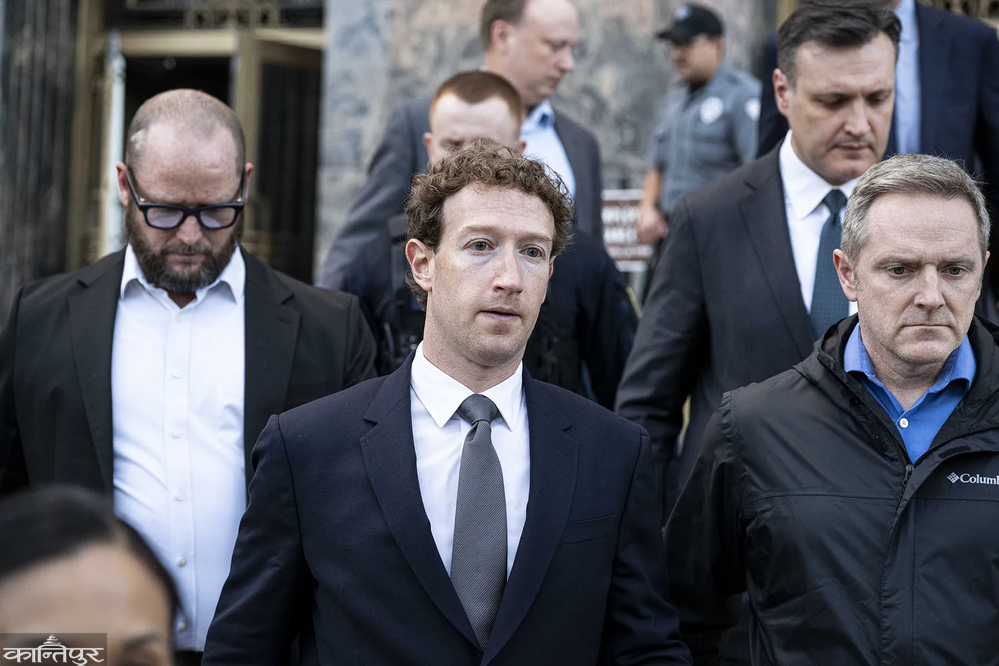
Meta CEO Mark Zuckerberg and Instagram CEO Adam Mosseri appeared in court to testify in the case. Meta claimed that a person's mental health can be affected by many factors and that its platform includes strong security measures. YouTube also stated that its platform is not harmful and that it pays attention to user safety.
However, the jury rejected these arguments and found Meta and YouTube guilty, concluding that the companies’ negligence caused the victim’s harm. The verdict ordered the victim to pay $6 million in damages. This is the first jury trial and verdict in a social media addiction case. American media outlets have reported that this will set a precedent for thousands of similar cases. Last week, a jury in the state of New Mexico also ordered Meta (the parent company of Facebook, Instagram, and WhatsApp) to pay a fine of $375 million (about 50 billion Nepali rupees). The fine was imposed for negligence in protecting children and violating consumer protection laws.
In the information technology hub of California alone, there are more than 1,600 complaints filed about the negative effects of social media, and more than 2,400 cases are pending in US federal courts, according to various local media outlets. Following the US ruling, British Prime Minister Keir Starmer responded by saying that Google and Meta had deliberately created addictive platforms. This has increased pressure around the world to regulate social media and make stricter laws on child protection.
More ‘Screentime’
A Netflix series, ‘Adultsense’, recently became very popular about how uncontrolled access to the internet can affect children. In it, a 13-year-old boy, Jamie Miller, is arrested for the murder of his colleague, Katie Leonard. While examining the background of why he did so, the topic of how teenagers in the digital world become victims of toxic ideas like ‘manosphere’, symbols like ‘purple devil emoji’ and subcultures like ‘incel’ is presented in depth.

This series of internet-induced child crimes shows the complexity of modern teenage life. It explores the new trends of cyberbullying, online hate, self-esteem crises and the anger, isolation and vindictiveness that toxic forums like the ‘manosphere’, where anti-women views are shared, create. According to the BBC, British Prime Minister Keir Starmer said it was difficult to watch the series with his teenage children. While social media scrolling and excessive screen time are becoming a global problem, such problems are increasingly common in places like Nepal where digital literacy is low.
Research by leading scientists from Singapore’s Agency for Science, Technology and Research and the National University of Singapore found that excessive screen time can slow decision-making by the age of 8 and increase symptoms of anxiety and depression by the age of 13. “This research provides scientific evidence to support why limiting screen time in the first two years of life is so important,” Associate Professor Tan I-Peng, who led the study, published in December, told Reuters. In his 2026 New Year’s address, French President Emmanuel Macron pledged to protect children and adolescents from the negative effects of social media and screens. “The more screen time, the more mental health problems,” Macron said. “Cyberbullying, access to pornography and the mental health problems that are being seen in children are not just a new phenomenon; they are a direct result of how digital platforms are designed and how they are targeted.”
Concerns have been growing in the professional and research communities about the issue. Torkel Klingberg, a professor at the Karolinska Institute in Sweden, said social media use is increasing the risk of attention deficit hyperactivity disorder (ADHD) in children. “This research provides scientific evidence to support why limiting screen time in the first two years of life is so important,” Tan I-Peng, an associate professor at the University of Cambridge, told Reuters in December.
He said that just thinking about a message or notification on social media can lead to a decline in children’s ability to concentrate and become forgetful. While the impact on an individual may be small, the impact on the population as a whole could have serious consequences.
Social media and internet access controls have yielded mixed results on children and students' academic achievement. A survey of 317 high schools in the Netherlands, commissioned by the Dutch government, found that a third of schools saw an improvement in student academic performance after banning mobile phones and other electronic devices. Three-quarters of schools also reported an increase in student concentration. A study called 'Smart Schools' published in The Lancet found no significant difference in the academic achievement of students in 30 UK secondary schools that banned phone use (particularly in English and maths). The study found that even with the ban, academic standards declined and unruly behaviour in the classroom increased as mobile phone use increased.
Historic hearing in US court against social media platforms
According to Dr. Orben, while digital content can cause serious harm to some children, a complete ban on access could have a much more negative impact on other high-risk groups. In addition, experts have pointed out that they risk using measures such as VPNs to reach the unregulated world of the internet, the ‘dark web’.
Parental role models
Some parents feel anxious and helpless when they see their children getting involved in mobile and online activities. Raj Poudel of Dhapasi has experienced that the habit of giving mobile phones to children to entertain or feed them is causing them to become seriously addicted. ‘My 6-year-old twins absolutely need mobile phones while eating, and I feel like they don’t even know the taste of food when they are looking at mobile phones while eating,’ he says, ‘It is so difficult to separate mobile phones and TV, I have to disconnect the internet.’
Poudel’s wife has had to quit her job to take care of this addiction of children and their care. ‘When I turn off the mobile/TV, the children get very angry and cry,’ Poudel said, ‘Especially my son gets very angry and sometimes he even comes to beat me.’ He said that they are now emphasizing puzzle games and painting to keep children away from digital addiction. He also has the experience that using mobile phones less is effective.
‘Most parents themselves are victims of digital addiction,’ says child psychologist Dr. Sirjana Adhikari, ‘When people are busy with their own mobile phones without talking to anyone at home, children are learning the same culture. Instead of scolding children, parents themselves need to become role models. They should reduce their screen time and spend time with their children.’ He said that they are now emphasizing puzzle games and painting to keep children away from digital addiction. He also has the experience that using mobile phones less is effective.
Some schools in Nepal have started efforts to manage the ‘digital life’ of teenage students. Kathmandu’s Manmaiju School has been listening to students’ problems through the ‘Balika Sanjaya’ group. Principal Ravina Maharjan said that this initiative was started after the risk of students falling into cybercrime and sending nude photos due to social media has increased. ‘We screen awareness materials and videos on the Balika Sanjaya with the help of school nurses and female teachers once a week or a month,’ she said. ‘This has been providing students with practical knowledge about the advantages and disadvantages of social media, incidents of cybercrime and ways to avoid it.’
With the formation of the new government, ordinary citizens and experts expect the state to pay attention to this issue. It is believed that Prime Minister Balendra Shah, especially since he is the father of a minor daughter, will prioritize this issue related to the future of children. While talking about digital transformation, child psychologist Adhikari says that it is equally important to protect the new generation from its side effects. She suggests that the government should formulate appropriate legal standards regarding the use of social media and AI.



