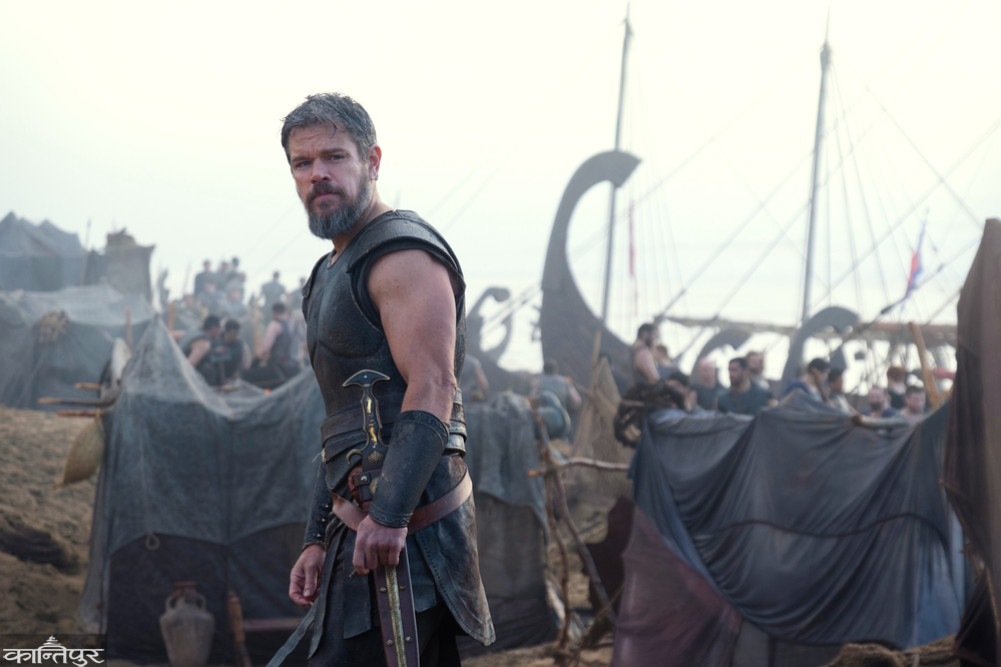
Critics around the world agree, ”This is a film that should be experienced directly on the big screen of a theater, not on a mobile or laptop screen.”
We use Google Cloud Translation Services. Google requires we provide the following disclaimer relating to use of this service:
This service may contain translations powered by Google. Google disclaims all warranties related to the translations, expressed or implied, including any warranties of accuracy, reliability, and any implied warranties of merchantability, fitness for a particular purpose, and noninfringement.
Bringing Homer's ancient Greek epic to the modern screen was a huge challenge in itself. But when director Christopher Nolan took command, it became more than just a film, it became a global festival. Matt Damon and Tom Holland starrer 'The Odyssey' has now created a huge wave in movie theaters and media around the world.
The film tells the story of King Odysseus (Matt Damon)'s 10-year journey at sea, his encounters with monsters, and his wife Penelope waiting for him at home after winning the Trojan War.
The film speaks to the pain of post-traumatic stress disorder (PTSD) that has been going on for generations. After any war, many soldiers return home quickly, physically, but it can take years or decades for them to return to their pre-war emotional or spiritual state, and some may never return.
Back home, to fill the power vacuum that Odysseus’s possible death could create, his wife Penelope is forced to entertain dozens of potential suitors. A shameless feast of greed and lust ensues. Chief among those suitors is the ruthless Antinous, played with great skill and scorn by Robert Pattinson. He brutalizes Odysseus’ blind servant Eumaeus (played by John Leguizamo, a sympathetic and emotional character). Odysseus’s mentally disturbed son Telemachus (Tom Holland) is now forced to embark on his own odyssey to find his father, or rather his father’s body.
When Odysseus must descend into the underworld to speak to the spirits of the dead, the scene is unforgettably strange, with Nolan showing the shrouded spirits crouching on the ground like the witches in Macbeth. The spirits of the dead, like the gods, can be approached on almost the same level. This is the strange pagan rule of the Odyssey, which is as ambiguous and immoral as the secular symptoms of mental illness.
But when Odysseus finally approaches Penelope’s house—which is now under a brutal siege by suitors (which resembles the siege of Troy)—he enters the Christian Christ-like state of a yogi. In the final stages of the story, Odysseus begins his own mysterious metamorphosis into a god.
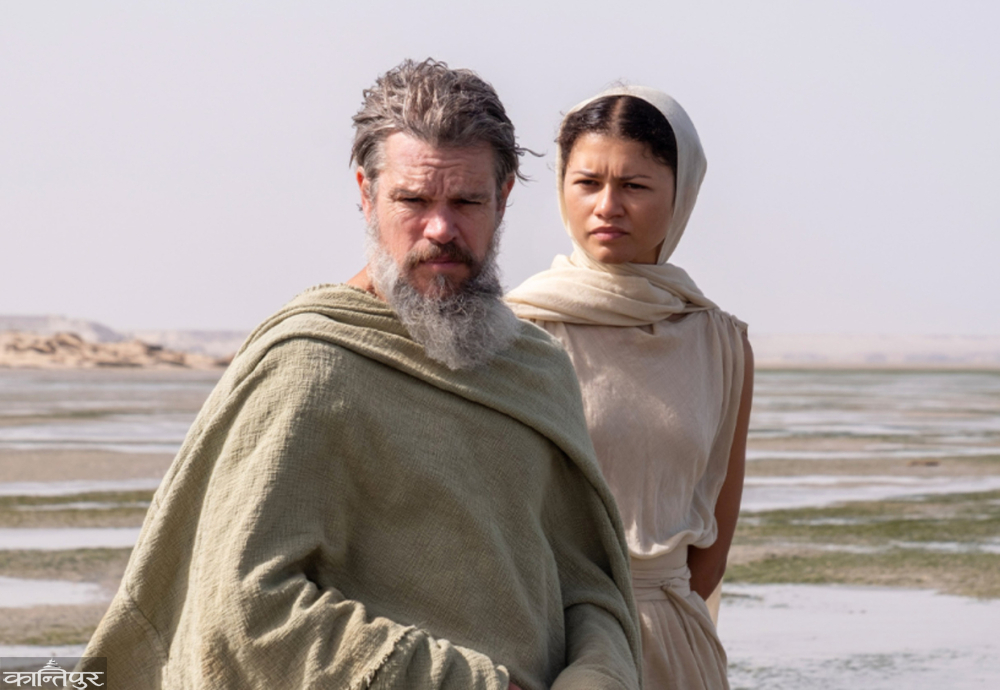
Peter Brads, chief film critic for the prestigious British newspaper ‘The Guardian’, gave the film a four-star rating out of five, calling it a ‘new height of visual language’. According to the Guardian, Nolan’s film, shot entirely on IMAX 70mm cameras, transports the audience not to the seats in the auditorium, but directly to the middle of the Asian Sea. Nolan has succeeded in showing the storm-tossed sea and the wrath of the sea god Poseidon through more realistic and experimental effects than computer-generated effects (CGI).
Peter Brads has pointed out one of Nolan's old weaknesses, writing, 'Like Nolan's previous films, 'The Odyssey' is technically flawless, but emotionally it feels a bit pale and cold. The audience is more surprised by the grandeur of the screen and Nolan's making skills than by the emotional pain of Odysseus' separation.'
Coldness or emotionless style is a characteristic of Nolan's films. Critics interpret Nolan's cold style as the very thoughtfully woven, mathematically precise but emotionally distant artistic structure seen in his films. Nolan's films, from 'Memento' and 'Inception' to 'Tenet' and 'Oppenheimer', are often considered intellectual, impersonal or a bit harsh by the audience. But this 'coldness' is not his weakness but a deliberate measure. Visually, Nolan does not use very bright or 'warm' scenes in his films.
Similarly, he prefers to use harsh and pale colors. Neither are there many dark or bright colors in his films. Instead, dark gray, charcoal black and pale colors are preferred.
Nolan loves the architecture of modern, tall and large buildings. The glass castles of 'Inception' or the concrete structures of 'Tenet' help the characters look very lonely and small in this vast world.
Nolan attaches great importance to the structure of the story in his films. His main
characters are often men who are immersed in some kind of pain or madness. The Cubs of ‘Inception’ or Leonard of ‘Memento’ are examples of this. They seem more preoccupied with explaining scientific or technical matters than with emotional dialogue.
Nolan rarely puts crowds of people or very close emotional scenes in the frame. He focuses only on a character’s face, so that the viewer understands the complex psychology going on inside his mind rather than his external relationships.
Critics also call Nolan’s films like ‘computer calculations’ without emotion. But his fans claim that Nolan’s way of expressing emotions is a little different and serious. The harsh rules of Nolan’s world (such as the different speeds of time in ‘Interstellar’ or the rules of dreams in ‘Inception’) are actually designed to test human love and relationships.
The pain of a father losing important years of his daughter’s life due to the physical laws of a black hole feels even more powerful, because the universe around him is so cruel and cold.
The American newspaper ‘The New York Times’ has called it ‘a daring and intellectual work of art’, emphasizing the film’s plot and philosophical aspects. The Times’ reviewer praised Matt Damon’s performance and wrote, ‘Damon does not just present Odysseus as a brilliant or arrogant mythical king, he has acted as a modern soldier who has been mentally damaged by war, lost his friends and is burdened with guilt.’
According to the New York Times, this film is not just a story of fighting monsters and monsters, it is a psychological journey of a man who is searching for his identity and yearning to return home. The Times concludes that Tom Holland’s performance in the role of Telemachus, a son who grew up without a father, has succeeded in connecting the film with family and human feelings.
The prestigious Hollywood magazine ‘Variety’ has called the film a ‘masterclass’ in the technical team of the film, especially in the fields of sound and music. Variety's reviewer writes, "The background music by Oscar-winning composer Ludwig Göransson gives the film a different life. The fusion of ancient Greek instruments and modern orchestras makes the atmosphere in the hall tense when the one-eyed monster (Cyclops) enters the scene."
'Variety' considers the scene where Odysseus travels to Hades to meet the spirit of his dead friends and mother as the best part of the film. 'Variety' claims that the dim lighting, excellent play of shadows and haunting sound effects will keep the scene fresh in the audience's mind for a long time.
'The Independent' writes that Nolan, who is also the screenwriter of the film, prioritizes visuals over dialogue. 'Homer's poetic language seems to be lost somewhere in the film's long and explanatory dialogues. The Independent gave the film a 3.5 star rating overall, saying, "A film that deserves 5 stars in terms of visuals, but falls short of 3 stars in terms of screenplay." Similarly, The Telegraph gave it 5 out of 5 stars, saying, "This is the most ambitious mythological film ever made. Nolan has abandoned the traditional Hollywood trappings and the video game-like style of CGI and presented the mythological world realistically through 'experimental effects.'" In Screen Daily, Matt Damon reviewed Odysseus as a wounded soldier mentally and emotionally damaged by war rather than as a shining and flawless hero, while Tom Holland's performance as the fatherless son Telemachus was very poignant.
"The Odyssey" is not just a spicy mythological Hollywood film. It is a masterpiece of Christopher Nolan's ambition and technical mastery. While some critics have expressed disagreement over the length of the script and the lack of emotion, it has set a new standard for how ancient literature should be adapted into modern film. Critics from around the world agree, “This is a film that should be experienced on the big screen of a theater, not on a mobile or laptop screen.”