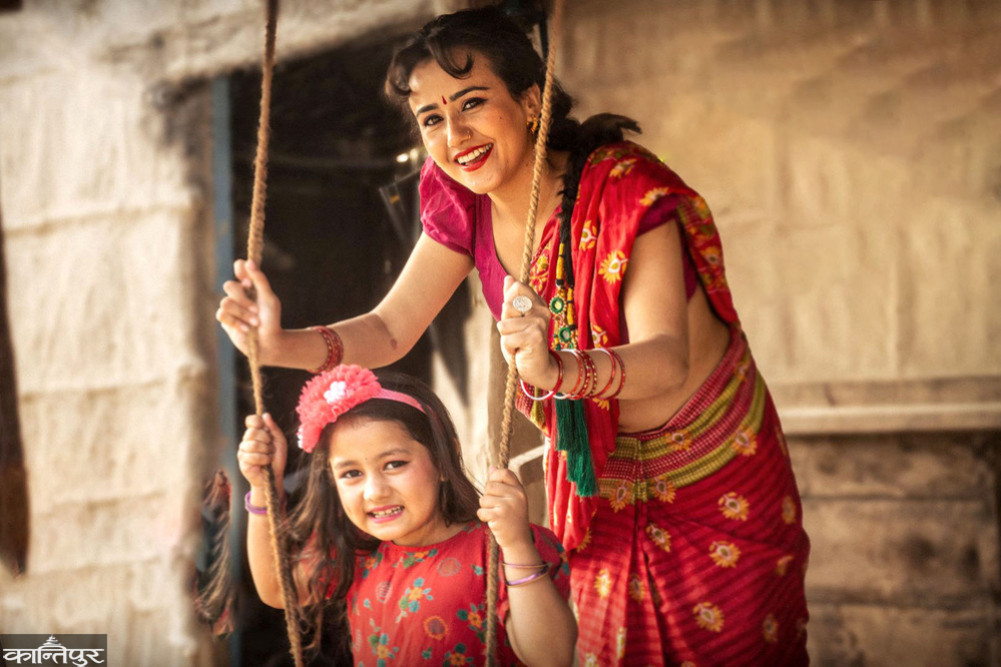
Even though the film 'Lalibazar' has won the love of the audience as it enters its third week of release, some women from the Badi community continue to raise questions about the film.
We use Google Cloud Translation Services. Google requires we provide the following disclaimer relating to use of this service:
This service may contain translations powered by Google. Google disclaims all warranties related to the translations, expressed or implied, including any warranties of accuracy, reliability, and any implied warranties of merchantability, fitness for a particular purpose, and noninfringement.
As the film 'Lalibazar' enters its third week of release, some women from the Badi community are constantly raising questions about the film. Roshni Badi and her group are constantly protesting, saying that the film, which earned Rs 52.5 million in its second week, has killed the character of women from the Badi community. Roshni is still moving the court demanding that the film be stopped. Why did this film, which is loved by most of the audience, upset Roshni's group? Why do they want to stop the film?
We have told the story very responsibly. The audience has understood the topic we were trying to show - Producer Rabindra Singh Baniya Roshni says that her view of women from the Badi community has changed since the film was released. She accuses the film of killing the character of women from the Badi community like her because the film portrays women from the Badi community as characters involved in the sex trade. 'Raping, in particular, does not mean killing someone?' This film is raping thousands of women from the Dalit community,' said Roshni, 'After this film, we have started feeling ashamed to say that we are Dalits. The way we are viewed has changed. The language our friends speak has started changing.' Roshni says that this film has tried to suppress Dalit women even more. She adds, 'Now, after watching this film, your mother and sister were in the sex trade earlier, now a situation has been created where people call you saying, "What do you want to spend time with me for a moment?" That is why the new government had to ban this film. It was not just an apology to Dalits.'
Producer Rabindra Singh Baniya, who played a leading role in 'Lalibazar', says that he is telling a story of the time rather than killing someone's character. 'Sex work is a topic that happened in the time. We have talked to the people concerned about what happened then. We have audio/video. We have said that it was like that then rather than saying it is like this now,' Baniya says, 'The fact that they are having problems because it was shown that way is suspicious of their activities.' The film's director, Yama Thapa, believes that he has taken responsibility in the storytelling. He says, 'The background of a character is shown in the film, and within that, we have shown this community. We have told the story very responsibly. The audience has understood the topic we are trying to show.'
Accusation of character assassination
Basanti Nepali (plaintiff), who is also moving the court with Roshni, claims that the name of the film (Lalibazar) incorrectly depicts the slum where the Badi community lives. She says that although the film depicts this place as a place where Badi women work as sex workers, it humiliates other castes living there. 'Non-Dalits also live there. There, people from the Badi and Brahmin Kshetri communities are earning a respectable living. Such a slum is depicted as a market where sex workers live. We have a problem with the name of the film,' said Basanti.
Producer Baniya said that the film was named 'Lalibazar' when they tried to present a place where people who wear red lipstick live. 'We used this name as an image to describe the market where people who wear red lipstick live. Later, it was found out that that place also exists. We told them the same thing,' says Baniya, 'There is no question of not being able to name the film. The audience will tell whether the place has been insulted or not. The film, which has become a hit, will speak for itself.'
Roshni also sees a problem with the film's poster. In the poster, actress Swastima Khadka's character is seen pregnant. She is standing at the door of her house in a bright dress and makeup with a plump body. Roshni says that she objected to the poster because it depicts a woman from the Wadi community as a sex worker even when she is pregnant. Roshni claims that the film's storyline also portrays women from the Wadi community in a wrong way. She says, 'Our problem is not with the words and scenes. We have a problem with the entire story, which has wrongly portrayed the Wadi community.'
Saying that Roshni's protests are baseless, producer Baniya analyzes that they are trying to show motherhood in the poster. 'What he said is not logical at all. I don't think it's right to answer people who don't understand the arc of the film, what the intention is,' said Ravindra, who appears in the lead role in the film, 'That is the scene in the film after the pregnant mother quits her job. She is not shown working while pregnant. It is not even written on that poster that she is a sex worker. I see motherhood in that poster.'
Directed by Yama Thapa, a woman from the Badi community is shown in the beginning of this film. The main character 'Madhuwala', played by actress Swastima Khadka, is shown continuing the same profession as her mother. It is shown that the stove in the house will not light until Madhuwala does sex work, and the sick mother will not be treated. Madhuwala's brother Madan (played by Govinda Sunar) is also shown as dependent on his sister and has no work.
These scenes portray women from the Badi community as sex workers, and Roshni also points out the problem with their brothers being shown as useless characters. 'When a daughter is born, it means that now my daughter's happy days have begun, which means that she will sell her body and become a sex worker.' This shows that women from our community are born for sex work, which is problematic,' Roshni told Kantipur.
Ravindra says that the problem lies in Roshni's perspective on the film. 'Their perspective has changed. After this film, it was like that before, they were suffering.' The perspective of seeing this community being compensated and rehabilitated has changed,' Baniya argued, 'Even though there was such a situation earlier, the film has the perspective that women doctors there have become engineers.' The director of this film, Yama Thapa, says that the character of Madan, who became a brother, was written while writing the story of a family and other characters in the film. 'The character of brother came while writing the story of a family within the framework of the film. This character was not written in a way that humiliates any community,' said director Thapa. Roshni believes that it is wrong for the
film to show the Nathiya tradition as inherent in the Badi community. 'The Nathiya tradition has been shown in this film. The Nathiya tradition has been banned by the government,' Roshni said, 'There must have been sexual exploitation among Thakurs, non-Dalits and Bahuns as well. But it is not wrong to say that only women from our community were exploited by the rulers. What kind of example does this set in the minds of the viewers? Isn't this portrayal of our character assassination?'
Refuting this allegation, Ravindra says, 'If other communities also had that custom, let them write, make a film. Let them debate, we didn't make the story of all communities. We made a film on a specific incident and topic.'
While talking to activist Uma Badi, Ravindra's argument is that they included this custom in the film because it is common in the Badi community. 'There is an audio/video where Uma Didi says that it was a custom. We did not create any incident by imagining it,' Baniya said, 'We must have imagined the story and presented it. We wrote it under the influence of the incident and the character.' Roshni said that she has written 44 points that she has problems with in the film and submitted it to the court from the censor board.
Is it possible to assassinate someone's character in the name of art and creation? - Roshni is also aware of the creative freedom raised by the Wadi Even though questions are being raised about the portrayal of the Wadi community, filmmakers who stand in favor of 'Lalibazar' are saying - do not stop the film's screening. Roshni's group still seems determined to stop the film. Actress Swastima, along with Rabindra, Yama Thapa, and Pradeep Bhattarai, the filmmakers raised their voices in favor of freedom of expression.
filmmakers. She is in favor of leaving creation free, but as long as the story does not hurt any community. Roshni argues that as long as art and creation do not assassinate someone's character, it is an issue of freedom of expression. 'Is it possible to assassinate someone's character in the name of art and creation?' We would not have said anything if you made a film about sex workers and told their stories,' she said, 'But, in the interest of telling the story of a community, you are killing the character of thousands of people in front of the coming generation. You are killing self-respect. Which the filmmaker cannot compensate for.'
My personal opinion is that the film cannot be said to have killed the character of the entire community - Asmita Wadi Baniya argues that the Wadi community other than Roshni's group liked the film. 'How can you address someone's personal grievances when making a film? When the entire community has accepted it. The leaders themselves are saying that this is okay. Where can you answer those who are cultivating issues like them?' Baniya argued.
Another activist, Asmita Wadi, says that they protested because the film hurt Roshni's group. However, her perspective on the film is different from Roshni's. 'They may have objected to it out of pain. I don't think there is anything to be concerned about,' says Asmita, 'They have declared the issue of Nathiya at the end of the film as not being a custom. My personal opinion is that the film cannot be said to have assassinated the character of the entire community.'
Asmita is also upset with some of the film's commentary. For example, in the film, Madhuwala (Swastima Khadka) knocks on the doors of other men demanding her daughter's citizenship. Asmita says that this has created a commentary that children born in the Wadi community have 'no father's name'. She says, 'The thing that really bothers me in the film is the dress-up used. Swastima Khadka's character goes door to door asking her daughter to be named after her father. This scene has created a narrative that children born in the Badi community do not have a father.'