Asha had said about Ranjit, ”Kanchha Bhai and I have been together for 50 years. I also came to Nepal for Kanchha, you have also come, I am very happy.”
We use Google Cloud Translation Services. Google requires we provide the following disclaimer relating to use of this service:
This service may contain translations powered by Google. Google disclaims all warranties related to the translations, expressed or implied, including any warranties of accuracy, reliability, and any implied warranties of merchantability, fitness for a particular purpose, and noninfringement.
Famous singer Asha Bhosle had a deep respect for Nepal and Nepali songs. The only reason for that is the composer Ranjit Gajmer. She first knew Ranjit, then sang Nepali songs and came to Nepal.
Ranjit had met Asha for the first time in Bombay (now Mumbai) in the 1970s. Ranjit had also reached Mumbai carrying a madal to struggle in music. He had been struggling for a long time. One day, he suddenly met the famous composer of that time, RD Burman. He narrated the tune of the madal he was carrying to 'Pancham Da'. Pancham Da was surprised to hear that tune. Later, he incorporated the rhythm of Ranjit's madal into music. And the famous song - Kanchha Re Kanchha Re... became famous.
‘My first meeting with Ashaji was at Pancham Dakai Studio,’ Ranjit, who is based in Mumbai, told Kantipur over the phone, ‘From that first meeting, my relationship with Ashaji grew stronger.’
Pancham Dalai used to address Ranjit as ‘Kancha’. Later, the entire music industry in India started to know him by the nickname Kancha. ‘It is not true that no one knows me by my name,’ he had said in an interview, ‘Everyone knows me only when I say Kancha.’
Asha, who was about 5 years older than him, used to respectfully call him ‘Kancha Bhai.’
In the 1980s, Tulsi Ghimire, a young man from Kalimpong, was struggling in the film industry. It was at that time that he and Ranjit met there. And these two Darjeelings hatched a plan to make a film. Tulsi would find a producer, Ranjit would handle the music.
After the song in the film Bansuri, Asha accepted Ranjit's request every time. Most of Tulsi Ghimire's songs have Ranjit's music and Asha's voice. Asha was also involved in Mesomo Ghimire's first film 'Bansuri'. She sang two songs, 'Jhjalko lehi ayecha Sawan...' and 'Mirmire saanjma simsime pani...'.
Tulsi's plan was to call Taradevi from Nepal or Aruna Lama from Darjeeling to Mumbai to sing. However, that process was also very expensive. She had to bear all the expenses of the flight fare and hotel. Amidst this confusion, Ranjit's wife, lyricist Kusum, said one day, 'Instead of calling her from Nepal and Darjeeling to sing, why don't you request Asha Didi? You have a good relationship with her. Do you agree?' Without saying a word, Ranjit asked the then famous singer Asha, feeling embarrassed, 'I have a song to sing for a Nepali movie. Will you sing it?' Asha replied in one word, 'Of course, why not.' Ranjit was overjoyed by Asha's words. Asha had already sung a signature song for the film 'Maitighar' before that. After the song for the film Bansuri, Asha accepted Ranjit's request every time. Most of Tulsi Ghimire's songs feature Ranjit's music and Asha's voice. ‘Asha has not taken any money from me for any of the songs I have composed,’ Ranjit said, ‘Perhaps it is because of her relationship with me and her immense love for Nepali songs and music.’
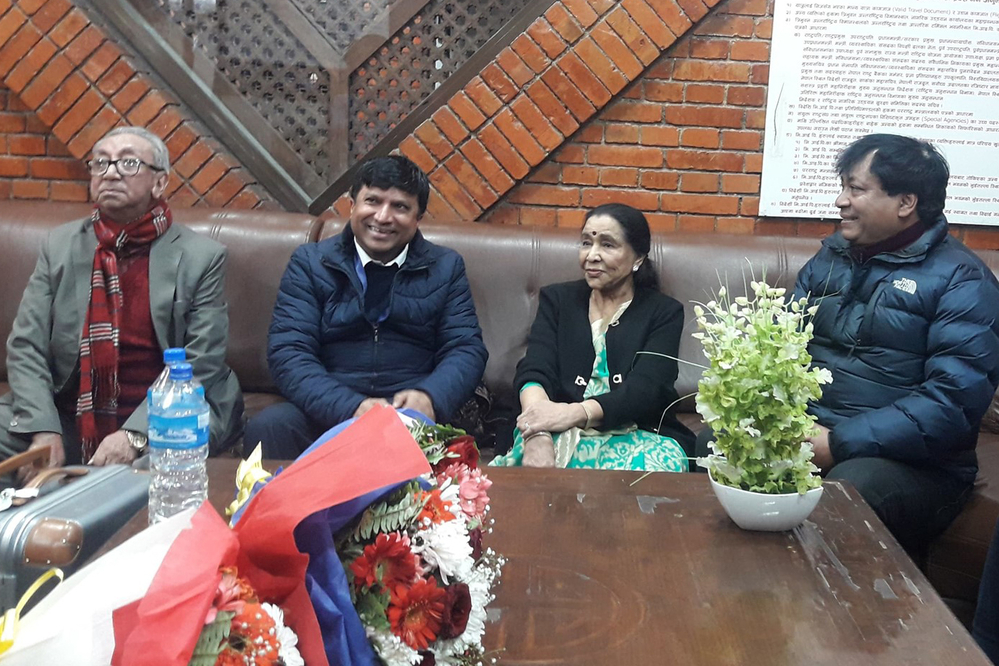
About 6 years ago, Milan Moktan and his team invited Asha to Nepal. On a program called ‘Music Journey of Ranjit Gamjer with Asha Bhosle’ .
In that program, she sang the much-loved songs – Jhajhalko Lere..., Kin Gadhe Cha Dhukdhuki..., Aage Aage Topaiko Gola..., Mohani Lagla Hai....
At that time, she had said about Ranjit, ‘Kanchha Bhai and I have been together for 50 years . I have also come to Nepal for Kanchha, you have also come, I am very happy .’
Ranjit's relationship with Asha was like a family . They would talk on the phone from time to time . She would ask about his happiness and sorrows . Some time ago, after learning that Ranjit was ill, she had called him in a panic and wished him a speedy recovery .
Asha had spoken to Ranjit on the phone only three days before his death . Even then, she had asked about his health . She had told him to take care of himself .
However, Asha, who had given more than 12,000 timeless songs to the world, including more than a dozen Nepali ones, passed away forever on Sunday .
'I am very saddened by his death,' Ranjit said emotionally, 'He left millions of fans crying, on a journey that will never return .'


