It is equally necessary to take care that movies made on serious social issues are not approving the crime in the name of feeling for the victim characters.
We use Google Cloud Translation Services. Google requires we provide the following disclaimer relating to use of this service:
This service may contain translations powered by Google. Google disclaims all warranties related to the translations, expressed or implied, including any warranties of accuracy, reliability, and any implied warranties of merchantability, fitness for a particular purpose, and noninfringement.
A spark of protest is burning in the middle of the road. A police car is about to move from the side. But suddenly a group of bulls arrive. After crossing the road, the police car stops. It is right to stop at once, at this moment the two bulls of the hull start to play trumpets.
This scene from the
movie Rajaganj tells in a subtle but ironic way - Madhesh was burning, bulls were fighting. Let's start from the
image.
The 'props' used in Rajaganj are mostly ironic. Often the props have a deeper meaning in the scene . Director Deepak Rauniyar's style of playing with images is exactly reminiscent of American filmmaker and screenwriter Andrew Stanton's '2+2 rule of storytelling'.
Stanton says - the audience should never be shown 4 . 2 and 2 should be shown and left to the audience to arrive at 4 by adding them . Connecting the dots of the story should be left to the audience. Like a
, on one side the scene of fire burning in the road (2) and on the other side the scene of bulls fighting in the road (2) . The director has shown just that. Decoding it 4, that is, the scene where the bulls are fighting while Madhesh is burning, has been constructed by the audience themselves. Similarly, in the next scene of the movie, the audience gets to know the background of the underlying purpose of a character by adding 2 and 2 from the picture of Lord Krishna hanging on the wall.
However, some of the props used in the movie carry images, but it is not clear what their function is in the story. Like a 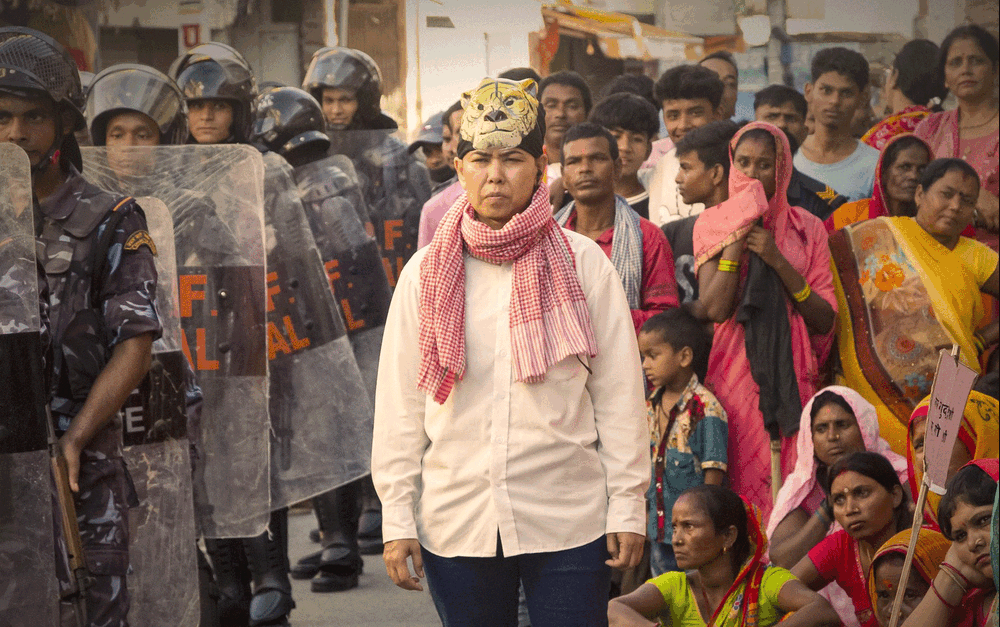
, Prithvi Narayan Shah's photo and King Birendra's family photo shown in the insert . What is the role of these props in advancing the story? Not exactly clear. Also, the director has cleverly shown a nameplate with 'Prithvinarayan Sah' written in English in one scene . It creates a contrast with 'Prithvinarayan Shah' but again the question is, what is the merit in the story?
feature is not only of the image, but also of the sub-story that runs parallel?
This is a movie trying to tell the story of child abduction in Madhesh during the 2072 constitution-making ceremony-Rajaganj . At the heart of director Rauniyar's plot are two characters - the first, whose child is kidnapped . Second, whose womb is miscarried due to the first woman .
Although the overall story of the movie revolves around these two women, it seems that the movie has lost the opportunity to be great when director Rauniar focuses on the commentary towards Madhesh instead of the plot. Because, the 'resolution' of the movie itself says that the 'backdrop' of the Madhesh movement was not necessary in the child abduction.
Even if there was no background of the Madhesh movement, the original story of the child abduction could have been equally dense in the page. On the other hand, while weaving a parallel story, the director seems to have done injustice to the original story. No matter how serious the social commentary is shown through the movie, it feels sad when the topic is ultimately unrelated to the plot.
However, again Rauniar has done an injustice to the story, but he has excelled in the technical aspect . Cinematographer Shelden Chow has brought every scene of Rajaganj to life. Be it the scenes shot in 'low key light' or the camera movements, he keeps the suspense of the story going with a tight . Be it the geography and society of the Terai or the movement and unrest, their visualization in this movie can be a 'formula' for Nepali movies.
means something is great, its 'take away' . That is, the best thing is always followed . The 'take away' of Rajaganj is its cinematography. Another admirable work of the
movie is in the sound . The effort in 'Ambience Sound' has brought the movie closer to reality . The same editing has allowed the speed of the movie to be neither less nor more . As a result, the situation will not come until you watch the movie.
Characterization While
excels at many things, the film's improvement aspect is the characterization . Like, the portrayal of Prajia or SP Madan Rai (Dayahang Rai) in a movie made on a serious social issue is very 'cliché'. This will make the story that the director wants, but there is also a risk that the movie, which is said to have social commentary, has not played the 'victim card'. 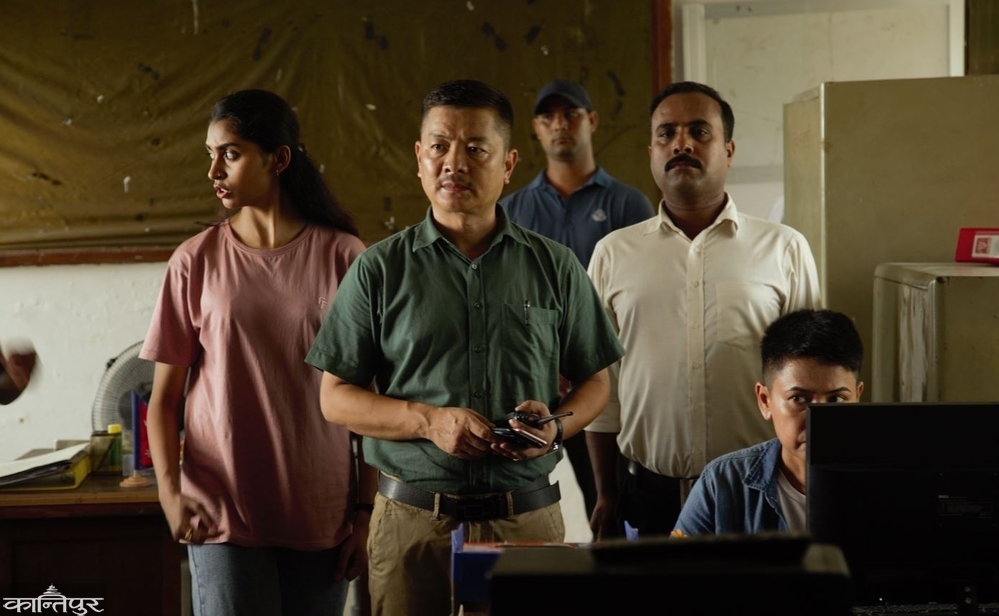
Moreover, the characterization of the main character of the movie, Inspector Pooja Thapa (Asha Magrati) is not so reassuring. Although it is admirable to advance the story through a strong sexual and gender minority character, it is seen as a weakness in not being able to establish the portrayal of that character .
A police officer who is said to have been trained by the British Intelligence Organization (MI-6) is not presented on screen.
characterization cannot be established in the case of other characters .
acting
Actor Pashupati Rai, who appears in a very short role, and Nikita Chandak, who is stuck in relatively less scenes, look lively. However, the acting of the main protagonist of the movie, Asha Magrati, is not found according to the demand of the story . Be it the scene of running or being beaten by the protesters or the tension-free atmosphere; Inspector Pooja Sir's expression is the same, flat .
Madhesh, the main character who is unfamiliar with Madhesh's society and customs, comes and solves a national level case, but the acting does not express 'realization' in that character, it seems that the acting has created an obstacle in the pace of the story .
Dayahang Rai, who is seen in the role of SP Madan Rai, is also 'underplayed'. Vijay Baral has not opened up about Amar's character .
is the main aspect of the film made in the police investigation genre, the investigator repeatedly reaches a "dead end" and struggles to get out of it. If it's necessary, it creates tension and conveys the character's excitement . After all, telling a story is a collection of characters that resolve stress and tension.
In Rajaganj, there is no such tension. The main character Pooja Sir's struggle to get out of the dead end is not seen. This hole in the story may also have weakened the characterization of this character .
On the other hand, in crime investigation movies, the investigator has a motive. This purpose is also the 'driving force' of the story. But when no relationship is shown between Pooja Sir and the abducted boy or his family, the driving force of the story seems to be weak. As a result, at times the film seems to go beyond the licks . When investigating a
crime, the police is looking for the criminal, not the criminal coming to the police. Another 'loose end' in the story of Rajaganj is the delivery of the criminal to the police, the non-investigation of the crime. This somewhat weakens the story as problems are easily resolved . As it is often said in
film reviews, don't look for what is not in the film . That is, there is no need to review what is not shown in the movie.
Breaking this rule at once, it must be said that what the story should show is not visible. In other words, this movie has failed to become the best because it cannot go deeper into the love between two women.
Although the main point of the story is the crisis of the ego of two mothers (one fetus was lost), when trying to connect it with the Madhesh movement, the story does not come naturally .
On the other hand, it is equally necessary to take care that the movies made on such serious social issues are not approving the crime in the name of feeling for the victim characters.

